Some things are helpful, while others are essential. The difference matters when you want your writing to be clear, accurate, and convincing.
Whether you are writing an essay, preparing for an IELTS exam, sending a work email, or having a casual conversation, choosing the right alternative to essential can make your message more effective.
The word essential often describes something that is needed, very important, or necessary for a particular purpose. However, not every alternative carries the same meaning.
Necessary focuses on need, vital suggests great importance, and fundamental points to something that forms a basic part of a subject or system.
Using these words carefully can help you avoid repetition and express your ideas more precisely. It can also make academic work sound more natural and professional writing easier to understand.
In this guide, you will discover 20 useful synonyms for essential, along with simple definitions, tone labels, and natural examples.
You will also learn about stronger and softer alternatives, academic vocabulary, words that can be misleading in certain contexts, and practical ways to choose the best word for your sentence.
What Does “Essential” Mean?
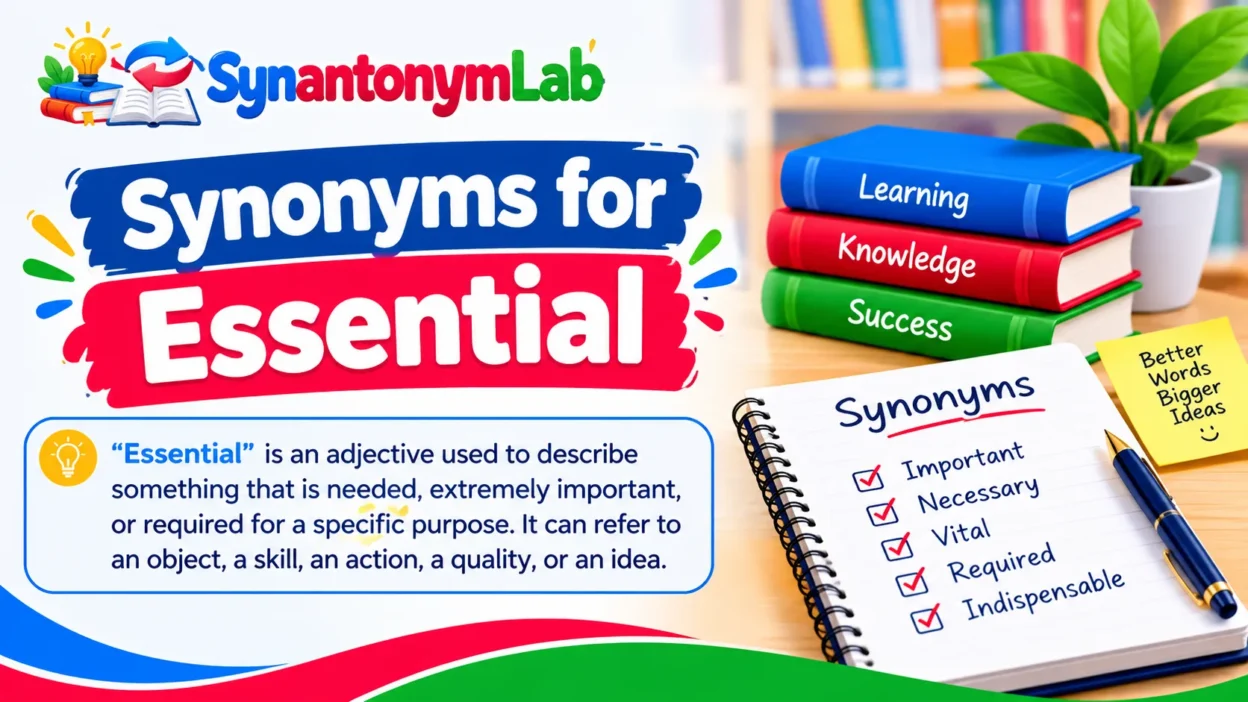
Essential is an adjective used to describe something that is needed, extremely important, or required for a specific purpose. It can refer to an object, a skill, an action, a quality, or an idea.
For example, clean water is essential for human survival. In this sentence, the word expresses a basic need rather than a simple preference.
Essential can also describe something that plays a major role in success. For example, good communication is essential for teamwork. Communication may not be the only factor involved, but it is highly important.
The word is common in academic writing, business communication, instructions, everyday conversation, and formal reports. It sounds neutral to slightly formal and works well in most situations.
Grammatical note: Essential is an adjective. It commonly appears before a noun, as in essential skills, or after a linking verb, as in these skills are essential.
It is also useful to understand the difference between essential and important. Something important deserves attention, but something essential is needed or plays a crucial role. The two words sometimes overlap, but they are not always interchangeable.
20 Best Synonyms for “Essential”
The following alternatives cover different meanings and situations. Choose one based on whether you want to express need, importance, basic principles, or a strong effect on an outcome.
1. Necessary
Meaning: Needed to achieve a goal, complete a task, or meet a requirement.
Tone: Neutral, formal, and academic.
Example: Regular practice is necessary to improve your writing.
Difference: Necessary is one of the closest alternatives to essential. It focuses on what is needed, while essential can place more emphasis on importance.
2. Vital
Meaning: Extremely important to the success, health, or continued existence of something.
Tone: Formal and professional.
Example: Clear instructions are vital to the safety of the workers.
Difference: Vital is often stronger than essential and works especially well when the result has serious consequences.
3. Crucial
Meaning: Extremely important to the outcome of a situation.
Tone: Professional, academic, and neutral.
Example: Careful planning is crucial to the success of the project.
Difference: Use crucial when the outcome depends heavily on a particular factor. It is especially useful when discussing decisions, turning points, and results.
4. Indispensable
Meaning: So important or useful that it is difficult or impossible to manage without it.
Tone: Formal and professional.
Example: Accurate records are indispensable to effective financial management.
Difference: This word suggests that something cannot easily be replaced or done without. It is stronger than many everyday uses of essential.
5. Fundamental
Meaning: Forming a basic part of something or providing its foundation.
Tone: Academic and formal.
Example: Trust is fundamental to a healthy relationship.
Difference: Fundamental emphasizes a basic principle or building block, rather than simply something that is required.
6. Key
Meaning: Very important to understanding, achieving, or controlling something.
Tone: Neutral and professional.
Example: Good time management is key to meeting deadlines.
Difference: Key is concise and natural in both speech and writing. It often highlights one important factor among several.
7. Critical
Meaning: Extremely important to the success or safety of a process, decision, or situation.
Tone: Professional and formal.
Example: Accurate measurements are critical to the experiment.
Difference: Critical can suggest urgency, risk, or a serious effect on the outcome. It does not always mean that something is required in every situation.
8. Imperative
Meaning: So important that an action must be taken.
Tone: Formal and authoritative.
Example: It is imperative that all staff follow the safety rules.
Difference: Imperative often describes an urgent need to act. It can sound forceful, so it may be too strong for a simple suggestion.
9. Required
Meaning: Demanded by a rule, process, agreement, or set of instructions.
Tone: Formal and administrative.
Example: A valid ID is required to enter the building.
Difference: Required points to an explicit condition or rule. Something can be essential without being formally required.
10. Fundamental to
Meaning: Necessary as a basic part of a particular process, idea, or relationship.
Tone: Academic and professional.
Example: Critical thinking is fundamental to effective problem-solving.
Difference: This is a useful phrase when you want to explain how one thing supports another. It is not a direct one-word replacement in every sentence.
11. Core
Meaning: Central to the main purpose, identity, or structure of something.
Tone: Neutral, professional, and academic.
Example: Customer service is a core part of the company’s strategy.
Difference: Core highlights the central part of something. It does not always mean that the thing is strictly necessary.
12. Basic
Meaning: Forming the starting level or simplest foundation of something.
Tone: Neutral and conversational.
Example: Every new employee receives basic safety training.
Difference: Basic is often weaker than essential. Use it when you mean introductory or foundational rather than absolutely necessary.
13. Principal
Meaning: The main or most important among several things.
Tone: Formal and academic.
Example: The principal aim of the study is to examine reading habits.
Difference: Principal means primary or leading. It does not automatically mean that something is necessary.
14. Major
Meaning: Important, large, or significant in its effect or role.
Tone: Neutral and professional.
Example: Access to reliable data is a major factor in the decision.
Difference: Major describes importance or scale, but it is generally weaker than essential. A major factor may influence an outcome without being required.
15. Important
Meaning: Having considerable value, influence, or significance.
Tone: Neutral and widely used.
Example: Regular feedback is important for student progress.
Difference: This is a broad, flexible alternative. It is useful when you want to express value without claiming that something is absolutely necessary.
16. Relevant
Meaning: Directly connected to the topic, purpose, or situation being discussed.
Tone: Academic and professional.
Example: Please include only relevant details in your report.
Difference: Relevant concerns connection to a subject, not necessity. Relevant information may be helpful without being essential.
17. Integral
Meaning: Forming a necessary part of a larger whole.
Tone: Formal and academic.
Example: Research is an integral part of the university course.
Difference: Integral emphasizes that something belongs within a larger system or activity. It is especially useful in academic and professional writing.
18. Necessary for
Meaning: Needed to make something possible or achieve a particular result.
Tone: Neutral and formal.
Example: A stable internet connection is necessary for the online meeting.
Difference: This phrase makes the relationship between a need and its purpose clear. It often reads more naturally than a single adjective when the reason matters.
19. Urgent
Meaning: Requiring immediate attention or action.
Tone: Direct and professional.
Example: The team must address the urgent safety concern today.
Difference: Urgent is not an exact synonym for essential. It describes timing and the need for prompt action, not necessarily lasting importance.
20. Meaningful
Meaning: Having real value, purpose, or significance.
Tone: Neutral, personal, and professional.
Example: Meaningful feedback can help students understand their progress.
Difference: Meaningful emphasizes value or purpose. It is appropriate when discussing personal growth, communication, or results, but it does not necessarily mean something is required.
Stronger Alternatives
Sometimes, essential does not express enough urgency or importance. These alternatives can make your meaning stronger, but each has a slightly different use.
1. Vital
Use vital when something is extremely important to health, safety, or success.
Example: Clean drinking water is vital for survival.
2. Crucial
Use crucial when a decision, action, or factor can strongly affect the final result.
Example: Early planning is crucial to completing the project on time.
3. Indispensable
Use indispensable when something is so valuable that it is very difficult to manage without it.
Example: Reliable staff are indispensable to the daily operation of the hospital.
4. Critical
Use critical when something has a major effect on safety, success, or a serious outcome.
Example: Quick action is critical during a medical emergency.
5. Imperative
Use imperative when an action is necessary and must not be delayed.
Example: It is imperative that the company protect its customers’ data.
6. Non-negotiable
Use non-negotiable when a requirement or standard cannot be changed or compromised.
Example: Respect for every team member is non-negotiable.
7. Paramount
Use paramount when something matters more than other concerns or priorities.
Example: Patient safety must remain paramount in every treatment decision.
Usage tip: These words are not equally strong in every situation. Vital often emphasizes need, crucial highlights an outcome, and paramount emphasizes the highest priority. Avoid using the strongest option when a simple word such as necessary would be clearer.
Softer or Polite Alternatives
Not every situation calls for strong language. In emails, discussions, and friendly advice, a softer word may sound more respectful or less forceful.
1. Helpful
Use this when something offers support or makes a task easier without being absolutely necessary.
Example: A short guide would be helpful for new employees.
2. Useful
Use this when something has practical value.
Example: These notes may be useful when you prepare for the exam.
3. Beneficial
Use this when something has a positive effect or offers an advantage.
Example: Regular breaks can be beneficial during long study sessions.
4. Advisable
Use this when recommending an action without presenting it as a strict requirement.
Example: It is advisable to save a copy of your work before editing.
5. Recommended
Use this when an action is suggested as a good choice but is not necessarily compulsory.
Example: Early registration is recommended for new students.
6. Valuable
Use this when something has worth or provides an important benefit.
Example: Your feedback is valuable to our team.
7. Worthwhile
Use this when an action deserves the time, effort, or cost involved.
Example: Reviewing your mistakes is worthwhile before the final exam.
Usage tip: These alternatives often soften a message because they describe benefits, advice, or value rather than strict need. However, they are not exact replacements for essential. If a safety rule must be followed, calling it merely helpful could understate its importance.
Academic & IELTS-Friendly Alternatives
Academic writing benefits from precise language, not simply longer or more advanced words. The following alternatives work well when their meanings match your argument.
| Word or phrase | Best use | Example |
|---|---|---|
| Necessary | Expressing a clear need | Reliable evidence is necessary for a sound conclusion. |
| Vital | Emphasizing great importance | Public trust is vital to effective government. |
| Crucial | Highlighting a key factor in an outcome | Early education is crucial to language development. |
| Fundamental | Discussing basic principles | Equality is fundamental to a fair society. |
| Integral | Describing a necessary part of a system | Assessment is integral to the learning process. |
| Indispensable | Emphasizing something difficult to do without | Accurate data is indispensable to this analysis. |
| Critical | Highlighting a major influence or risk | Sample size is critical to interpreting the results. |
| Principal | Identifying the main aim or factor | The principal objective is to reduce waste. |
| Key | Naming a central factor | Access to education is a key concern. |
| Significant | Describing something with notable importance or effect | The findings show a significant change in behavior. |
A few distinctions deserve special attention.
- Significant often means important or noticeable. In research, it can also have a specific statistical meaning, so do not use it casually when discussing statistical results.
- Principal means main, not necessarily required. It works well for aims, causes, reasons, and concerns.
- Integral is useful for explaining how one part belongs within a larger system.
- Fundamental is particularly effective when discussing principles, rights, skills, or basic conditions.
- Necessary is often the clearest option when you need to explain what must happen for a result to be possible.
For IELTS Writing Task 2, choose the word that matches your argument. For example, access to clean water is vital for public health makes a strong claim, while access to clean water is important for public health sounds broader and less forceful.
Do not replace every instance of essential with an advanced alternative. Repetition can be improved through sentence structure as well as vocabulary.
Synonyms You Should Avoid
Some words look similar to essential because they describe importance, value, or need. However, using them in the wrong context can change your message.
1. Optional
Why to avoid it: Optional means something can be chosen or left out. This is almost the opposite of essential when a task is required.
Incorrect for the intended meaning: A seat belt is optional for safe driving.
Better: A seat belt is essential for safety.
2. Urgent
Why to avoid it: Urgent describes something that needs quick attention. It does not necessarily mean that the matter is essential in every situation.
Awkward: Sleep is urgent for good health.
Better: Sleep is essential for good health.
Use urgent when the timing of an action matters, such as an urgent repair or an urgent request.
3. Convenient
Why to avoid it: Convenient means easy or practical to use. Something can be convenient without being necessary.
Incorrect for the intended meaning: A convenient food supply is essential for survival.
Better: A reliable food supply is essential for survival.
Use convenient when discussing ease, comfort, or practicality.
4. Relevant
Why to avoid it: Relevant means connected to a subject. Information can be relevant without being required.
Awkward: Every relevant detail is essential to the report.
Better: Every essential detail must be included in the report.
Use relevant when deciding whether information belongs to a discussion or topic.
5. Major
Why to avoid it: Major indicates importance, size, or scale. It does not automatically mean something is necessary.
Weak for the intended meaning: Clean water is a major need for survival.
Better: Clean water is essential for survival.
Use major for significant factors, events, problems, or changes. Choose essential when you mean that something is needed.
How to Choose the Right Synonym in Writing
The best synonym depends on what you want your reader to understand. Before replacing essential, consider these five points.
1. Check the Context
Ask yourself whether you mean something is required, highly important, or simply useful.
- A passport is required for this application.
- Trust is fundamental to a strong relationship.
- A clear checklist is helpful when preparing for a trip.
Each word fits a different situation. Think about the exact message before choosing a replacement.
2. Match the Tone
Your word choice should suit the setting.
In casual conversation, important and key often sound natural. In academic writing, fundamental or integral may fit a discussion of principles or systems. In formal instructions, required may be more precise.
Avoid using words such as imperative in every email. They can make a simple request sound like an order.
3. Consider Your Audience
A general reader may understand necessary more quickly than a less familiar word. A specialist audience may benefit from integral when the word describes a component of a system.
For example:
- General: Practice is necessary to improve.
- More specific: Regular practice is fundamental to skill development.
The second version is useful when you want to emphasize the basic role of practice, not merely its necessity.
4. Choose the Right Level of Strength
Words carry different levels of force.
Compare these sentences:
- Good planning is helpful for the event.
- Good planning is important for the event.
- Good planning is crucial to the event’s success.
The first suggests a benefit. The second expresses importance. The third stresses the effect on the outcome.
Choose a stronger word only when the situation supports that level of emphasis.
5. Check Grammar and Sentence Flow
Not every synonym fits the same grammatical pattern.
- This tool is essential for the job.
- This tool is necessary for the job.
- This tool is key to completing the job.
- This tool is indispensable to the process.
Notice that key commonly takes to, while essential and necessary often take for or to, depending on the meaning. Some words also work better before certain nouns.
Read your revised sentence aloud. If the word sounds unnatural or changes the meaning, keep the original or restructure the sentence.
Example Paragraph Rewritten Using Synonyms
Consider this original paragraph:
Original paragraph:
Good communication is essential for a successful team. Team members need to share information, solve problems, and understand their roles. Regular feedback is also essential because it helps people improve their work. Without these practices, the team may struggle to meet its goals.
Rewritten Paragraph
Good communication is vital to a successful team. Members must share information, solve problems, and understand their roles. Regular feedback is valuable because it helps people improve their work. Clear responsibilities are fundamental to effective teamwork, while regular planning is crucial to meeting shared goals.
Why These Replacements Work
- Vital adds emphasis to communication’s role in team success.
- Valuable shows that feedback offers a benefit without claiming it is always required.
- Fundamental highlights the basic role of clear responsibilities.
- Crucial stresses the effect of planning on the team’s goals.
The paragraph uses different words because each sentence expresses a slightly different idea. This is more effective than replacing every occurrence of essential with the same alternative.
FAQs
1. What is the closest synonym for essential?
Necessary is often the closest synonym. Both words describe something needed for a purpose. However, essential can place more emphasis on basic importance, while necessary often focuses on need or requirements.
2. What are the strongest synonyms for essential?
Vital, crucial, indispensable, and paramount can express strong importance. The best choice depends on the sentence. Paramount emphasizes the highest priority, while indispensable suggests that something cannot easily be done without.
3. What is a simple word for essential?
Needed is a simple alternative in many everyday sentences. For example, “Water is needed for survival” is a straightforward way to express a basic requirement. Important is another simple option, but it does not always express necessity.
4. What is a formal synonym for essential?
Indispensable, imperative, necessary, and fundamental can work in formal writing. Use imperative when an action must be taken, fundamental for basic principles, and indispensable when something is extremely difficult to do without.
5. What is the difference between essential and important?
Essential usually suggests that something is needed or plays a crucial role. Important means that something has considerable value or significance. An important detail deserves attention, but an essential detail may be required to complete a task or understand an issue.
6. Which synonyms for essential are best for IELTS writing?
Necessary, vital, crucial, fundamental, integral, and significant can be useful when they match the intended meaning. Use them accurately rather than choosing advanced vocabulary simply to make an essay sound more formal.
7. Can essential and indispensable be used interchangeably?
Sometimes. Both can describe something that is needed. However, indispensable often makes a stronger claim that something cannot easily be done without or replaced. For example, “Accurate records are essential” expresses a need, while “Accurate records are indispensable” emphasizes how difficult the process would be without them.
Conclusion
The best synonym for essential depends on what you want to say.
Use necessary when something is needed, vital when it matters greatly, crucial when the outcome depends on it, and fundamental when it forms the basis of something.
For a softer tone, consider helpful, useful, or beneficial when strict necessity is not intended.
The goal is not to use as many different words as possible. It is to choose words that express your meaning clearly and naturally.
When you match each alternative to its context, your writing becomes more precise, engaging, and effective.

Milo Carter is a passionate writer who loves exploring words, synonyms, and antonyms. Through SynantonymLab, he helps readers improve their English vocabulary and language skills.