The word is is one of the most common words in English. It helps us describe people, places, things, feelings, and situations. Y
et using it too often can make writing sound flat or repetitive.
That is why many students, teachers, writers, and English learners search for synonyms for is to make their sentences clearer and more engaging.
However, finding a replacement is not always simple. The word is is a form of the verb to be, and it serves several purposes.
It can describe a state, identify a person or thing, show a quality, or help form continuous and passive verb structures.
Because of this, no single word can replace is in every sentence.
The best alternative depends on what you want to say. In academic writing, words such as represents or constitutes may add precision.
In everyday conversation, seems or looks may fit better when describing an impression. In professional writing, serves as can explain a role more clearly.
This guide explores 20 useful alternatives to is, explains when each one works, and shows how to use them in academic, professional, and casual writing.
You will also learn which replacements to avoid and how to choose words that preserve your intended meaning.
What Does “Is” Mean?
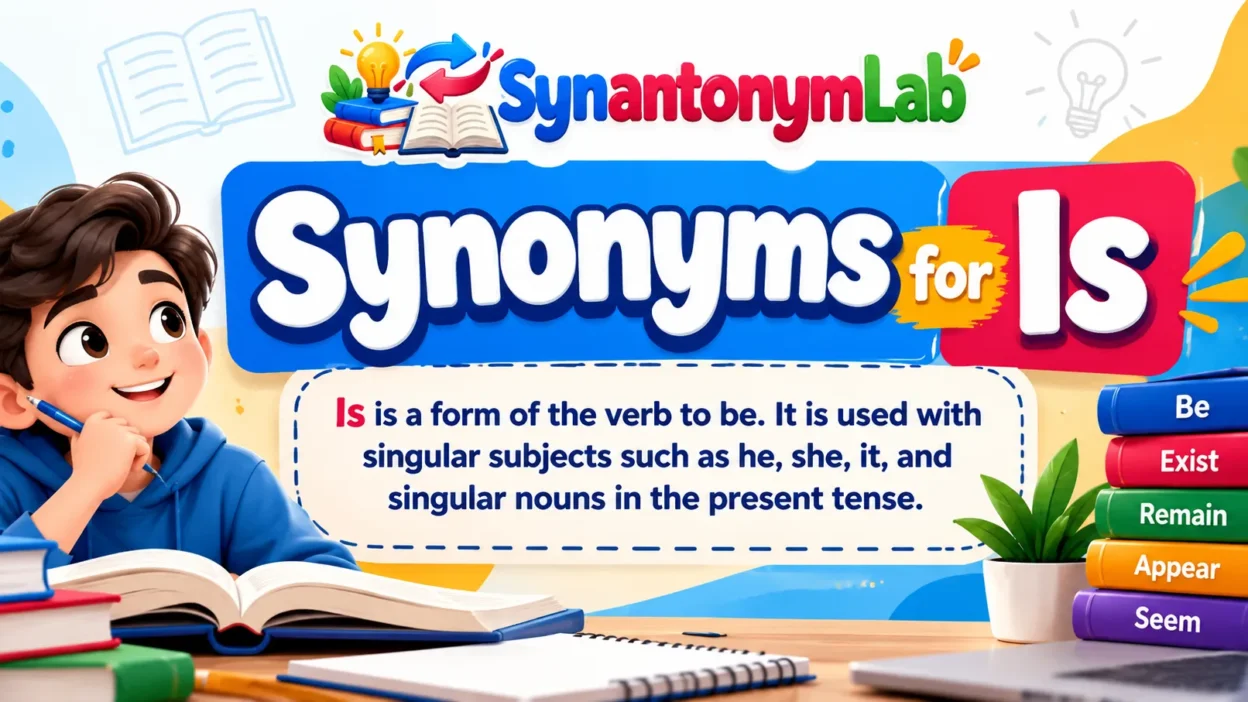
Is is a form of the verb to be. It is used with singular subjects such as he, she, it, and singular nouns in the present tense.
It can describe a condition, name something, identify a quality, or explain a relationship between two things.
For example:
- Condition: The child is tired.
- Identity: She is my sister.
- Quality: The room is bright.
- Location: The library is nearby.
- Ongoing action: He is reading a book.
- Passive voice: The letter is written in English.
In each example, is serves a different purpose. This matters because an alternative that works in one sentence may not work in another.
For instance, “The room is bright” could become “The room looks bright” if you are describing how it appears. But “She is my sister” cannot naturally become “She looks my sister.”
The word is is a present-tense linking verb in many sentences, but it also acts as an auxiliary, or helping verb, in other structures. It is neutral in tone and suitable for casual, professional, and academic writing.
Important distinction: Most alternatives to is are contextual replacements rather than exact synonyms. Some express appearance, change, identity, or function. Choose one only when it preserves the meaning of your sentence.
20 Best Synonyms for “Is”
The following 20 alternatives can replace is in suitable contexts. Each has its own meaning, so check the example before using it in your writing.
1. Exists
Meaning: Indicates that something is real or present.
Tone: Formal / Academic
Example: A strong link exists between sleep and learning.
Use exists when you mean that something is present or real. It does not replace is when describing every quality or identity.
2. Remains
Meaning: Shows that a condition continues over time.
Tone: Formal / Professional
Example: The main goal remains the same.
Use remains when a state continues despite time or change. It adds the idea of continuation, which is does not always express.
3. Stays
Meaning: Describes a condition that continues.
Tone: Casual / Conversational
Example: The kitchen stays clean throughout the day.
Stays is common in everyday English. It can sound less formal than remains, so choose according to your audience.
4. Becomes
Meaning: Shows that something changes into a new state.
Tone: Neutral / Academic
Example: The road becomes slippery after rain.
Use becomes when a change takes place. It is not interchangeable with is if no change is intended.
5. Seems
Meaning: Presents something as likely or true based on available evidence or an impression.
Tone: Neutral / Polite
Example: The task seems easier today.
Seems leaves room for doubt. It is useful when you do not want to state something as a certain fact.
6. Appears
Meaning: Describes how something looks or seems.
Tone: Formal / Professional
Example: The plan appears practical.
Appears often sounds more formal than seems. Use it when reporting an observation rather than confirming a fact.
7. Looks
Meaning: Describes the visual appearance of a person or thing.
Tone: Casual / Neutral
Example: The new design looks simple.
Looks works well when sight supports your judgment. It is less suitable for facts that cannot be judged by appearance alone.
8. Feels
Meaning: Describes a physical sensation or a personal impression.
Tone: Conversational / Neutral
Example: The fabric feels soft.
Use feels for touch, emotion, or a subjective sense of something. It may make a statement more personal than is.
9. Sounds
Meaning: Describes how something seems when heard or considered.
Tone: Casual / Neutral
Example: Your suggestion sounds helpful.
Sounds is useful when responding to spoken information or an idea. It signals an impression rather than proven fact.
10. Represents
Meaning: Shows what a person, object, or idea stands for.
Tone: Formal / Academic
Example: The blue line represents the monthly average.
Use represents when something symbolizes, illustrates, or stands for something else. It is more specific than is.
11. Constitutes
Meaning: Indicates that something forms or makes up a whole, condition, or category.
Tone: Formal / Academic
Example: Clear communication constitutes an important part of teamwork.
Constitutes often appears in academic, legal, or formal writing. Use it only when the subject genuinely forms or amounts to the stated thing.
12. Equals
Meaning: Expresses numerical equality or, in some contexts, an equivalent result.
Tone: Neutral / Technical
Example: Eight divided by two equals four.
Equals is particularly useful in mathematics. Outside technical contexts, it can suggest a direct equivalence that may be too strong.
13. Means
Meaning: Explains the meaning or intended significance of something.
Tone: Neutral / Academic
Example: A red light means stop.
Use means when explaining a word, sign, action, or idea. It does not simply describe every property of a subject.
14. Signifies
Meaning: Indicates or communicates a particular meaning.
Tone: Formal / Academic
Example: In this chart, a darker shade signifies a higher value.
Signifies is helpful when discussing symbols, signals, and ideas. It is more formal than means and may sound excessive in simple conversation.
15. Indicates
Meaning: Points to a fact, result, or possible conclusion.
Tone: Formal / Academic
Example: The latest test indicates a steady improvement.
Use indicates when evidence points toward a conclusion. Avoid treating it as proof when the evidence only suggests a possibility.
16. Serves As
Meaning: Describes the role or purpose of a person or thing.
Tone: Professional / Formal
Example: This room serves as a meeting space.
Serves as explains what something does or what role it fills. It is especially useful in workplace and organizational writing.
17. Functions As
Meaning: Explains how something operates or what practical role it performs.
Tone: Technical / Academic
Example: The small device functions as a wireless receiver.
Use functions as when the practical operation of an object, system, or process matters. It can sound overly technical in casual writing.
18. Acts As
Meaning: Describes a person or thing performing a particular role.
Tone: Neutral / Professional
Example: A clear checklist acts as a guide for new staff.
Acts as emphasizes the role something plays in a situation. It is close to serves as, but it can suggest a temporary or practical role.
19. Stands For
Meaning: Identifies the word, idea, or phrase represented by a symbol or abbreviation.
Tone: Neutral / Educational
Example: In this formula, A stands for area.
Use stands for when explaining abbreviations, symbols, or representations. It is not a general substitute for is.
20. Lies
Meaning: Describes where something is located or where a quality, cause, or key issue can be found.
Tone: Formal / Literary
Example: The main problem lies in poor planning.
Lies is useful for location and abstract ideas. In formal writing, “The answer lies in careful research” can sound more natural than a vague statement about where an answer is.
Stronger Alternatives
Sometimes is feels too plain because you want to make a stronger, more precise statement. These alternatives add force or detail, but they are not universal synonyms.
1. Proves
Use proves when evidence establishes a conclusion. It is much stronger than is or indicates.
Example: The repeated tests prove that the method works under these conditions.
Do not use it when the evidence only suggests a result.
2. Demonstrates
Use demonstrates when an example, action, or set of results clearly shows something.
Example: The study demonstrates the value of regular practice.
It is common in academic writing, but the evidence must support the claim.
3. Establishes
Use establishes when evidence, a decision, or an action sets something firmly in place.
Example: The report establishes a clear link between the two events.
It often describes the result of a process rather than a simple state.
4. Confirms
Use confirms when new information supports or verifies something already suspected or stated.
Example: The second test confirms the earlier result.
It implies stronger support than seems or appears.
5. Defines
Use defines when something sets the limits or key features of a concept.
Example: Trust defines the relationship between the two partners.
This is stronger and more specific than saying trust is part of their relationship.
6. Determines
Use determines when a factor decides or controls an outcome.
Example: The final score determines the winner.
It suggests a direct effect, so avoid it when a factor only influences an outcome.
7. Embodies
Use embodies when a person, action, or thing clearly expresses an idea or quality.
Example: Her actions embody the values of the team.
This word is more expressive and often more literary than is. It works best when the subject represents an idea in a meaningful way.
Softer or Polite Alternatives
A softer alternative can make a statement less certain, less direct, or more considerate. These words are especially useful in feedback, discussions, and professional communication.
1. Seems
Example: Your answer seems correct.
It expresses a judgment without claiming complete certainty.
2. Appears
Example: The document appears to be complete.
It gives a measured impression, which can be useful when reviewing work.
3. May Be
Example: This may be a useful option.
It expresses possibility rather than certainty. The phrase uses a modal verb, so it changes the grammar as well as the tone.
4. Might Be
Example: That might be the best place to begin.
It presents an idea cautiously. It is often helpful when offering a suggestion rather than giving a firm instruction.
5. Could Be
Example: This could be a good time to review the plan.
It presents a possible option or outcome without claiming that it is certain.
6. Tends to Be
Example: This method tends to be more reliable.
It describes a usual pattern rather than an absolute rule. Use it when exceptions may exist.
7. Seems to Be
Example: The issue seems to be a missing file.
It softens a direct statement and leaves room for further checking.
Usage tip: These alternatives are not always more polite. Use them when uncertainty or caution is appropriate. If a fact is certain and important, excessive hedging can make your writing unclear.
Academic & IELTS-Friendly Alternatives
In academic writing and IELTS tasks, the best word is the one that expresses your point accurately. A complex word is not automatically better than a simple one. The following options are useful when their meanings fit the sentence.
| Alternative | Best use | Example |
|---|---|---|
| Indicates | Evidence points to a result | The graph indicates a gradual rise in sales. |
| Demonstrates | Evidence or an example shows something | The results demonstrate a clear improvement. |
| Represents | Something stands for a value or idea | The figure represents annual spending. |
| Constitutes | Something forms a whole or category | Regular practice constitutes part of the course. |
| Signifies | A symbol or action carries meaning | The change signifies a new stage. |
| Suggests | Evidence points toward a possible conclusion | The data suggests a link between the two factors. |
| Reflects | Something shows a quality, state, or trend | The score reflects the student’s progress. |
| Comprises | Something includes its component parts | The course comprises four main units. |
| Corresponds to | Two things match or relate to each other | Each number corresponds to a specific category. |
| Is associated with | Two things are linked | Regular exercise is associated with better fitness. |
Here are some important differences to keep in mind.
Indicates vs. Suggests
Indicates often presents a clearer sign of something, while suggests leaves more room for doubt.
- The graph indicates a rise in demand.
- The early results suggest a possible rise in demand.
Choose the word that matches the strength of your evidence.
Represents vs. Reflects
Represents means that something stands for or depicts another thing. Reflects means that something shows or reveals a quality, condition, or trend.
- The symbol represents peace.
- The survey reflects public opinion among its respondents.
Comprises vs. Constitutes
Comprises describes the parts included in a whole. Constitutes can describe something that forms a whole or qualifies as a particular thing.
- The report comprises five sections.
- The action constitutes a breach of the agreement.
Use comprises when listing components. Use constitutes when explaining what something amounts to or forms.
Corresponds to vs. Is Associated With
Corresponds to suggests a match or relationship between items. Is associated with describes a link without necessarily proving that one thing causes another.
- Each color corresponds to a different group.
- High stress is associated with several health risks.
For IELTS writing, use these terms to describe data, explain relationships, and report findings accurately. Do not replace every instance of is just to make your vocabulary appear more advanced.
Synonyms You Should Avoid
Some words may look like suitable alternatives to is, but using them without checking the sentence can change its meaning or make the grammar incorrect.
1. Does
Why to avoid it: Does is a different verb form. It usually expresses an action or helps form questions and negative sentences.
Incorrect: She does happy.
Correct: She is happy.
Use does when the sentence requires it, such as “She does her homework.”
2. Has
Why to avoid it: Has often expresses possession or acts as a helping verb. It cannot replace is in every description.
Incorrect: The room has quiet.
Correct: The room is quiet.
However, “The room has a quiet atmosphere” is correct because has introduces a noun phrase.
3. Seems
Why to avoid it: Seems suggests an impression rather than a confirmed fact.
Original: The door is locked.
Changed: The door seems locked.
The second sentence expresses less certainty. Use it only if that difference matches your intention.
4. Proves
Why to avoid it: Proves makes a strong claim about evidence.
Original: The result is important.
Changed: The result proves the theory.
These sentences do not mean the same thing. Use proves only when evidence supports a firm conclusion.
5. Becomes
Why to avoid it: Becomes expresses a change of state.
Original: The water is cold.
Changed: The water becomes cold.
The first describes the current condition. The second describes a change that takes place. Choose the verb that matches the timing and meaning you want.
How to Choose the Right Synonym in Writing
Finding an alternative to is starts with understanding what the sentence needs to express. Follow these practical steps.
1. Check the context
Ask what is means in your sentence. Does it describe a quality, identify something, show a location, explain a role, or introduce an action?
For example:
- Original: The room is quiet.
- Alternative: The room remains quiet.
Use remains only if you want to show that the quiet condition continues.
2. Match the tone
Your choice should suit the reader and purpose.
- Casual: The food looks good.
- Professional: The proposal appears practical.
- Academic: The evidence indicates a clear trend.
A formal word can help in a report, but it may sound unnatural in a message to a friend.
3. Consider your audience
Young learners and general readers usually benefit from simple, familiar words. Specialists may need precise terms that describe a process or relationship.
For example, “The device works as a receiver” may be easier for a general reader than “The device functions as a receiver.”
Both can be correct, but clarity should guide your choice.
4. Preserve the strength of the statement
Some alternatives make a statement more certain, while others make it less certain.
Compare these examples:
- The results seem promising.
- The results indicate progress.
- The results confirm improvement.
Each sentence makes a different claim. Do not use confirm or prove unless the evidence supports that level of certainty.
5. Check the grammar
A replacement must fit the sentence structure.
- Correct: The answer is clear.
- Correct: The answer seems clear.
- Correct: The answer remains clear.
- Incorrect: The answer represents clear.
The last sentence is incomplete or awkward because represents usually needs an object, such as “The answer represents a major change.”
Also remember that is can be part of a continuous or passive verb structure:
- She is writing a report.
- The report is being reviewed.
You cannot simply remove is or replace it with a linking verb without changing the grammar. For instance, “She writes a report” changes the verb structure and may change the meaning.
6. Avoid changing meaning for variety
Not every sentence needs a synonym. Sometimes is is already the clearest choice.
Instead of changing “Water is essential for life” to a less natural sentence, keep the original. Strong writing depends on accuracy, not on replacing common words whenever possible.
7. Read the sentence aloud
If your replacement sounds forced, return to the original or try a simpler option. Natural English is more valuable than a sentence filled with formal words.
A useful rule is to replace is only when the new word adds meaningful detail, improves precision, or fits the context better.
Example Paragraph Rewritten Using Synonyms
Here is how a paragraph can change when you choose alternatives to is carefully.
Original paragraph
The library is an important part of the school. It is a quiet place for students. The main purpose of the library is to support learning. It is also a useful space for group work.
Rewritten paragraph
The library serves as an important learning space within the school. It remains a quiet place where students can read and study. Its main purpose is to support learning, and it also functions as a useful area for group work.
Why these changes work
- Serves as highlights the library’s role in the school.
- Remains emphasizes the continued quiet setting.
- Is stays in the third sentence because it expresses the purpose clearly.
- Functions as describes the library’s practical use for group work.
Notice that the rewrite keeps is where it works well. The goal is not to remove every instance of the word. It is to use alternatives where they improve meaning, flow, or precision.
FAQs
1. What are the best synonyms for “is”?
Useful alternatives include seems, appears, remains, becomes, represents, indicates, and serves as. The best choice depends on the sentence. For example, remains shows continuation, while becomes describes change.
2. Can I replace “is” with “are”?
No, not in every sentence. Is is used with singular subjects in the present tense, while are is used with plural subjects and certain pronouns, such as you. For example, “The book is new” becomes “The books are new” when the subject changes to plural.
3. What is a formal alternative to “is”?
Depending on the meaning, formal alternatives include constitutes, represents, indicates, signifies, and serves as. For example, “The chart represents the yearly results” may be more precise than “The chart is the yearly results.”
4. How can I avoid using “is” too often?
Look for sentences where is gives a vague description. Replace it with a more precise verb when appropriate. For example, “The data is a sign of progress” could become “The data indicates progress.” Keep is when it communicates your meaning clearly.
5. What is an academic synonym for “is”?
There is no single academic synonym that works in every situation. Constitutes can describe what forms a whole, indicates can introduce a finding, and represents can explain what a figure or symbol stands for.
6. Are “seems” and “is” interchangeable?
Not always. Is can state a fact directly, while seems expresses an impression or judgment. “The answer is correct” sounds definite. “The answer seems correct” leaves room for doubt.
7. Can I use synonyms for “is” in IELTS writing?
Yes. Use alternatives when they describe data, trends, roles, or relationships more accurately. Words such as indicates, reflects, represents, and corresponds to can be useful in the right context. However, using is correctly is better than choosing a complicated word that changes your meaning.
Conclusion
Choosing the right alternative to is can make your writing more precise, natural, and engaging.
Words such as remains, becomes, seems, represents, and indicates offer useful options, but each serves a different purpose.
The key is to understand what your sentence means before changing the verb. Consider your audience, tone, grammar, and level of certainty.
In academic writing, focus on accurate descriptions of evidence and relationships. In everyday communication, choose familiar words that sound natural.
Most importantly, do not replace is simply to avoid repetition.
When it expresses your idea clearly, it is often the best word to use.

Milo Carter is a passionate writer who loves exploring words, synonyms, and antonyms. Through SynantonymLab, he helps readers improve their English vocabulary and language skills.