Anger is a common human emotion, but the word anger does not always express exactly what a writer wants to say.
Sometimes, a person feels mild annoyance. At other times, they experience deep resentment, sudden rage, or strong indignation over something unfair.
Choosing the right word helps readers understand the feeling more clearly.
Learning synonyms for anger can improve essays, school assignments, workplace communication, creative writing, and everyday conversations.
It can also help English learners build vocabulary for academic tasks, including IELTS writing and speaking.
However, not every alternative has the same meaning or emotional strength. For example, irritation suggests a milder feeling, while fury describes a much more intense response.
This guide explores 21 useful synonyms for anger, with simple meanings, natural example sentences, and notes on how each word differs.
You will also learn stronger alternatives, softer and more polite expressions, academic vocabulary, and common word choices that can change your intended meaning.
Whether you want to describe your own feelings, explain someone else’s reaction, or make your writing more precise, these words will help you express anger in the right way.
What Does “Anger” Mean?
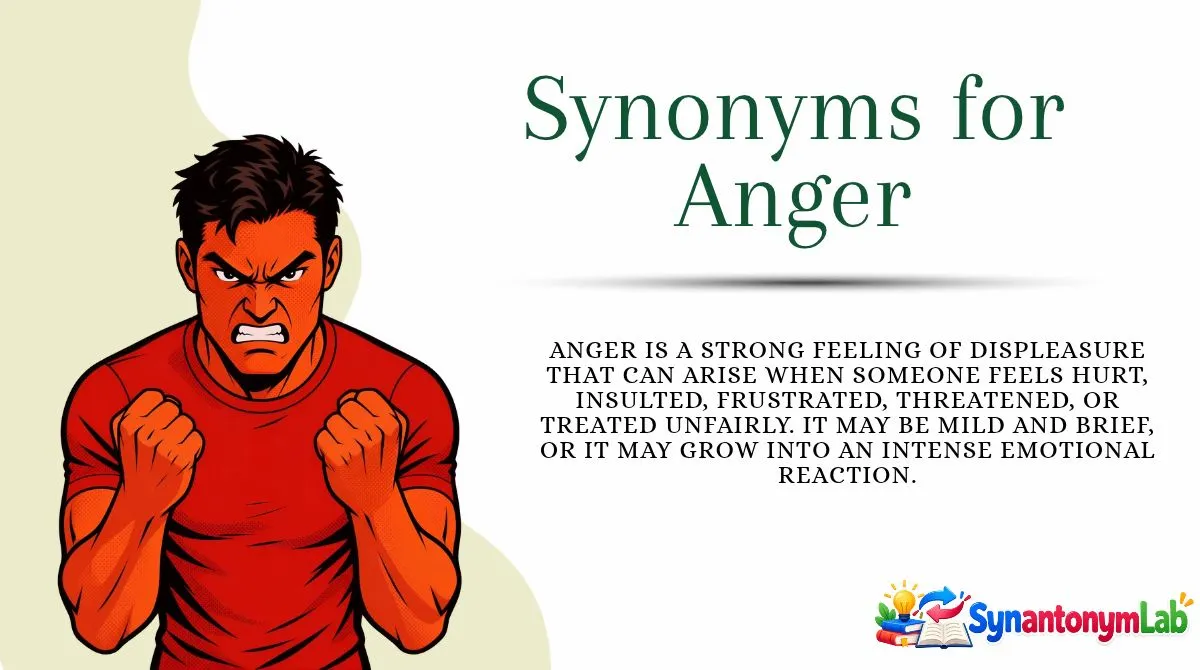
Anger is a strong feeling of displeasure or emotional upset that may arise when someone feels hurt, treated unfairly, blocked, or disrespected. It can range from mild irritation to intense rage.
The word anger is a noun. Its related adjective is angry, and its verb form is anger, as in “His careless remark angered her.”
Anger can appear in many situations. A student may feel angry about an unfair grade. An employee may feel angry after being treated rudely. A reader may notice anger in a character’s words or actions.
The word is generally neutral in formality. It works in casual conversation, professional communication, academic writing, and literature. Its tone depends on the situation and the words around it.
One important distinction is that anger does not always mean aggression. A person can feel angry without shouting, arguing, or acting in a harmful way. Likewise, words such as hostility and rage may suggest different levels or expressions of anger rather than the same feeling in every context.
21 Best Synonyms for Anger
These 21 alternatives describe anger in different ways. Some are close substitutes, while others fit particular situations or levels of emotional intensity.
1. Annoyance
Meaning: A mild feeling of anger caused by something irritating or inconvenient.
Tone: Casual
Example: She showed her annoyance when the meeting started late again.
Usage: Use annoyance for small problems or repeated inconveniences. It is usually less intense than anger.
2. Irritation
Meaning: A feeling of anger or impatience caused by something bothersome.
Tone: Neutral
Example: His constant interruptions caused irritation among the team members.
Usage: Irritation often describes a reaction to repeated noise, delays, habits, or interruptions. It can also refer to physical discomfort, so context matters.
3. Displeasure
Meaning: A feeling of dissatisfaction or unhappiness about someone’s actions or a particular situation.
Tone: Formal
Example: The manager expressed displeasure with the team’s careless work.
Usage: This word is useful in professional settings when you want to express dissatisfaction without sounding overly emotional.
4. Frustration
Meaning: Anger or upset caused by obstacles, delays, or the inability to achieve a goal.
Tone: Neutral
Example: He felt frustration when the computer crashed before he could save his work.
Usage: Frustration often involves feeling blocked or powerless. It may include anger, but it can also involve disappointment.
5. Exasperation
Meaning: Strong irritation caused by something that continues to be difficult or annoying.
Tone: Neutral to formal
Example: She sighed in exasperation when the same mistake appeared for the third time.
Usage: Choose exasperation when patience is wearing thin after repeated problems.
6. Indignation
Meaning: Anger caused by something believed to be unfair, insulting, or morally wrong.
Tone: Formal
Example: The residents expressed indignation over the unfair eviction notice.
Usage: Unlike general anger, indignation often carries a sense of justice or moral disapproval. It is useful in essays, reports, and formal discussions.
7. Resentment
Meaning: Lasting anger or bitterness caused by feeling hurt, mistreated, or treated unfairly.
Tone: Neutral
Example: Years of unequal treatment created resentment among the workers.
Usage: Resentment often remains for a long time, even after the original event has passed.
8. Ire
Meaning: Anger, especially anger directed at a person, action, or event.
Tone: Formal or literary
Example: The company’s sudden price increase drew the ire of its customers.
Usage: Ire is a concise alternative that appears often in formal reporting and literary writing. In everyday speech, anger sounds more natural.
9. Rage
Meaning: Very intense anger that may be difficult to control.
Tone: Strong, neutral
Example: He struggled to contain his rage after discovering the deliberate damage.
Usage: Rage is much stronger than ordinary anger. Use it when the emotion is extreme, not simply when someone is unhappy.
10. Fury
Meaning: Extremely intense anger, often accompanied by a powerful emotional reaction.
Tone: Strong, expressive
Example: She was filled with fury when she learned that someone had stolen her savings.
Usage: Fury is close to rage. It often adds dramatic force to a description of someone’s emotional response.
11. Wrath
Meaning: Intense anger, often directed toward someone who has done something seriously wrong.
Tone: Formal or literary
Example: The dishonest official faced the wrath of the public.
Usage: Wrath sounds more dramatic and elevated than everyday anger. It is common in literature and formal expressions.
12. Outrage
Meaning: Strong anger caused by an action or event seen as deeply unfair, offensive, or unacceptable.
Tone: Formal or neutral
Example: The unfair decision sparked outrage throughout the community.
Usage: Outrage often describes a public or shared reaction. It can also mean an offensive or shocking act, depending on the sentence.
13. Hostility
Meaning: An unfriendly or openly antagonistic attitude that may include anger.
Tone: Formal
Example: The discussion became difficult because of the hostility between the two groups.
Usage: Hostility is not simply a feeling of anger. It often describes how unfriendly or opposed someone is toward another person or group.
14. Bitterness
Meaning: Lasting anger mixed with hurt or disappointment.
Tone: Neutral
Example: He spoke with bitterness about the promises that had been broken.
Usage: Bitterness often develops when someone feels deeply disappointed or wronged over time. It may affect a person’s attitude as well as their emotions.
15. Vexation
Meaning: Annoyance or frustration caused by a troubling or inconvenient situation.
Tone: Formal or literary
Example: To her vexation, the important document had disappeared.
Usage: Vexation is a useful alternative in formal prose, but it is less common in everyday conversation than annoyance or frustration.
16. Umbrage
Meaning: Offense or resentment caused by something someone considers insulting or disrespectful.
Tone: Formal
Example: He took umbrage at the suggestion that he had acted dishonestly.
Usage: The usual expression is take umbrage at something. It focuses more on feeling offended than on anger in general.
17. Pique
Meaning: A brief feeling of irritation or resentment, often caused by wounded pride.
Tone: Formal or literary
Example: In a moment of pique, she refused to answer his message.
Usage: Pique often describes a short-lived reaction to a slight or disappointment. It is less suitable for deep or prolonged anger.
18. Aggravation
Meaning: Annoyance or frustration caused by something that makes a situation more difficult.
Tone: Casual or neutral
Example: The repeated phone calls added to his aggravation during the busy afternoon.
Usage: In everyday American English, aggravation often means annoyance. In other contexts, aggravation can mean making a problem worse, so the surrounding sentence is important.
19. Animosity
Meaning: Strong dislike or ill will toward another person or group, often lasting over time.
Tone: Formal
Example: Years of rivalry created animosity between the neighboring teams.
Usage: Animosity describes a hostile relationship or deep-seated ill will more than a passing burst of anger.
20. Acrimony
Meaning: Harsh anger or bitterness expressed through hostile words or behavior.
Tone: Formal
Example: The business partners ended their agreement with considerable acrimony.
Usage: Acrimony is especially useful when describing bitter arguments, disputes, or relationships marked by harsh exchanges.
21. Resentfulness
Meaning: The quality of feeling or showing resentment toward someone or something.
Tone: Neutral to formal
Example: His resentfulness grew as he watched others receive credit for his work.
Usage: This word is less common than resentment. It can describe an ongoing attitude, but in most sentences, resentment is the more natural choice.
Stronger Alternatives
When ordinary anger does not fully express the strength of an emotion, a more intense word may be appropriate. These alternatives are useful for dramatic writing, personal accounts, and descriptions of serious conflict.
- Rage: Use for extremely strong anger that may be hard to control. He shook with rage after the betrayal.
- Fury: Suggests powerful, intense anger. Her fury was clear from her sharp response.
- Wrath: A dramatic or elevated word for severe anger. The leader faced the wrath of the people.
- Outrage: Best when an event causes strong anger because it seems unfair or unacceptable. The decision caused widespread outrage.
- Indignation: Strong anger based on a sense of justice. She spoke with indignation about the unequal rules.
- Resentment: Use for anger that lasts because of a perceived wrong. Resentment grew after years of unfair treatment.
- Hostility: Describes an openly unfriendly or antagonistic attitude. Hostility between the groups prevented an honest discussion.
Not all these words are stronger versions of anger in exactly the same sense. Rage and fury express intensity, while indignation and outrage point to the reason for the anger. Choose the word that matches both the emotion and its cause.
Softer or Polite Alternatives
Sometimes, saying “I am angry” may sound too direct. A softer expression can help you explain a concern without making a conversation more tense.
- Annoyed: “I was annoyed when the appointment was delayed.” Use for mild anger.
- Irritated: “I felt irritated by the repeated interruptions.” Useful for a clear but moderate reaction.
- Frustrated: “I am frustrated because we have not found a solution.” Focuses on a problem rather than blaming someone.
- Displeased: “I was displeased with the way the issue was handled.” A more formal way to express dissatisfaction.
- Upset: “I was upset by the way the conversation ended.” A broad, gentle term that may include sadness as well as anger.
- Concerned: “I am concerned about the way these changes were made.” Focuses on a problem without directly stating anger.
- Unhappy: “I am unhappy with the current arrangement.” A mild way to communicate dissatisfaction.
These expressions are not perfect replacements in every sentence. Concerned, upset, and unhappy can describe feelings that are not anger at all. Use them when they accurately reflect your reaction, not just to make anger sound more polite.
Academic & IELTS-Friendly Alternatives
In academic essays and IELTS responses, the best vocabulary is the vocabulary that expresses your point accurately. Complex words are not automatically better than simple ones. These options can help you discuss emotions, social issues, workplace conflict, and unfair treatment with greater precision.
| Word | Meaning and best use | Example |
|---|---|---|
| Indignation | Anger over perceived injustice | The policy caused indignation among local residents. |
| Resentment | Anger that lasts after unfair treatment | Resentment can grow when workers feel ignored. |
| Frustration | Upset caused by obstacles or a lack of progress | Delays increased public frustration. |
| Displeasure | Formal dissatisfaction | The director expressed displeasure with the results. |
| Hostility | An unfriendly or antagonistic attitude | Hostility can prevent groups from working together. |
| Outrage | Strong anger over something considered unacceptable | The report prompted public outrage. |
| Acrimony | Bitterness shown in a dispute | The negotiations ended in acrimony. |
| Exasperation | Strong irritation after repeated problems | Repeated delays led to exasperation. |
| Animosity | Deep dislike or ill will | Historical disputes created animosity between the groups. |
| Bitterness | Lasting hurt mixed with anger | Bitterness remained after the disagreement. |
| Dissatisfaction | Unhappiness with a result or situation | Dissatisfaction with public services continued to rise. |
How to use these words effectively
- For cause-and-effect essays: Use frustration when explaining how delays or barriers affect people.
- For social issues: Use indignation or outrage when people react strongly to perceived injustice.
- For workplace topics: Use displeasure or dissatisfaction when discussing professional concerns.
- For conflict and relationships: Use hostility, animosity, or acrimony when describing unfriendly attitudes or bitter disputes.
- For long-term emotional effects: Use resentment or bitterness when anger continues after an upsetting experience.
For IELTS, pay attention to grammar as well as meaning. For example, write “The decision caused public outrage,” not “The decision caused public outraged.” The noun outrage fits after “caused,” while outraged is an adjective, as in “The public was outraged.”
Synonyms You Should Avoid
Some words may look like synonyms for anger but express a different emotion or describe a related behavior. They are not always wrong, but using them in the wrong context can change your meaning.
1. Hatred
Hatred describes intense dislike, not simply anger. A person may feel angry about a mistake without hating the person who made it.
Better choice: Use anger for the immediate emotion and hatred only when deep dislike is intended.
2. Aggression
Aggression refers to hostile or forceful behavior, not the feeling of anger itself.
Better choice: Write “He felt anger” if you mean an emotion, or “He acted aggressively” if you mean his behavior.
3. Sadness
Sadness is a feeling of sorrow, not a direct synonym for anger. Both emotions can occur together, such as when someone feels hurt by a friend’s actions.
Better choice: Use anger when the person is mad and sadness when the main feeling is sorrow.
4. Jealousy
Jealousy involves fear, insecurity, or distress about a valued relationship or advantage being threatened. It may lead to anger, but the two words do not mean the same thing.
Better choice: Use jealousy when the situation involves a perceived threat to something or someone important.
5. Disappointment
Disappointment describes sadness or dissatisfaction when an outcome does not meet expectations. It may cause anger, but it is not interchangeable with anger.
Better choice: Write “She felt disappointed by the result” when expectations were not met, and use angry when her main reaction was anger.
The main lesson is simple: related emotions are not always synonyms. Select a word based on what the person actually feels or how they behave.
How to Choose the Right Synonym in Writing
The right alternative depends on more than the meaning of a word. Consider the situation, the audience, the level of formality, and the strength of the emotion.
1. Consider the context
Ask yourself why the person feels angry.
- A delayed delivery may cause annoyance.
- A difficult task may lead to frustration.
- Unfair treatment may create indignation.
- A long-standing conflict may produce resentment.
The cause of the emotion often helps you select the most precise word.
2. Match the tone
Choose words that suit the style of your writing.
- Casual: annoyance, irritation, frustration
- Professional: displeasure, dissatisfaction, frustration
- Academic: indignation, resentment, hostility
- Literary: wrath, fury, ire
A word that works in a novel may sound unnatural in a routine business email. Likewise, an overly formal term can make casual conversation feel stiff.
3. Think about your audience
When speaking to a friend, “That really annoyed me” sounds natural. When raising a workplace concern, “I was displeased with how the issue was handled” may be more suitable.
For an academic essay, explain the cause and effect clearly instead of choosing a difficult word simply to impress the reader.
4. Check the intensity
Imagine anger as a range rather than a single feeling.
- Mild: annoyance
- Moderate: irritation or frustration
- Lasting: resentment or bitterness
- Intense: rage or fury
- Based on perceived injustice: indignation or outrage
This is a rough guide, not a fixed scale. A person’s tone and the surrounding situation can affect how strong a word sounds.
5. Use the correct grammatical form
A synonym must fit the sentence grammatically.
- Noun: “Her anger was obvious.”
- Adjective: “She was angry.”
- Verb: “The decision angered the staff.”
- Adjective describing a cause: “The delay was frustrating.”
- Adjective describing a person: “The delay was frustrating, and the staff were frustrated.”
Also remember that a word can change meaning depending on its form. Outrage is a noun or verb, outraged is an adjective, and outrageous usually describes something shocking or unacceptable.
6. Read the sentence aloud
If the word sounds too dramatic, too formal, or unclear, try a simpler option. The purpose of a synonym is to improve communication, not to make every sentence sound complicated.
Example Paragraph Rewritten Using Synonyms
Consider this original paragraph:
Original paragraph:
Mark felt angry when his team ignored his suggestions. He became angry when the same problems happened again, and he was angry that his manager gave credit to someone else.
Rewritten paragraph
Mark felt frustrated when his team ignored his suggestions. He grew increasingly exasperated when the same problems happened again, and he felt deep resentment when his manager gave credit to someone else.
Why these synonyms work
- Frustrated explains Mark’s difficulty in getting his ideas heard.
- Exasperated shows that repeated problems have worn down his patience.
- Resentment suggests a lasting feeling of unfairness about the manager’s decision.
The revised paragraph avoids repeating angry and gives readers a clearer picture of Mark’s changing emotions. Each word adds a slightly different meaning instead of serving as a simple replacement.
FAQs
1. What are the best synonyms for anger?
Some useful synonyms are irritation, frustration, resentment, indignation, rage, and fury. The best choice depends on the cause, intensity, and duration of the emotion.
2. What is a stronger word for anger?
Rage and fury are strong alternatives that express intense anger. Wrath is another option, especially in literary or formal writing.
3. What is a milder word for anger?
Annoyance and irritation are good choices for mild anger. Displeasure can also work when you want to express dissatisfaction in a more formal way.
4. What is a formal synonym for anger?
Indignation, ire, displeasure, and resentment can work in formal writing. Choose the word that matches the specific meaning you want to express.
5. What is the difference between anger and frustration?
Anger is a general emotional response to something upsetting or wrong. Frustration often develops when a person faces an obstacle, delay, or difficulty that prevents progress. The two emotions can occur together.
6. Which synonyms for anger are useful in IELTS writing?
Frustration, resentment, indignation, hostility, and dissatisfaction are useful when they fit the topic. For example, public dissatisfaction may suit an essay about services, while indignation may fit a discussion of perceived injustice.
7. Can I use anger synonyms in everyday conversation?
Yes. Words such as annoyance, irritation, frustration, and upset are common in everyday communication. More formal words, such as umbrage and acrimony, are usually better suited to specific contexts.
Conclusion
Choosing the right synonym for anger helps you express emotions with greater accuracy and variety.
Annoyance suits minor problems, frustration describes obstacles, resentment suggests lasting hurt, and rage conveys intense anger.
Other words, such as indignation and outrage, highlight anger caused by perceived unfairness.
The key is to consider the meaning, tone, and strength of each word before using it.
Whether you are writing an essay, preparing for IELTS, communicating at work, or improving your everyday English, a precise word will make your message clearer and more natural.

Milo Carter is a passionate writer who loves exploring words, synonyms, and antonyms. Through SynantonymLab, he helps readers improve their English vocabulary and language skills.