The word says is one of the most common words in English.
We use it to report what someone tells us, explain an idea, share an opinion, or describe information in a book, article, or speech. However, using says in every sentence can make writing feel repetitive.
Choosing a suitable alternative can make your sentences clearer, more natural, and more engaging.
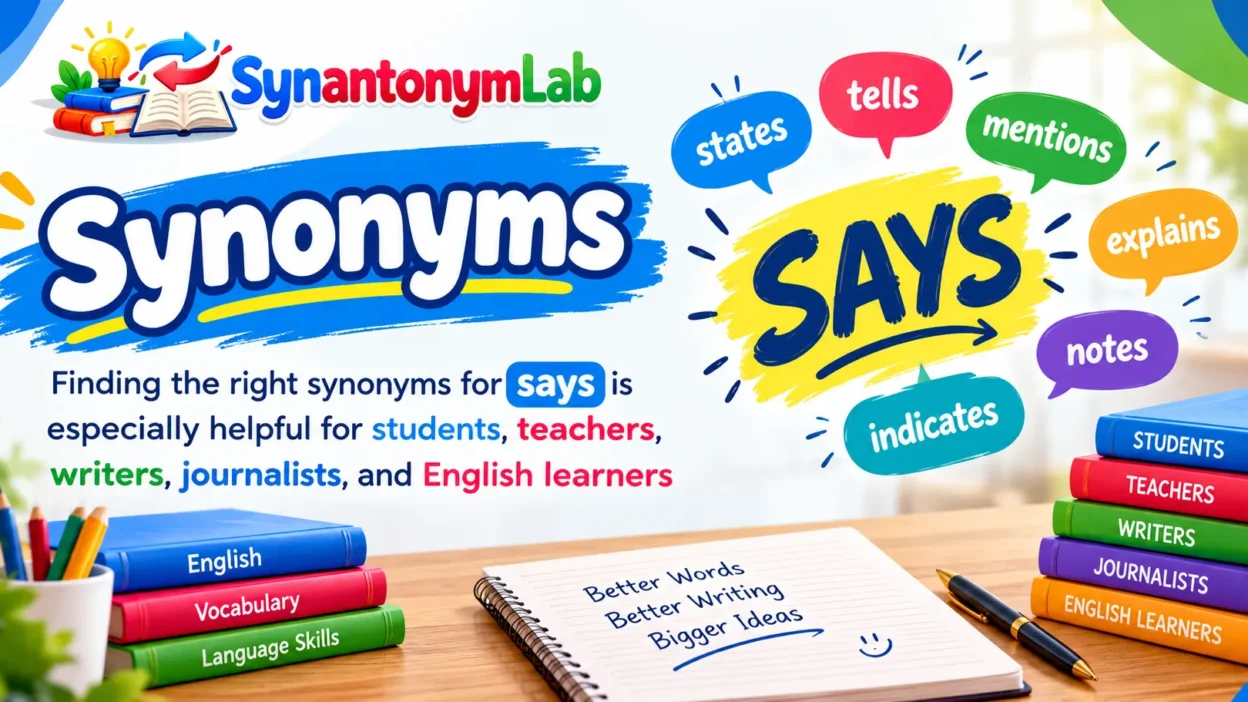
Finding the right synonyms for says is especially helpful for students, teachers, writers, journalists, and English learners.
In academic writing, a precise reporting verb can show whether a person argues, explains, suggests, or claims something. In professional communication, it can help you report instructions and information accurately. In casual conversations, simpler words may sound warmer and more natural.
Still, not every alternative means exactly the same thing.
For example, states sounds more formal than says, while whispers describes how someone speaks. Similarly, claims can suggest that a statement needs proof, and suggests often expresses an idea indirectly.
This guide explores 21 useful alternatives to says, along with clear definitions, natural examples, stronger and softer options, academic vocabulary, and common mistakes.
You will learn how to select the best word for your meaning, audience, and writing style.
What Does “Say” Mean?
Say is a verb used to express words, thoughts, information, or opinions. Its present-tense form, says, is used with singular third-person subjects, such as he, she, it, or a singular noun.
For example:
- She says she is ready.
- The teacher says the answer is correct.
- The report says that prices may rise.
The word is neutral and works in casual conversations, news reports, stories, and everyday writing. It usually reports what someone communicates without adding a strong judgment about the truth or importance of the message.
However, alternatives can add meaning. States often sounds formal and direct. Explains suggests that information is being made clearer. Argues presents a reasoned position, while claims may imply doubt or a need for evidence. Remarks often refers to a comment made during a conversation.
It is also important to distinguish says from words that describe the manner of speaking. Whispers, shouts, and murmurs tell readers how the words are spoken, not simply what is communicated.
The best replacement depends on the sentence. A synonym should preserve the original meaning while making the intended tone or action clearer.
21 Best Synonyms for “Say”
These 21 alternatives help you replace says without changing the intended message. Each word has a slightly different purpose, so choose the one that best fits the sentence.
1. States
Meaning: Expresses information or an opinion clearly and directly.
Tone: Formal
Example: The report states that sales increased last month.
Use states when reporting facts, official information, rules, or written statements. It sounds more formal than says and works well in reports and academic writing.
2. Tells
Meaning: Gives information to someone or shares something with another person.
Tone: Casual / Neutral
Example: Maria tells her brother to close the window.
Use tells when the sentence focuses on a person receiving information or instructions. Unlike says, tells usually needs an object when reporting what someone communicates directly: tells me, tells them, or tells her.
3. Explains
Meaning: Makes an idea, reason, or process easier to understand.
Tone: Neutral / Academic
Example: The teacher explains why the answer is incorrect.
Choose explains when a speaker gives details or reasons. It is more specific than says because it suggests an effort to make something clear.
4. Mentions
Meaning: Refers to something briefly without discussing it in depth.
Tone: Neutral / Casual
Example: He mentions that the meeting starts at noon.
Use mentions when information appears as a small part of a larger conversation. It is not suitable when someone gives a detailed explanation or makes a major announcement.
5. Notes
Meaning: Points out or records a particular fact or detail.
Tone: Formal / Academic
Example: The researcher notes that the sample size was small.
Notes is useful when highlighting an observation or detail that matters to the discussion. It often appears in essays, reports, reviews, and research writing.
6. Remarks
Meaning: Makes a comment about a subject or situation.
Tone: Neutral / Formal
Example: The manager remarks that the team has made good progress.
Use remarks when reporting a comment or observation. It can sound slightly more formal or literary than says, depending on the sentence.
7. Comments
Meaning: Gives an opinion or reaction about something.
Tone: Neutral / Professional
Example: The coach comments that the players need more practice.
Choose comments when someone reacts to an event, decision, or idea. It is particularly useful in interviews, discussions, reviews, and professional settings.
8. Declares
Meaning: Announces a position, decision, or statement firmly.
Tone: Formal / Strong
Example: The mayor declares that the city will open a new library.
Declares sounds more forceful than says. It works when someone makes a clear public statement or firmly expresses a position, but it can sound dramatic in an ordinary conversation.
9. Announces
Meaning: Shares news or information that people need to know.
Tone: Formal / Professional
Example: The school announces that classes will begin on Monday.
Use announces for news, plans, decisions, and important updates. It suggests that information is being shared with an audience rather than simply mentioned in conversation.
10. Reports
Meaning: Gives information about an event, finding, or situation.
Tone: Formal / Journalistic
Example: The newspaper reports that the road has reopened.
Reports is appropriate for news, research findings, workplace updates, and observations. It often suggests that information is being passed on from a source.
11. Claims
Meaning: Presents something as true, especially when it may be questioned.
Tone: Neutral / Potentially Skeptical
Example: The company claims that its new product saves energy.
Use claims when the truth of a statement is uncertain, disputed, or relevant to the discussion. It can imply doubt, so avoid using it when you want to report an established fact neutrally.
12. Argues
Meaning: Gives reasons to support a position or point of view.
Tone: Academic / Formal
Example: The author argues that public parks improve city life.
Argues is especially useful in essays, debates, and critical discussions. It suggests reasoning or evidence rather than simply speaking. It does not always mean that two people are fighting.
13. Suggests
Meaning: Presents an idea or possibility without stating it as an absolute fact.
Tone: Neutral / Academic
Example: The evidence suggests that the treatment may be effective.
Use suggests when an idea is offered indirectly or when evidence points toward a possible conclusion. It is often less definite than states or confirms.
14. Points Out
Meaning: Draws attention to a fact, detail, or issue.
Tone: Neutral / Professional
Example: She points out that the final page is missing.
This phrase is useful when someone highlights information that others may have overlooked. It can sound corrective if the speaker is pointing out an error.
15. Expresses
Meaning: Communicates a thought, feeling, belief, or attitude.
Tone: Neutral / Formal
Example: The student expresses concern about the new policy.
Choose expresses when the focus is on a person’s feelings, views, or reactions. It often works better with nouns such as concern, support, doubt, and gratitude than with a direct quotation.
16. Observes
Meaning: Makes a thoughtful comment based on something noticed.
Tone: Formal / Academic
Example: The writer observes that the two results are different.
Observes is useful when a person identifies a pattern, detail, or difference. It can suggest careful thought, but it should not replace says in every ordinary conversation.
17. Adds
Meaning: Provides another point or piece of information.
Tone: Neutral / Conversational
Example: She adds that everyone should arrive ten minutes early.
Use adds when a speaker contributes something more to an ongoing conversation or explanation. It is particularly helpful when reporting several statements from the same person.
18. Confirms
Meaning: States that information is correct or that something is true.
Tone: Formal / Professional
Example: The email confirms that your booking is complete.
Confirms is stronger than says because it indicates verification or agreement with existing information. Do not use it when the speaker is merely making an unverified claim.
19. Admits
Meaning: Acknowledges something that may be difficult, embarrassing, or unfavorable.
Tone: Neutral / Emotionally Marked
Example: He admits that he forgot to send the file.
Choose admits when someone acknowledges a mistake, problem, or uncomfortable truth. It often carries an emotional meaning that the neutral word says does not.
20. Replies
Meaning: Responds to something another person has said or asked.
Tone: Neutral / Conversational
Example: “I will be there at six,” she replies.
Use replies when the statement is a response to an earlier comment or question. It is especially useful in dialogue and storytelling.
21. Answers
Meaning: Responds to a question or provides the requested information.
Tone: Neutral / Everyday
Example: He answers that the store closes at nine.
Answers is best when a question has been asked. In many cases, answers that the store closes at nine is grammatical, but answers, “The store closes at nine” sounds more natural in dialogue.
Stronger Alternatives
Some alternatives to says communicate a stronger feeling, firmer position, or more important action. These words are useful when a neutral reporting verb does not capture the speaker’s intent.
- Insists: Shows that someone firmly maintains a position. She insists that the figures are correct. Use it when the speaker is unwilling to give up a point.
- Proclaims: Announces something publicly or with great confidence. The leader proclaims a new beginning. It may sound grand or dramatic in everyday writing.
- Emphasizes: Gives special importance to a point. The teacher emphasizes the need for careful reading. It highlights importance rather than simply reporting speech.
- Asserts: States a position confidently. The researcher asserts that more testing is needed. This is common in formal arguments, but the word does not itself prove the claim.
- Contends: Argues for a particular position, often in a debate or written discussion. The author contends that the policy should change. It sounds more formal than argues.
- Denounces: Publicly condemns something as wrong or unacceptable. The group denounces the unfair decision. Use it only when strong criticism is intended.
- Accuses: Claims that someone has done something wrong. She accuses the company of hiding information. This can harm the tone if there is no clear accusation in the original meaning.
These are not interchangeable in every sentence. Use them only when their added strength matches the speaker’s message.
Softer or Polite Alternatives
When you want to sound gentle, respectful, or less forceful, the right reporting verb can help. These alternatives are useful in conversations, workplace messages, feedback, and sensitive discussions.
- Suggests: Offers an idea without demanding agreement. He suggests meeting a little earlier. This is useful when making a proposal.
- Mentions: Shares information briefly. She mentions that she may be late. It keeps the statement casual and low-key.
- Notes: Draws attention to a detail in a calm way. The reviewer notes a small error in the report. It can sound professional without being harsh.
- Observes: Shares a thoughtful impression. She observes that the room feels quieter today. It works well for gentle comments.
- Recommends: Advises someone to consider a particular choice. The doctor recommends taking regular breaks. It is suitable when giving guidance, not when merely repeating information.
- Proposes: Puts forward an idea for others to consider. He proposes changing the meeting time. It sounds constructive and professional.
- Indicates: Shows or communicates something without necessarily stating it directly. The survey indicates that customers prefer shorter forms. It is useful for evidence and indirect signals.
A useful tip: Softer words are not always more polite in every situation. For example, suggests may sound too uncertain when you need to give a clear instruction. Choose a word that respects your audience while keeping the message accurate.
Academic & IELTS-Friendly Alternatives
In academic essays, reports, and IELTS Writing Task 2, precise reporting verbs help you explain ideas and discuss evidence. The goal is not to use the most advanced word possible. It is to select the word that accurately describes the source’s purpose.
| Alternative | Best use | Example |
|---|---|---|
| Argues | Presents a reasoned position | The author argues that education should be accessible to all. |
| Asserts | States a position firmly | The researcher asserts that the results support the theory. |
| Contends | Defends a position in a debate | The writer contends that public transport needs improvement. |
| Maintains | Continues to support a belief or position | The author maintains that prevention is more effective than treatment. |
| Proposes | Puts forward a plan or idea | The study proposes a new method of measuring progress. |
| Indicates | Points toward a finding or conclusion | The data indicates a change in consumer behavior. |
| Demonstrates | Shows something clearly through evidence | The experiment demonstrates how temperature affects the process. |
| Highlights | Draws attention to an important point | The report highlights the need for better planning. |
| Concludes | Presents a final judgment after consideration | The researcher concludes that further study is needed. |
| Acknowledges | Accepts or recognizes a fact or concern | The author acknowledges the limits of the study. |
A few usage details matter:
- Use argues, asserts, contends, and maintains for a position or belief.
- Use indicates when evidence points toward a conclusion without necessarily proving it.
- Use demonstrates when the evidence clearly shows the point being discussed.
- Use highlights to emphasize importance, not as a general substitute for every reporting verb.
- Use concludes when a source reaches a final judgment, not when it simply introduces an idea.
- Use acknowledges when the writer recognizes a point, limitation, or concern.
In IELTS writing, these verbs can improve precision when discussing an author’s view, a research finding, or an argument. However, they do not automatically improve your score. Clear reasoning, correct grammar, and relevant examples remain essential.
Also, be careful with subject–verb agreement. Write the author argues, the report indicates, and the researchers argue. The singular forms take an -s, while plural subjects generally do not.
Synonyms You Should Avoid
Some words look like useful replacements for says but change the meaning or create an awkward sentence. They are not always wrong; they simply belong in specific contexts.
1. Thinks
Why to be careful: Thinks describes a thought or belief, which may not have been spoken aloud.
- Original: She says the plan will work.
- Different meaning: She thinks the plan will work.
Use thinks when reporting someone’s private opinion or belief, rather than their spoken words.
2. Knows
Why to be careful: Knows expresses knowledge or certainty, not the act of speaking.
- Original: He says the answer is correct.
- Different meaning: He knows the answer is correct.
Use knows only when the sentence concerns what someone understands or is aware of.
3. Promises
Why to be careful: Promises suggests a commitment to do something or ensure something happens.
- Original: She says she will help.
- Stronger commitment: She promises to help.
The second sentence conveys a more definite commitment. Do not use promises unless the speaker is making one.
4. Questions
Why to be careful: Questions can mean asking for information or expressing doubt about an idea.
- Original: He says the decision is fair.
- Different meaning: He questions whether the decision is fair.
Use questions when someone challenges an idea or asks for clarification, not when they simply state it.
5. Yells
Why to be careful: Yells describes loud or forceful speech.
- Original: She says his name.
- Different meaning: She yells his name.
Use yells only when the volume or intensity of the speech matters. Otherwise, it can make a calm scene sound angry or dramatic.
How to Choose the Right Synonym in Writing
The best alternative depends on what the speaker means, how the message is delivered, and who will read it. Use these practical checks before replacing says.
Consider the context
Ask what the person is doing with their words.
- Sharing information: states or reports
- Giving reasons: explains
- Offering an idea: suggests
- Responding to a question: answers
- Recognizing a mistake: admits
A verb that matches the action will usually make the sentence clearer.
Match the tone
A casual conversation may call for mentions, tells, or replies. A formal report may work better with states, notes, or indicates. A strong disagreement may need insists or contends.
Do not make ordinary dialogue sound overly formal just to avoid repetition.
Think about your audience
Young readers and English beginners often benefit from simple words such as says, tells, and explains. Academic readers may expect more precise reporting verbs when discussing arguments, evidence, and conclusions.
Choose words that help your audience understand the message without extra effort.
Check the level of certainty
Words can change how readers judge a statement.
- Says reports a statement neutrally.
- Claims may suggest that the statement is disputed.
- Suggests can express a possibility or an indirect conclusion.
- Confirms indicates that information has been verified.
- Demonstrates suggests that evidence clearly shows something.
Do not use confirms or demonstrates if the available information does not support that level of certainty.
Keep the grammar correct
Not every synonym fits the same sentence structure.
- She says that she is ready.
- She tells me that she is ready.
- She explains why she is ready.
- She suggests meeting earlier.
- She insists on leaving early.
Some verbs take a person as an object, some commonly introduce a that-clause, and others take an -ing form or a different structure. Check the grammar after changing the word.
Avoid replacing words mechanically
Read the sentence again after making a substitution. Does it still express the same idea? Does the new word add a meaning you did not intend? If says is already clear and natural, keeping it may be the best choice.
Good writing is not about eliminating common words. It is about using the most accurate word for the situation.
Example Paragraph Rewritten Using Synonyms
Changing reporting verbs can make a paragraph more engaging, but every replacement should serve a purpose.
Original paragraph
The teacher says that students need more time to prepare. She says the final exam will cover all the main topics. One student says that the practice questions are difficult. Another student says that more examples would help. The teacher says she will review the hardest questions in class.
Rewritten paragraph
The teacher explains that students need more time to prepare. She announces that the final exam will cover all the main topics. One student remarks that the practice questions are difficult. Another student suggests that more examples would help. The teacher confirms that she will review the hardest questions in class.
Why these changes work
- Explains emphasizes the teacher’s effort to make the situation clear.
- Announces presents important information about the exam.
- Remarks introduces a student’s comment.
- Suggests presents an idea for improving learning.
- Confirms indicates that the teacher has verified or firmly established the plan.
These alternatives reduce repetition while preserving the paragraph’s main message. However, confirms is appropriate only if the teacher is verifying or affirming an existing plan. If she is simply sharing a new intention, says or states may be more accurate.
FAQs
1. What are the best synonyms for says?
Some useful alternatives are states, tells, explains, mentions, notes, remarks, reports, suggests, and replies. The best choice depends on whether someone is sharing information, giving an opinion, explaining an idea, or responding to another person.
2. What is a formal synonym for says?
States is a strong general choice for formal writing. Other options include asserts, reports, notes, and indicates. Use each according to the meaning: reports passes on information, while asserts expresses a firm position.
3. What is another word for says in an essay?
Useful essay alternatives include argues, suggests, contends, maintains, explains, and acknowledges. For example, write “The author argues that public transport should improve” when the author presents a reasoned position.
4. What are some stronger words for says?
Insists, asserts, proclaims, and emphasizes can communicate greater force or importance. Denounces and accuses are stronger still, but they express criticism or blame rather than ordinary speech.
5. What is a polite alternative to says?
Suggests, mentions, notes, and proposes can sound gentle or professional in suitable contexts. For example, “She suggests trying another approach” presents an idea without making it sound like a demand.
6. Can says and states be used interchangeably?
Often, yes. Both can introduce information or a statement. However, states usually sounds more formal and direct. “He says he is ready” is natural in everyday speech, while “The report states that the results are incomplete” suits a formal document.
7. How can I avoid repeating says in a story?
Choose reporting verbs that match each character’s action. Use replies for an answer, whispers for quiet speech, shouts for loud speech, and asks for a question. You can also use actions and context to show who is speaking. Keep says when it is the clearest option rather than forcing a different verb into every line.
Conclusion
Choosing the right alternative to says can make your writing more precise, natural, and engaging.
Words such as states, explains, mentions, and reports are useful for sharing information, while argues, suggests, and insists express different kinds of opinions and positions.
The key is to consider meaning, tone, audience, and grammar before making a change. A formal word is not always better, and a stronger word is not always more accurate.
Use synonyms to express your intended message clearly, not simply to avoid repetition. When says communicates your meaning well, it remains an excellent choice.

Milo Carter is a passionate writer who loves exploring words, synonyms, and antonyms. Through SynantonymLab, he helps readers improve their English vocabulary and language skills.