Resilience is an important word in everyday communication, education, professional writing, and personal development. It describes the ability to face difficulties, recover from setbacks, and continue moving forward when life becomes challenging.
People often search for synonyms of resilience because they want to express strength, determination, recovery, and the ability to handle pressure without repeating the same word.
Choosing the right alternative can make your writing clearer and more engaging.
For example, perseverance highlights the decision to keep going, while fortitude focuses on mental and emotional strength during hardship. Similarly, toughness suggests the ability to withstand difficult situations.
These differences matter in academic essays, IELTS writing, workplace communication, speeches, and casual conversations.
A suitable alternative can help you explain an idea more precisely and match the tone of your audience.
In this guide, you will discover 24 useful alternatives, their meanings, natural example sentences, and differences in usage. You will also learn about stronger expressions, softer alternatives, academic vocabulary, and common word choices that may not fit every context.
What Does “Resilience” Mean?
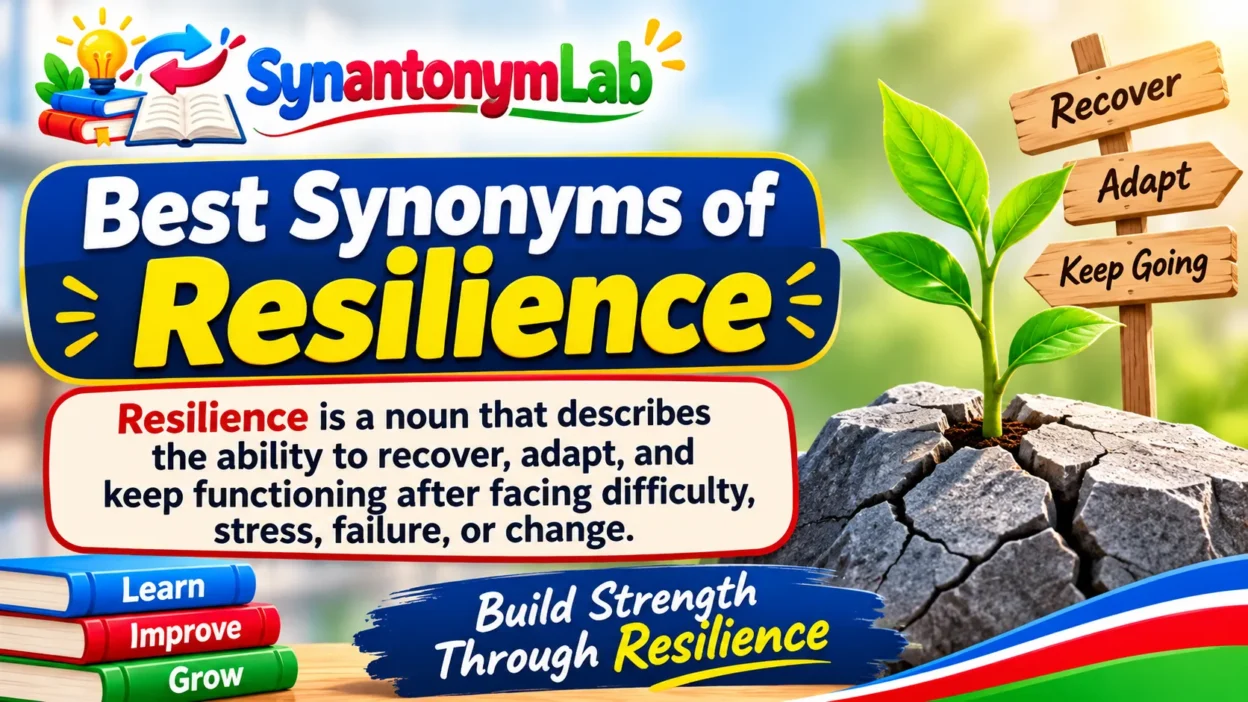
Resilience is a noun that describes the ability to recover, adapt, and keep functioning after facing difficulty, stress, failure, or change.
A resilient person does not necessarily avoid problems or remain happy all the time. Instead, they find ways to deal with challenges, learn from difficult experiences, and regain their balance.
For example:
- After losing her job, she showed resilience by developing new skills and finding another opportunity.
- The community demonstrated resilience after the severe storm.
- Resilience helps students manage academic pressure and learn from mistakes.
The word has a positive and encouraging tone. It is common in psychology, education, business, leadership, health discussions, and everyday communication.
Part of speech: Noun.
Related adjective: Resilient.
Related adverb: Resiliently.
Resilience can describe people, communities, organizations, systems, and even materials. However, its meaning changes slightly depending on the subject. For a person, it often refers to emotional or mental recovery. For a business, it may describe the ability to continue operating during difficult conditions.
One important distinction is that resilience does not mean never feeling upset, weak, or discouraged. It means having the capacity to respond to challenges and move forward.
24 Best Synonyms for “Resilience”
The following words are useful alternatives, but they do not all have exactly the same meaning. Some emphasize recovery, while others highlight courage, endurance, or the ability to continue despite difficulties.
1. Perseverance
Meaning: The ability to continue working toward a goal despite difficulties, delays, or setbacks.
Tone: Formal / Academic.
Example: Her perseverance helped her complete her degree despite many challenges.
Difference: Perseverance focuses on continued effort. Resilience can also include recovering and adapting after hardship.
2. Endurance
Meaning: The ability to withstand physical or mental difficulty over an extended period.
Tone: Formal / Academic.
Example: The long journey tested the endurance of every team member.
Difference: Endurance emphasizes lasting through hardship, while resilience also involves recovery.
3. Fortitude
Meaning: Mental and emotional strength when facing pain, pressure, or serious difficulties.
Tone: Formal / Literary.
Example: He faced the difficult situation with remarkable fortitude.
Difference: Fortitude highlights courage and inner strength rather than the process of bouncing back.
4. Toughness
Meaning: The ability to handle difficult situations without giving up easily.
Tone: Informal / Casual.
Example: The young athlete showed great toughness after her injury.
Difference: Toughness often suggests strength and resistance. It can sound more forceful or less emotionally sensitive than resilience.
5. Adaptability
Meaning: The ability to adjust to new conditions, changes, or unexpected situations.
Tone: Formal / Academic.
Example: Adaptability helped the company respond to changing customer needs.
Difference: Adaptability focuses on adjustment, while resilience includes recovering from setbacks as well.
6. Tenacity
Meaning: Strong determination to continue pursuing something despite obstacles.
Tone: Formal.
Example: Her tenacity helped her overcome repeated failures.
Difference: Tenacity emphasizes persistence and determination rather than emotional recovery.
7. Grit
Meaning: A combination of determination, persistence, and commitment when pursuing long-term goals.
Tone: Informal / Academic.
Example: His grit helped him continue training after several disappointing results.
Difference: Grit is especially useful when discussing long-term effort and determination.
8. Strength
Meaning: The ability to deal with difficult experiences or challenging situations.
Tone: Neutral / Casual.
Example: She found the strength to rebuild her life after the loss.
Difference: Strength is broader than resilience. It may refer to physical, emotional, or mental ability.
9. Hardiness
Meaning: The ability to remain strong and cope with stressful or demanding conditions.
Tone: Formal / Academic.
Example: The harsh environment required considerable mental hardiness.
Difference: Hardiness emphasizes the capacity to withstand stress. It is often used in discussions of personality and coping.
10. Robustness
Meaning: The ability of a person, system, or organization to withstand pressure or difficult conditions.
Tone: Formal / Technical.
Example: The robustness of the system allowed it to continue working during the disruption.
Difference: Robustness is especially suitable for technology, systems, organizations, and processes.
11. Resistance
Meaning: The ability or action of opposing, withstanding, or refusing to be affected by something.
Tone: Formal / Neutral.
Example: The organization showed resistance to external pressure.
Difference: Resistance focuses on withstanding or opposing something. It does not always include recovery.
12. Staying Power
Meaning: The ability to continue for a long time despite challenges or competition.
Tone: Informal / Casual.
Example: The small business proved it had the staying power to survive difficult years.
Difference: This expression emphasizes lasting ability rather than emotional recovery.
13. Recovery
Meaning: The process of returning to a normal or improved condition after difficulty, illness, or failure.
Tone: Neutral / Formal.
Example: Her recovery after the accident took several months.
Difference: Recovery describes the process or result of bouncing back, while resilience describes the ability to do so.
14. Elasticity
Meaning: The ability to return to an earlier shape or condition after being stretched or changed.
Tone: Technical / Formal.
Example: The material’s elasticity allowed it to return to its original shape.
Difference: Elasticity is most suitable for physical materials and certain economic or technical contexts. It is not usually a direct replacement when discussing human emotions.
15. Buoyancy
Meaning: The ability to remain hopeful, positive, or cheerful during difficult circumstances.
Tone: Literary / Formal.
Example: Her natural buoyancy helped lift the team’s spirits during a difficult period.
Difference: Buoyancy focuses on optimism and a positive attitude rather than the broader ability to recover.
16. Persistence
Meaning: The ability to continue doing something despite obstacles or repeated difficulties.
Tone: Neutral / Academic.
Example: His persistence helped him improve his writing skills.
Difference: Persistence focuses on continuing an effort, while resilience also includes adjusting and recovering.
17. Resolve
Meaning: Firm determination to deal with a challenge or achieve a particular goal.
Tone: Formal.
Example: She showed strong resolve when facing the unexpected challenge.
Difference: Resolve describes a determined attitude rather than the full ability to recover from hardship.
18. Self-Reliance
Meaning: The ability to depend on your own judgment, skills, and resources.
Tone: Formal / Neutral.
Example: Years of experience developed her self-reliance.
Difference: Self-reliance focuses on independence. A person can be resilient while still depending on other people for support.
19. Resourcefulness
Meaning: The ability to find practical solutions when facing difficult situations or limited resources.
Tone: Formal / Neutral.
Example: His resourcefulness helped the team solve the problem with limited equipment.
Difference: Resourcefulness emphasizes creative problem-solving, which can support resilience but is not identical to it.
20. Emotional Strength
Meaning: The ability to manage difficult feelings and respond to emotional challenges.
Tone: Neutral / Casual.
Example: She showed emotional strength while dealing with a painful experience.
Difference: This expression focuses specifically on emotional challenges rather than every type of hardship.
21. Mental Strength
Meaning: The ability to manage pressure, remain focused, and face challenging situations.
Tone: Neutral / Formal.
Example: Mental strength helped him stay calm during the competition.
Difference: Mental strength emphasizes psychological control and focus. Resilience also involves recovery and adjustment.
22. Indomitability
Meaning: The quality of being extremely difficult to defeat, discourage, or overcome.
Tone: Formal / Literary.
Example: The team’s indomitability became clear when they continued competing after several losses.
Difference: Indomitability is much stronger than ordinary resilience and may sound dramatic in everyday writing.
23. Stamina
Meaning: The physical or mental energy needed to continue an activity over time.
Tone: Neutral / Casual.
Example: The demanding project required patience and stamina.
Difference: Stamina focuses on sustained energy. It does not necessarily suggest the ability to recover after a setback.
24. Unshakability
Meaning: The quality of remaining firm, steady, or confident despite pressure or difficulty.
Tone: Formal / Literary.
Example: Her unshakability gave the team confidence during the crisis.
Difference: Unshakability highlights steadiness under pressure rather than the ability to adapt or recover.
Stronger Alternatives
Sometimes, resilience is not strong enough to express the level of determination or courage someone demonstrates. In these situations, stronger words can make your writing more powerful.
Here are seven useful alternatives:
1. Indomitable Spirit
Meaning: A powerful determination that cannot easily be defeated.
Example: Her indomitable spirit helped her face years of hardship.
When to use it: Use this expression when describing exceptional courage and determination.
2. Unbreakable Strength
Meaning: A powerful ability to remain strong during serious difficulties.
Example: His unbreakable strength inspired everyone around him.
When to use it: Suitable for motivational writing and personal stories. It is an expressive phrase rather than a precise technical term.
3. Exceptional Fortitude
Meaning: Remarkable mental and emotional strength during painful experiences.
Example: The family showed exceptional fortitude during the crisis.
When to use it: Best for formal writing and serious situations.
4. Unwavering Determination
Meaning: Firm commitment that does not easily change because of difficulties.
Example: Her unwavering determination helped her reach her goal.
When to use it: Use it when the main focus is commitment and persistence.
5. Invincibility
Meaning: The quality of seeming impossible to defeat.
Example: The team’s confidence created a feeling of invincibility.
When to use it: This is a very strong word. It can sound exaggerated when describing ordinary human coping skills.
6. Iron Will
Meaning: Extremely strong determination that is difficult to weaken.
Example: He relied on his iron will to complete the demanding training program.
When to use it: Suitable for describing intense discipline and determination.
7. Extraordinary Hardiness
Meaning: An exceptional ability to withstand demanding or stressful conditions.
Example: The workers demonstrated extraordinary hardiness during the difficult project.
When to use it: Appropriate for formal discussions of endurance and the ability to handle pressure.
Softer or Polite Alternatives
In some situations, the word resilience may sound too strong or dramatic. A softer expression can communicate the same general idea without overstating someone’s experience.
These alternatives are especially useful in personal conversations, professional communication, and supportive writing.
1. Inner Strength
Meaning: Personal strength that helps someone deal with difficult experiences.
Example: She used her inner strength to get through a challenging period.
When to use it: A warm and encouraging expression for personal situations.
2. Ability to Adapt
Meaning: The capacity to adjust when circumstances change.
Example: His ability to adapt helped him settle into his new workplace.
When to use it: Suitable for workplace discussions and everyday communication.
3. Steadiness
Meaning: The ability to remain calm and consistent during difficult situations.
Example: Her steadiness helped the group remain focused.
When to use it: Use this when calm behavior matters more than recovery.
4. Coping Ability
Meaning: The ability to manage stressful experiences or difficult circumstances.
Example: Good coping ability can help students manage exam pressure.
When to use it: Particularly useful in educational and psychological discussions.
5. Flexibility
Meaning: The willingness and ability to adjust to different situations.
Example: Flexibility allowed the team to handle unexpected changes.
When to use it: Best when discussing adjustment rather than recovery.
6. Calmness
Meaning: The ability to remain peaceful and controlled during pressure.
Example: Her calmness helped everyone respond to the emergency.
When to use it: Suitable when describing someone’s reaction to a difficult moment.
7. Positive Attitude
Meaning: A hopeful way of thinking when facing problems.
Example: His positive attitude helped him stay motivated after the setback.
When to use it: Appropriate for friendly, motivational, and everyday communication.
Academic & IELTS-Friendly Alternatives
In academic essays and IELTS writing, vocabulary should be precise and natural. Using a complicated word does not automatically improve your writing. The best choice is the one that communicates your meaning clearly.
The following alternatives are useful in formal discussions about education, psychology, business, society, and personal development.
| Word | Meaning and suitable context |
|---|---|
| Perseverance | Continuing to work toward a goal despite difficulties. |
| Adaptability | Adjusting effectively to changing circumstances. |
| Fortitude | Mental and emotional strength during hardship. |
| Endurance | Withstanding difficulty over an extended period. |
| Tenacity | Maintaining determination despite obstacles. |
| Hardiness | Withstanding stressful or demanding conditions. |
| Persistence | Continuing an effort despite challenges. |
| Robustness | Withstanding pressure or disruption, especially in systems. |
| Resourcefulness | Finding practical solutions to difficult problems. |
| Recovery | Returning to a better condition after a setback. |
| Coping capacity | The ability to manage stressful experiences. |
| Psychological strength | Mental resources that help someone handle challenges. |
Examples for academic writing:
- Education can develop students’ adaptability and problem-solving skills.
- Perseverance plays an important role in achieving long-term academic goals.
- Community recovery often depends on cooperation and available resources.
- Psychological strength can help individuals manage stressful situations.
- Organizational robustness allows businesses to respond to unexpected disruptions.
IELTS writing tip: Avoid replacing resilience with the same advanced word throughout an essay. For example, use adaptability when discussing change, endurance when discussing prolonged hardship, and recovery when discussing improvement after a setback.
This makes your writing more accurate and shows a better understanding of vocabulary.
Synonyms You Should Avoid
Some words seem similar to resilience but communicate different ideas. They may work in certain sentences, but they should not be treated as direct replacements in every situation.
Here are five examples worth understanding.
1. Happiness
Happiness describes a positive emotional state. Resilience describes the ability to manage and recover from difficulties.
Awkward: Her happiness helped her recover from every setback.
Better: Her resilience helped her recover from every setback.
Happiness may support a positive outlook, but it does not automatically mean someone can handle hardship.
2. Confidence
Confidence means believing in your own abilities or decisions.
Awkward: His confidence helped him recover from every personal setback.
Better: His resilience helped him recover from every personal setback.
Confidence may contribute to resilience, but the two words have different meanings.
3. Aggression
Aggression refers to hostile, forceful, or attacking behavior.
Awkward: Her aggression helped her manage difficult experiences.
Better: Her mental strength helped her manage difficult experiences.
Aggression can be useful when describing forceful behavior, but it does not communicate healthy coping or recovery.
4. Stubbornness
Stubbornness describes an unwillingness to change an opinion or behavior.
Awkward: His stubbornness helped him adapt to every new situation.
Better: His adaptability helped him adjust to changing circumstances.
Resilience often requires flexibility, while stubbornness can sometimes prevent change.
5. Optimism
Optimism means expecting or believing that positive things may happen.
Awkward: The company’s optimism allowed it to recover from the financial crisis.
Better: The company’s resilience allowed it to recover from the financial crisis.
Optimism can encourage people during difficult times, but it does not necessarily mean they can overcome challenges.
How to Choose the Right Synonym in Writing
Choosing an alternative depends on what you want to communicate. Although many words are related to resilience, each one highlights a different quality.
Here are seven practical points to consider.
1. Understand the Context
First, identify the situation you are describing.
If you are discussing someone who continues working toward a goal, perseverance may be appropriate.
If you are discussing someone who adjusts to unexpected changes, adaptability is a better choice.
For example:
- The student’s perseverance helped her complete the course.
- The student’s adaptability helped her adjust to online learning.
Both sentences describe useful qualities, but they focus on different abilities.
2. Consider the Tone
Your word choice should match the feeling of your sentence.
- Formal: Fortitude, hardiness, robustness.
- Casual: Toughness, grit, staying power.
- Motivational: Inner strength, indomitable spirit.
- Academic: Adaptability, perseverance, endurance.
For example, grit may sound natural in a motivational speech, while psychological strength may be more suitable in an academic discussion.
3. Think About Your Audience
Consider who will read your writing.
For students, simple expressions such as inner strength and ability to adapt are easy to understand.
For professional readers, adaptability, robustness, and recovery may be more appropriate.
For everyday conversations, toughness and staying power can sound natural.
4. Match the Level of Strength
Some words communicate ordinary determination, while others suggest exceptional courage.
For example:
- Persistence suggests continued effort.
- Fortitude suggests strength during serious difficulty.
- Indomitability suggests an almost unbeatable spirit.
Avoid using extremely powerful expressions when a simple alternative communicates your meaning better.
5. Check the Grammar
Resilience is a noun, so its replacement should usually perform the same grammatical role.
For example:
- Her resilience impressed the teacher.
- Her perseverance impressed the teacher.
Both sentences are grammatically correct.
However, resilient is an adjective, while resilience is a noun.
Correct:
- She showed resilience.
- She was resilient.
Incorrect:
– She showed resilient.
Always check the part of speech before replacing a word.
6. Consider Formality
Some expressions work better in professional documents than in casual conversations.
For example:
- Casual: He has a lot of grit.
- Formal: He demonstrated considerable perseverance.
Both sentences are useful, but their styles are different.
7. Choose Clarity Over Complexity
Do not select a difficult word simply because it sounds impressive.
For example, adaptability may be clearer than indomitability when discussing an employee who adjusts to new responsibilities.
A good synonym makes your meaning easier to understand, not harder.
Example Paragraph Rewritten Using Synonyms
The following example shows how different alternatives can improve vocabulary while keeping the original meaning clear.
Original paragraph:
Resilience is important because people face many challenges throughout life. It helps individuals recover from difficult situations, adjust to changes, and continue working toward their goals. People who develop resilience can handle pressure and learn from their experiences.
Rewritten paragraph:
Mental strength is valuable because people encounter many challenges throughout life. It helps individuals recover from setbacks, demonstrate adaptability when circumstances change, and maintain perseverance while working toward their goals. People with strong coping abilities can manage pressure and learn from difficult experiences.
Why these alternatives work:
- Mental strength emphasizes the psychological side of resilience.
- Recovery describes returning to a better condition after difficulty.
- Adaptability highlights the ability to adjust to change.
- Perseverance focuses on continuing despite obstacles.
- Coping abilities describe managing stressful situations.
The rewritten paragraph avoids unnecessary repetition and gives each expression a clear purpose.
FAQs
1. What are the best synonyms of resilience?
Some useful alternatives include perseverance, endurance, fortitude, adaptability, toughness, tenacity, hardiness, and persistence. The best choice depends on whether you mean recovery, determination, or the ability to withstand hardship.
2. What is another word for resilience in a person?
Inner strength, emotional strength, fortitude, mental strength, and hardiness are useful expressions when describing a person’s ability to manage difficult experiences.
3. What is a stronger word for resilience?
Fortitude, indomitability, hardiness, and an indomitable spirit can express stronger forms of mental or emotional strength. Their meanings are slightly different, so choose according to context.
4. What is a simple word for resilience?
Strength, toughness, and the ability to bounce back are simple ways to communicate the general idea of resilience.
5. What is the difference between resilience and perseverance?
Resilience involves recovering and adapting after difficult experiences. Perseverance focuses on continuing an effort despite obstacles. A person can demonstrate both qualities at the same time.
6. What is the opposite of resilience?
Fragility, vulnerability, and susceptibility can express ideas opposite to resilience in certain contexts. However, the best antonym depends on the situation. For example, fragility describes a lack of resistance, while vulnerability describes being open to harm.
7. How can I use resilience in an academic essay?
Use resilience when discussing the ability of people, communities, or organizations to recover and adapt after challenges. You can also use related terms such as adaptability, perseverance, and psychological strength when they express your intended meaning more accurately.
Conclusion
Resilience is a valuable word for describing the ability to face challenges, recover from setbacks, and adapt to difficult circumstances.
However, choosing different vocabulary can make your writing more precise and interesting.
Words such as perseverance, fortitude, endurance, and adaptability are useful alternatives, but each emphasizes a different quality. Some describe determination, while others focus on recovery, mental strength, or adjustment to change.
For everyday writing, simple expressions such as inner strength and toughness can work well. For academic and professional writing, adaptability, hardiness, and perseverance may be more suitable.
The most important thing is to understand the meaning behind each word before using it. Choose vocabulary that fits your message, audience, and writing style.

Milo Carter is a passionate writer who loves exploring words, synonyms, and antonyms. Through SynantonymLab, he helps readers improve their English vocabulary and language skills.