The best way to find a synonym for neurodivergent is to consider what you want to say, who will read it, and how much detail the situation needs.
The word describes people whose brain development or functioning differs from what is considered typical.
It is often used when discussing autism, ADHD, dyslexia, and other forms of neurological difference.
However, not every alternative means exactly the same thing. Some words describe a broad range of differences, while others refer to a specific condition, a person’s identity, or the way they learn and process information.
Choosing the wrong term can change your meaning or make your writing sound less respectful.
This guide explores 25 synonyms and contextual alternatives for neurodivergent, with simple definitions, tone labels, and natural example sentences.
It also explains which terms work best in academic papers, professional documents, casual conversations, and IELTS-style writing.
You will learn how to distinguish close alternatives from related terms, choose respectful wording, and avoid expressions that may sound misleading or outdated.
Whether you are writing an essay, preparing a report, or looking for a more natural way to describe neurological differences, this guide will help you select words that fit your purpose.
What Does “Neurodivergent” Mean?
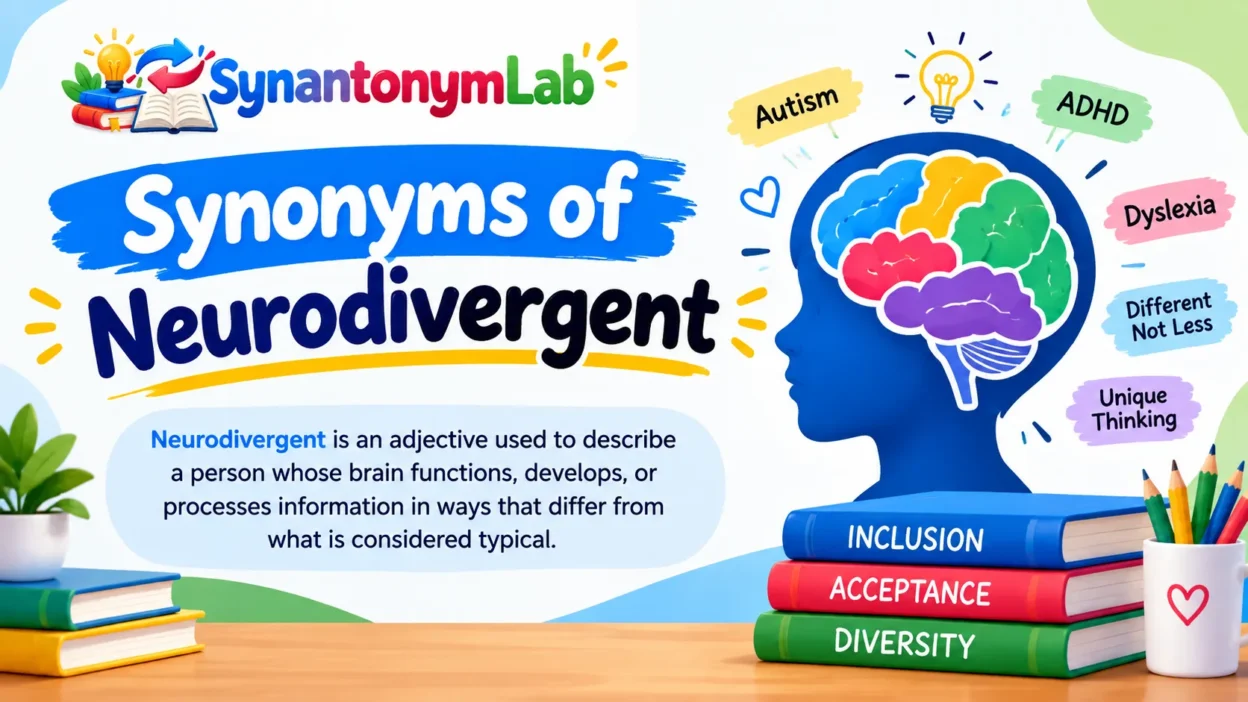
Neurodivergent is an adjective used to describe a person whose brain functions, develops, or processes information in ways that differ from what is considered typical.
It is commonly used in discussions about autism, attention-deficit/hyperactivity disorder (ADHD), dyslexia, and other neurological or developmental differences. The exact range of conditions covered can vary by person and context.
The word is linked to neurodiversity, which refers to the natural variation in how human brains work. Neurodiversity describes variation across people, while neurodivergent generally describes an individual whose neurological functioning differs from the typical pattern.
The term is often used in education, healthcare discussions, workplaces, advocacy, and everyday conversation. It can help people discuss differences without automatically describing them as defects or illnesses.
Grammatically, neurodivergent is an adjective.
- Correct: She is a neurodivergent student.
- Correct: The school supports neurodivergent learners.
- Less natural: She has neurodivergent.
The word is not a diagnosis on its own. It is also not a perfect synonym for a specific condition such as autism or ADHD. Some people prefer identity-first language, such as autistic person, while others prefer person-first language, such as person with autism. When possible, respect the language an individual uses for themselves.
25 Best Synonyms for “Neurodivergent”
There is no single word that replaces neurodivergent in every situation. The following 25 options include close alternatives, descriptive phrases, and related terms. Each entry explains where the wording fits and where its meaning differs.
1. Neurologically Different
Meaning: Describes a person whose brain functions or processes information disability from common patterns.
Tone: Neutral, descriptive.
Example: The program offers support for neurologically different learners.
Usage note: This is a plain-language alternative, but it is less established than neurodivergent and may sound broad or vague.
2. Neuroatypical
Meaning: Refers to a person whose neurological functioning differs from what is considered typical.
Tone: Academic, formal.
Example: The study explored the experiences of neuroatypical students.
Usage note: This is one of the closest alternatives, although it is less common. Some readers may find it unfamiliar.
3. Neurologically Diverse
Meaning: Describes neurological variation or, in some contexts, people with different neurological profiles.
Tone: Formal, inclusive.
Example: The university aims to create a welcoming space for neurologically diverse students.
Usage note: This phrase can describe a group with varied neurological profiles rather than one individual. Its meaning is not always identical to neurodivergent.
4. Neurodiverse
Meaning: Relates to differences in how brains function, especially within a group of people.
Tone: Academic, professional.
Example: The company wants to build a neurodiverse team.
Usage note: Neurodiverse is often used for groups, while neurodivergent commonly describes individuals. Some people use the words more broadly, but the distinction is useful in careful writing.
5. Neurodevelopmentally Different
Meaning: Describes differences associated with brain development and related functions.
Tone: Formal, clinical.
Example: The school provides tailored lessons for neurodevelopmentally different children.
Usage note: This term focuses on development. It may not cover every way someone identifies as neurodivergent.
6. Neurologically Atypical
Meaning: Describes neurological functioning that differs from what is considered typical.
Tone: Formal, academic.
Example: The report examined barriers faced by neurologically atypical adults.
Usage note: It is close in meaning to neuroatypical. However, atypical can sound clinical or imply deviation from a norm, so consider your audience.
7. Cognitively Different
Meaning: Describes differences in thinking, learning, memory, attention, or information processing.
Tone: Neutral, descriptive.
Example: The teacher adjusted the lesson for cognitively different learners.
Usage note: Cognition is only one part of neurological functioning. This phrase is useful when discussing thinking or learning, but it is not a complete substitute in every context.
8. Disability Wired
Meaning: An informal way to describe a brain that works disability from what is typical.
Tone: Casual, conversational.
Example: He says he is disability wired and prefers to solve problems visually.
Usage note: The phrase is easy to understand, but informal. Some people like its positive tone, while others prefer more precise language.
9. Neurodistinct
Meaning: Describes someone whose neurological traits differ from those of the broader population.
Tone: Neutral, contemporary.
Example: The group created resources for neurodistinct employees.
Usage note: This is a less widely recognized term. Define it if your audience may not know what it means.
10. Neurologically Non-Typical
Meaning: Describes a person whose neurological functioning does not follow common patterns.
Tone: Formal, descriptive.
Example: The service was designed to meet the needs of neurologically non-typical learners.
Usage note: It can work as a plain descriptive phrase, but it may sound less natural than neurodivergent.
11. Atypical Thinker
Meaning: Describes someone whose thinking style differs from common approaches.
Tone: Neutral, conversational.
Example: As an atypical thinker, she often finds unusual solutions to complex problems.
Usage note: This phrase focuses on thinking style rather than neurological status. Use it only when that narrower meaning fits.
12. Disability Abled
Meaning: A phrase intended to emphasize abilities rather than limitations.
Tone: Polite, but sometimes disputed.
Example: The organization reviews how it supports people with different access needs.
Usage note: disability abled is not a direct synonym for neurodivergent. It is also disliked by some disabled people because it can seem to avoid naming disability directly. A more precise term is often better.
13. Neurodivergent Individual
Meaning: Refers to one person whose neurological functioning differs from typical patterns.
Tone: Formal, professional.
Example: Each neurodivergent individual may have different learning needs.
Usage note: This is a variation of the original term, not a true synonym. It is useful when a document needs a formal noun phrase.
14. Person with Neurological Differences
Meaning: Describes someone whose neurological functioning differs from typical patterns.
Tone: Formal, person-first.
Example: The program offers flexible support for people with neurological differences.
Usage note: This wording may suit readers who prefer person-first language. It is broad and does not name any particular diagnosis.
15. Person with a Different Neurological Profile
Meaning: Refers to someone whose neurological traits or patterns differ from those commonly expected.
Tone: Professional, descriptive.
Example: The assessment considered each person with a different neurological profile.
Usage note: This phrase is useful in reports that focus on individual needs, but it is longer than neurodivergent.
16. Person with a Neurodevelopmental Condition
Meaning: Describes someone who has a condition related to brain development, such as autism or ADHD.
Tone: Clinical, formal.
Example: The clinic provides guidance for people with neurodevelopmental conditions.
Usage note: This phrase is more specific and medical in tone. It does not cover every person who identifies as neurodivergent, and some people may not view their differences as a condition.
17. Person with a Learning Difference
Meaning: Describes someone whose learning style or learning needs differ from common expectations.
Tone: Educational, supportive.
Example: The teacher offered extra time to a person with a learning difference.
Usage note: This works when the focus is learning. It is too narrow when the discussion concerns other aspects of neurological functioning.
18. Person with Cognitive Differences
Meaning: Refers to someone whose thinking or information-processing patterns differ from those of others.
Tone: Formal, descriptive.
Example: The training materials were adapted for people with cognitive differences.
Usage note: This phrase emphasizes cognition, not every aspect of neurodivergence. Use it when thinking or processing is central to the discussion.
19. Non-Neurotypical
Meaning: Describes a person who does not fit the usual pattern of neurological functioning.
Tone: Neutral, community-oriented.
Example: The event was designed to welcome neurotypical and non-neurotypical guests.
Usage note: This is a close alternative, particularly in discussions that contrast neurotypical and neurodivergent experiences. It can sound negative if the surrounding text treats typical functioning as superior.
20. Autistic
Meaning: Describes a person who is autistic.
Tone: Neutral, identity-based.
Example: The autistic student asked for written instructions before starting the task.
Usage note: Autism is one form of neurodivergence, not a replacement for the broader term. Do not use autistic unless it accurately describes the person.
21. ADHD
Meaning: Names attention-deficit/hyperactivity disorder, a specific neurodevelopmental condition.
Tone: Clinical, everyday.
Example: The employee with ADHD requested a quieter space for focused work.
Usage note: ADHD is not a synonym for neurodivergent. It is appropriate only when the specific condition is known and relevant.
22. Dyslexic
Meaning: Describes a person who has dyslexia, which can affect reading and spelling.
Tone: Neutral, educational.
Example: The dyslexic learner used text-to-speech software to review the lesson.
Usage note: Dyslexia is one possible form of neurodivergence. The term should not be used for someone simply because they read slowly or make spelling errors.
23. Neurodevelopmentally Diverse
Meaning: Describes variation in neurodevelopment, often across a group.
Tone: Academic, professional.
Example: The project explored how neurodevelopmentally diverse students experience higher education.
Usage note: This phrase is useful when discussing developmental variation. It may sound less direct than neurodivergent and is not always an individual-level synonym.
24. Cognitively Atypical
Meaning: Describes thinking or cognitive patterns that differ from what is considered typical.
Tone: Academic, clinical.
Example: The researcher considered how cognitively atypical participants approached the task.
Usage note: This is a narrower and more clinical phrase. It should not be used to suggest that a person’s intelligence is lower.
25. Neurodivergent Person
Meaning: Refers to a person whose neurological functioning differs from typical patterns.
Tone: Neutral, inclusive.
Example: The manager asked each neurodivergent person what workplace adjustments would help.
Usage note: Like neurodivergent individual, this is a grammatical variation rather than a true synonym. It is often a natural choice when referring to people directly.
Which alternatives are the closest matches?
For most writing, these options are worth considering first:
- Neuroatypical: A close alternative that may suit formal writing.
- Neurologically atypical: A descriptive option for professional or academic contexts.
- Non-neurotypical: Useful when contrasting neurological experiences.
- disability wired: A casual option for conversation.
- Neurologically different: A plain-language description.
- Person with neurological differences: An option for person-first wording.
Remember that many of the 25 options are contextual alternatives, not exact synonyms. If precision matters, neurodivergent may remain the clearest choice.
Stronger Alternatives
There is no simple scale of intensity for neurodivergent. Stronger wording often comes from naming a specific condition or describing a particular support need. These six options can be useful when the context calls for more detail.
1. Autistic
Names a specific neurodevelopmental identity. Use it when autism is known and relevant, not as a general label for all neurodivergent people.
2. Has ADHD
Names a specific condition and is often suitable for clinical or personal contexts. It is more precise than neurodivergent when ADHD is the subject.
3. Has a neurodevelopmental condition
Uses explicit, medical-style language. It may fit a healthcare report, but it can sound too clinical for a casual conversation.
4. Has significant support needs
Emphasizes the level of support a person may require. It does not describe neurodivergence itself, and support needs vary from person to person.
5. Experiences substantial processing differences
Highlights noticeable differences in how a person handles information. Use it only when those differences are relevant and supported by the context.
6. Has a diagnosed neurodevelopmental disorder
Names a formal diagnostic status rather than a broad identity. It is appropriate only when a diagnosis is established and the information is relevant.
Important: These expressions are not stronger synonyms in every case. They are more specific, clinical, or focused on support needs. Avoid using intense language merely to make a description sound more serious.
Softer or Polite Alternatives
Sometimes, you may want wording that feels gentle, clear, and respectful. The best choice depends on the person, the setting, and the point you want to make.
1. A Person Who Thinks Differently
This phrase focuses on thinking style rather than a label.
Example: She is a person who thinks differently and enjoys exploring new ideas.
Best for: Casual conversation and general descriptions.
Difference: It may sound positive, but it does not necessarily refer to neurodivergence.
2. Someone with Different Learning Needs
This wording focuses on the support a person may need to learn well.
Example: The teacher made changes for students with different learning needs.
Best for: Schools, training programs, and education reports.
Difference: Not every neurodivergent person has the same learning needs.
3. A Person with a Unique Learning Style
This phrase highlights an individual’s approach to learning.
Example: The tutor used visual tools to support a person with a unique learning style.
Best for: Friendly, education-focused writing.
Difference: A learning style alone does not establish that someone is neurodivergent.
4. A Person with Individual Support Needs
This wording emphasizes the help that may benefit a particular person.
Example: The workplace reviewed the individual support needs of every employee.
Best for: Workplace policies, education, and support planning.
Difference: It is broad and does not identify a neurological difference.
5. A Person with a Different Way of Processing Information
This phrase describes how someone takes in, understands, or responds to information.
Example: Written instructions helped the person who processes information differently.
Best for: Explanations of learning, communication, and work habits.
Difference: It is descriptive rather than a recognized identity label.
6. A Person with a Different Cognitive Profile
This wording focuses on a person’s pattern of cognitive strengths and differences.
Example: The assessment considered the person’s different cognitive profile.
Best for: Professional reports and educational discussions.
Difference: It is more technical and does not capture every aspect of neurodivergence.
7. A Person with Neurological Differences
This is a broad, person-first way to discuss neurological variation.
Example: The service aims to welcome people with neurological differences.
Best for: Professional communication, public information, and general writing.
Difference: It may sound more formal than neurodivergent person, but it does not imply that every person prefers person-first wording.
A useful rule: Polite language is not always vague language. When a person has shared their preferred term, use it. If you do not know their preference, choose clear, respectful wording and avoid making assumptions about their abilities or needs.
Academic & IELTS-Friendly Alternatives
In academic writing and IELTS essays, accuracy matters more than using advanced-sounding words. A precise phrase is usually better than an unfamiliar term that changes the meaning.
The following 10 options can help when discussing neurological differences, education, inclusion, or individual needs.
1. Neuroatypical
A relatively close alternative to neurodivergent.
Example: The research examined the experiences of neuroatypical students in higher education.
Use when: A concise adjective is needed in a formal discussion. Consider defining the term for readers unfamiliar with it.
2. Neurologically atypical
Describes neurological functioning that differs from typical patterns.
Example: Neurologically atypical learners may benefit from flexible teaching methods.
Use when: You need a formal, descriptive phrase. Be careful not to imply that typical functioning is inherently better.
3. Neurodevelopmentally different
Focuses on differences in neurological development.
Example: Schools should consider the needs of neurodevelopmentally different pupils.
Use when: The discussion concerns development or educational support. It may be narrower than the main term.
4. Cognitively different
Focuses on differences in thinking and information processing.
Example: The study considered how cognitively different participants approached complex tasks.
Use when: The relevant issue is cognition, not neurological identity as a whole.
5. Neurologically diverse
Describes neurological variation and may be useful when discussing a population or group.
Example: A neurologically diverse student population may require flexible learning options.
Use when: Writing about inclusion and variation across a group. Check whether the sentence refers to an individual or a group.
6. Non-neurotypical
Refers to someone who does not fit typical neurological patterns.
Example: The researchers consulted non-neurotypical participants during the design process.
Use when: Contrasting different neurological experiences. Define the term if needed.
7. Individuals with neurological differences
A formal, person-first phrase for people whose neurological functioning differs.
Example: The policy aims to improve access for individuals with neurological differences.
Use when: Writing a policy, report, or research summary. It is longer but can be clear for a broad audience.
8. People with neurodevelopmental conditions
Refers to people with relevant conditions, such as autism or ADHD.
Example: The study explored access to support for people with neurodevelopmental conditions.
Use when: The subject is specifically about conditions or clinical services. Do not assume it covers everyone who identifies as neurodivergent.
9. People with diverse cognitive profiles
Emphasizes variation in cognitive traits and abilities.
Example: The course was designed for people with diverse cognitive profiles.
Use when: Discussing differences in cognition, learning, or problem-solving. This phrase does not automatically imply neurodivergence.
10. Individuals with varied learning needs
Focuses on differences in the support people need to learn.
Example: Effective teaching should accommodate individuals with varied learning needs.
Use when: Writing about education and access to learning. It is not a direct synonym for neurological difference.
How should you use these alternatives in IELTS writing?
Do not replace neurodivergent with an academic alternative simply to make an essay sound more advanced.
For example:
- Less precise: Neurologically atypical people always need special teaching methods.
- More precise: Some neurodivergent students benefit from teaching methods tailored to their individual needs.
The second sentence avoids a sweeping claim and recognizes that support needs differ between people.
For IELTS, strong vocabulary means choosing the right words, not the longest words. Clear meaning, correct grammar, and relevant examples are more valuable than unnecessary complexity.
Synonyms You Should Avoid
Some words may appear similar to neurodivergent, but using them carelessly can change your meaning or create an unfair impression.
1. Mentally Ill
Why to avoid it: This phrase refers to mental health conditions, not neurodivergence as a whole.
When it may fit: When discussing a relevant mental health condition accurately and respectfully.
Better choice: Neurodivergent when that is the intended meaning.
2. Disabled
Why to avoid it: Disability and neurodivergence can overlap, but they are not identical. Not every neurodivergent person identifies as disabled, and not every disabled person is neurodivergent.
When it may fit: When a person identifies as disabled or the discussion concerns disability and access.
Better choice: Use the term that matches the person’s identity and the point being discussed.
3. Gifted
Why to avoid it: Giftedness generally refers to unusually strong ability in one or more areas. It is not a synonym for neurodivergence.
When it may fit: When discussing exceptional ability or educational programs for gifted learners.
Better choice: Describe a person’s specific strengths when that is what you mean.
4. Genius
Why to avoid it: This word suggests exceptional intellectual ability. Neurodivergence does not automatically mean someone has extraordinary intelligence.
When it may fit: When describing an exceptional achievement or ability supported by context.
Better choice: Neurodivergent or a more specific description of the person’s skills.
5. Abnormal
Why to avoid it: This word can sound judgmental and frame neurological differences as defects. It is usually unsuitable as a casual label for a person.
When it may fit: In a specific technical context where a clearly defined measurement or finding is being discussed, rather than as a broad judgment about a person.
Better choice: Neurologically different or neurodivergent, depending on the context.
The key lesson is simple: related words are not automatically interchangeable. Choose language that describes the person or situation accurately without adding assumptions.
How to Choose the Right Synonym in Writing
The best alternative depends on what you want readers to understand. Use these six checks before choosing a word.
1. Consider the context
Ask what your sentence is about. If you are discussing neurological identity, neurodivergent may be the clearest option. If you are discussing reading support, students with different learning needs may be more useful.
2. Match the tone
Casual conversations allow phrases such as differently wired. Academic papers may call for neurologically atypical or a carefully defined technical term.
Do not use clinical wording in a friendly message unless it serves a clear purpose.
3. Think about your audience
A general audience may understand people with neurological differences more easily than neuroatypical individuals. A specialist audience may be familiar with both.
When a term may be unfamiliar, explain it briefly the first time you use it.
4. Keep the meaning clear
Do not use autistic when you mean neurodivergent in general. Autism is one form of neurodivergence, not a label for everyone in that group.
Likewise, cognitively different is best when the discussion specifically concerns thinking or information processing.
5. Check the level of formality
| Setting | Possible wording |
|---|---|
| Casual conversation | Differently wired |
| School newsletter | Neurodivergent students |
| Academic paper | Neuroatypical participants, if appropriate |
| Workplace policy | Employees with different neurological profiles |
| Clinical report | A specific, accurate diagnostic term when relevant |
These are examples, not fixed rules. Follow the terminology preferred by the people involved.
6. Check grammar and sentence flow
A synonym must fit the sentence naturally.
- Correct: The school supports neurodivergent learners.
- Correct: The school supports learners with different neurological profiles.
- Awkward: The school supports learners neurodivergent.
The last sentence needs a grammatical change. Replacing a word is not enough; sometimes you must rewrite the sentence around it.
Example Paragraph Rewritten Using Synonyms
Consider this original paragraph:
Original paragraph
Neurodivergent students may learn in different ways. Some may benefit from written instructions, while others may prefer visual tools or extra time to complete a task. Teachers can help by listening to students and offering flexible ways to learn.
Here are three ways to adapt the paragraph for different audiences.
Version 1: Simple and conversational
Students who think and learn differently may benefit from different types of support. Some may prefer written instructions, while others may learn better with pictures or extra time. Teachers can help by listening and offering flexible ways to learn.
Why it works: The wording is easy to understand and focuses on practical learning needs. However, think and learn differently is broader and less precise than neurodivergent.
Version 2: Formal and professional
Students with different neurological profiles may benefit from tailored learning support. Some may respond well to written instructions, while others may prefer visual tools or additional time. Teachers can support them by listening to their needs and offering flexible learning options.
Why it works: The wording suits a school report or professional document. It emphasizes individual needs without assuming every student requires the same support.
Version 3: Academic
Neuroatypical students may benefit from flexible teaching approaches. Depending on their individual needs, some may prefer written instructions, while others may find visual resources or additional time helpful. Teachers can promote access to learning by considering these differences.
Why it works: The tone is more formal and suitable for an academic discussion. However, neuroatypical may be less familiar to some readers, so retaining neurodivergent may be preferable.
What to remember: Good writing does not require replacing every repeated word. Sometimes the clearest improvement is to describe the person’s needs, the situation, or the support being discussed.
FAQs
1. What is the closest synonym for neurodivergent?
Neuroatypical and neurologically atypical are among the closest alternatives. Both describe neurological functioning that differs from typical patterns. However, neurodivergent is often the more familiar and direct choice.
2. What is another word for neurodivergent in simple English?
Neurologically different is a straightforward alternative. Differently wired is another option in casual conversation. Both are descriptive phrases rather than exact equivalents in every context.
3. Is neurodiverse the same as neurodivergent?
Not always. Neurodivergent commonly describes an individual, while neurodiverse often describes a group with different neurological profiles. The terms are sometimes used more broadly, but this distinction helps maintain precision.
4. What is a more polite word for neurodivergent?
There is no universally more polite replacement. Person with neurological differences may suit someone who prefers person-first language, while others prefer neurodivergent person. When possible, use the individual’s preferred wording.
5. Can I use neurodivergent in academic writing?
Yes. The term can be appropriate in academic writing about education, cognition, accessibility, and neurological differences. Explain the term if necessary and use more specific terminology when the research concerns a particular condition.
6. Is neurodivergent the same as autistic?
No. Autism is one form of neurodivergence, but neurodivergence is a broader term. A person may be neurodivergent for reasons other than autism, so the words should not be used interchangeably.
7. What is the opposite of neurodivergent?
Neurotypical is the common contrasting term. It describes neurological functioning that fits what is generally considered typical. It does not mean that a person is more intelligent, healthier, or better than someone who is neurodivergent.
Conclusion
Choosing the right synonym for neurodivergent means understanding both the word and the situation in which you plan to use it.
Neuroatypical, neurologically different, and non-neurotypical can work in certain contexts, while phrases such as different learning needs are better suited to specific discussions about education and support.
Remember that related terms do not always carry the same meaning.
A clinical label, a description of learning needs, and a person’s preferred identity term each serve a different purpose.
For clear, respectful writing, choose the most accurate term for your audience and context.
If neurodivergent already expresses your meaning well, there is no need to replace it simply to add variety.

Milo Carter is a passionate writer who loves exploring words, synonyms, and antonyms. Through SynantonymLab, he helps readers improve their English vocabulary and language skills.