Finding the right word for anger can make your writing clearer, more natural, and more powerful. Sometimes, angry describes a mild feeling of annoyance.
At other times, it expresses deep frustration, strong resentment, or intense rage.
Choosing a suitable alternative helps readers understand exactly how a person feels and why.
The best synonyms for angry depend on the situation. In a casual conversation, you might say someone is upset or annoyed.
In an academic essay, frustrated or resentful may express the idea more clearly. In a story, words such as furious or irate can show that a character feels much stronger anger.
Using a variety of words also makes your writing less repetitive.
This is useful when writing school assignments, professional emails, IELTS essays, blog posts, stories, and everyday messages.
In this guide, you will learn 22 useful synonyms for angry, understand the differences between them, and discover when to use stronger, softer, and more formal alternatives.
You will also find natural example sentences, common word-choice mistakes, and practical tips to help you choose the right word for any situation.
What Does “Angry” Mean?
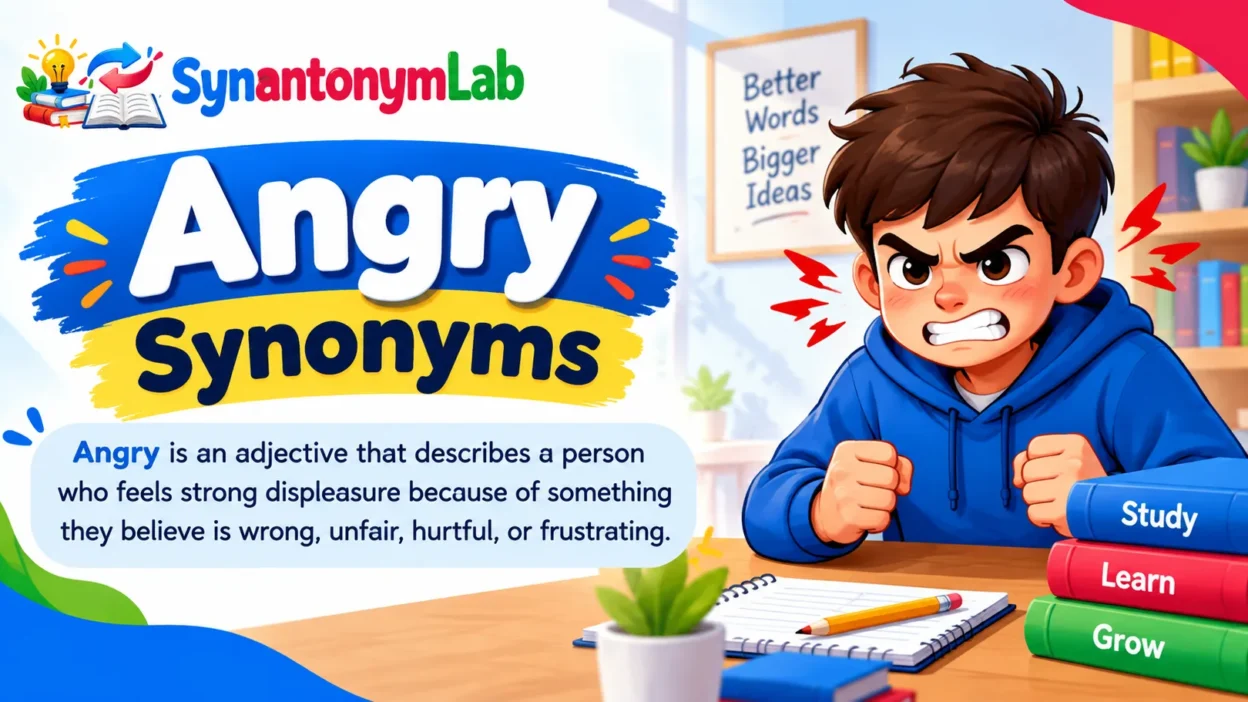
Angry is an adjective that describes a person who feels strong displeasure because of something they believe is wrong, unfair, hurtful, or frustrating.
Anger can appear in many forms. Someone may feel angry after being insulted, ignored, treated unfairly, or prevented from reaching a goal. The feeling can be mild and short-lived or intense enough to affect how the person speaks and acts.
The word is common in casual conversations, formal writing, academic discussions, and fiction. It can describe a person’s current emotion or the tone of their response.
For example:
- Casual: I was angry when my brother broke my headphones.
- Professional: The customer was angry about the repeated delays.
- Academic: Unfair treatment can make people angry and less willing to cooperate.
Angry is usually followed by with or at when identifying a person or situation that causes the feeling. For example, “She was angry with her colleague” and “He was angry at the decision” are both natural constructions.
Remember that anger is not the same as sadness, disappointment, or general unhappiness. These feelings can overlap, but they do not always mean the same thing. The best alternative depends on the cause, intensity, and expression of the emotion.
22 Best Synonyms for “Angry”
The following 22 words and expressions offer useful alternatives to angry. Some describe the same basic feeling, while others highlight a particular cause, intensity, or reaction. The tone labels describe typical use rather than strict rules.
1. Annoyed
Meaning: Slightly angry because something is bothersome or inconvenient.
Tone: Casual
Example: I was annoyed when the meeting started 30 minutes late.
When to use it: Choose annoyed for everyday problems that cause mild anger. It is usually less intense than angry.
2. Irritated
Meaning: Feeling bothered or angry because something keeps causing discomfort or frustration.
Tone: Neutral
Example: She became irritated when the phone kept ringing during her presentation.
When to use it: This word works well when a repeated action or small problem gets on someone’s nerves.
3. Upset
Meaning: Feeling unhappy, hurt, or troubled by something.
Tone: Casual
Example: He was upset when his friends made plans without him.
When to use it: Upset is softer and broader than angry. It may suggest sadness or hurt rather than anger alone.
4. Mad
Meaning: Angry or displeased about something.
Tone: Informal
Example: My sister was mad at me for borrowing her jacket without asking.
When to use it: Mad is common in everyday American English. In formal writing, angry, irritated, or frustrated may be more suitable.
5. Furious
Meaning: Extremely angry about something.
Tone: Neutral
Example: The coach was furious when the players ignored the safety rules.
When to use it: Use furious when the anger is much stronger than ordinary displeasure. It can sound exaggerated if the problem is minor.
6. Enraged
Meaning: Filled with very strong anger, often after a serious offense or upsetting event.
Tone: Formal / Literary
Example: The residents were enraged by the decision to close their only local clinic.
When to use it: Enraged emphasizes intense anger and is often suited to serious conflicts or dramatic writing.
7. Livid
Meaning: Extremely angry.
Tone: Informal / Neutral
Example: Dad was livid when he discovered that someone had damaged his car.
When to use it: This is a vivid way to describe powerful anger. It is stronger than annoyed and usually stronger than upset.
8. Irate
Meaning: Very angry, especially in response to a problem or perceived wrong.
Tone: Formal
Example: The irate passenger demanded an explanation for the canceled flight.
When to use it: Irate is useful in reports, news-style writing, and professional situations involving complaints.
9. Incensed
Meaning: Extremely angry because something seems deeply wrong or offensive.
Tone: Formal
Example: Parents were incensed by the unfair treatment of their children.
When to use it: Choose incensed when anger comes from a perceived insult, injustice, or serious violation.
10. Exasperated
Meaning: Extremely frustrated and annoyed after dealing with a difficult or repeated problem.
Tone: Neutral / Formal
Example: I was exasperated after explaining the same instructions four times.
When to use it: This word highlights frustration and loss of patience. It is not always as intense as furious.
11. Cross
Meaning: Slightly angry or displeased.
Tone: Informal / British English
Example: My teacher was cross because I forgot to bring my homework.
When to use it: Cross is common in British English, particularly when describing mild anger.
12. Peeved
Meaning: Mildly annoyed or irritated.
Tone: Informal
Example: She was peeved when her roommate used her favorite mug.
When to use it: This word suits minor frustrations in casual conversation. It can sound playful rather than serious.
13. Resentful
Meaning: Feeling lasting anger or bitterness because of unfair treatment or a past experience.
Tone: Neutral / Formal
Example: He grew resentful after being overlooked for promotion several times.
When to use it: Resentful suggests anger that may remain over time. It is more specific than simply feeling angry in the moment.
14. Indignant
Meaning: Angry because something seems unfair, insulting, or morally wrong.
Tone: Formal
Example: She was indignant when her honest work was blamed on someone else.
When to use it: This word is particularly useful when a person believes they or someone else has been treated unjustly.
15. Affronted
Meaning: Feeling offended or insulted by someone’s words or actions.
Tone: Formal
Example: He felt affronted when his colleagues questioned his honesty in public.
When to use it: Affronted focuses on the feeling of being insulted. It does not always mean the person is openly angry.
16. Aggrieved
Meaning: Feeling that you have been treated unfairly or denied something you deserve.
Tone: Formal
Example: Several employees felt aggrieved by the sudden change in promotion rules.
When to use it: This is helpful in formal discussions of complaints, disputes, and perceived unfair treatment.
17. Wrathful
Meaning: Filled with powerful anger.
Tone: Literary / Formal
Example: The novel describes a wrathful king who punishes anyone who challenges him.
When to use it: Wrathful is more dramatic than everyday angry. It is usually better for stories or expressive writing.
18. Fuming
Meaning: Feeling or showing intense anger, often while trying to control it.
Tone: Informal
Example: She was fuming after discovering that her ticket had been sold twice.
When to use it: This word often suggests that a person is visibly or privately boiling with anger. It is commonly used after be or was.
19. Displeased
Meaning: Unhappy or dissatisfied with someone’s behavior, a decision, or a result.
Tone: Formal / Professional
Example: The manager was displeased with the team’s failure to meet the deadline.
When to use it: Displeased is more restrained than angry and works well in professional communication.
20. Vexed
Meaning: Annoyed or troubled by a problem.
Tone: Formal / Literary
Example: The researcher was vexed by the repeated errors in the data.
When to use it: Vexed can be useful in formal or literary writing, but it is less common in everyday speech than annoyed.
21. Bitter
Meaning: Feeling deep anger or disappointment that may continue after a painful experience.
Tone: Neutral / Literary
Example: She remained bitter about how her former business partner had treated her.
When to use it: Bitter often describes a lasting emotional state. It may suggest resentment mixed with hurt rather than immediate anger.
22. Irritable
Meaning: Easily annoyed or likely to become angry.
Tone: Neutral
Example: He becomes irritable when he is tired and has too much work to do.
When to use it: Unlike angry, which describes a feeling, irritable usually describes a person’s tendency or current mood. It is a useful contextual alternative, but not an exact synonym in every sentence.
Stronger Alternatives
When ordinary angry does not express enough emotion, a stronger word can help readers understand the seriousness of the situation. However, intense words should match the event being described.
- Furious: Use for very strong anger. “She was furious about the broken promise.”
- Enraged: Suitable for intense anger caused by a serious event. “The crowd was enraged by the violent attack.”
- Livid: A vivid, conversational choice. “He was livid when he saw the damage.”
- Incensed: Best when anger comes from something considered deeply offensive or unfair. “The residents were incensed by the proposal.”
- Ir ate: Use in formal descriptions of angry customers, passengers, or complainants. “An irate customer asked to speak to the manager.”
- Wrathful: Best for dramatic, literary, or highly expressive contexts. “The wrathful ruler threatened his rivals.”
- Fuming: Useful when someone is extremely angry and struggling to hide it. “She was fuming after the argument.”
These words are not interchangeable in every situation. Furious and livid express intensity, while incensed highlights the cause of anger. Wrathful sounds more literary, and irate often fits formal descriptions of people expressing complaints.
Softer or Polite Alternatives
Sometimes, saying that someone is angry sounds too harsh. A gentler word can describe the situation more carefully, especially in workplace messages, sensitive conversations, and polite feedback.
Here are seven useful options.
- Annoyed: Use when something is bothersome but the anger is not severe. “I was annoyed by the delay.”
- Upset: Use when the person may feel hurt or disappointed as well as angry. “She was upset by the way the meeting ended.”
- Displeased: A restrained choice for formal or professional communication. “The client was displeased with the final result.”
- Frustrated: Use when someone cannot achieve a goal or solve a problem. “I am frustrated by the lack of progress.”
- Concerned: Suitable when a problem causes worry rather than direct anger. “We are concerned about the repeated errors.”
- Disappointed: Use when an outcome falls short of expectations. “He was disappointed that the team missed its target.”
- Unhappy: A broad, mild way to express dissatisfaction. “The customer was unhappy with the service.”
Important distinction: Concerned, disappointed, and unhappy are not exact synonyms for angry. They can be better choices when anger is not the main emotion or when you want to communicate dissatisfaction without sounding confrontational.
For example, “I am angry about this mistake” sounds direct, while “I am concerned about this mistake” emphasizes the problem and invites a discussion about fixing it.
Academic & IELTS-Friendly Alternatives
In academic essays and IELTS writing, the best word is the one that expresses your point precisely. A complicated word is not automatically better than a simple one.
These ten options can help you discuss anger, disagreement, and emotional responses with greater accuracy.
| Word | Meaning and best use | Example |
|---|---|---|
| Frustrated | Annoyed because progress is blocked | Students felt frustrated by the lack of resources. |
| Resentful | Angry about perceived unfairness over time | Workers became resentful about unequal workloads. |
| Indignant | Angry about something seen as unjust | Citizens were indignant about the unfair policy. |
| Irritated | Annoyed by a problem or repeated action | Residents were irritated by the constant noise. |
| Displeased | Dissatisfied in a restrained or formal way | The committee was displeased with the results. |
| Aggrieved | Feeling unfairly treated or disadvantaged | Several applicants felt aggrieved by the decision. |
| Hostile | Showing opposition, aggression, or unfriendliness | The discussion took place in a hostile atmosphere. |
| Outraged | Extremely angry about something considered shocking or wrong | The public was outraged by the abuse of power. |
| Exasperated | Frustrated after repeated difficulties | Researchers were exasperated by the lack of reliable data. |
| Indignant | Strongly offended by perceived injustice | The witness was indignant at the false accusation. |
The table contains nine distinct vocabulary choices because indignant appears twice. To complete the set with a different word, consider agitated, which describes someone who is visibly upset, restless, or emotionally disturbed. It can be useful when discussing reactions to stressful events, but it does not always mean anger.
How to use these words in academic writing
- Use frustrated to discuss barriers to progress, such as limited funding or poor communication.
- Use resentful when describing a lasting response to unequal treatment.
- Use indignant when the central issue is perceived injustice.
- Use hostile to describe an unfriendly environment, attitude, or interaction, rather than using it as a direct replacement for every instance of angry.
- Use outraged when a reaction is especially strong and the cause is serious.
- Use agitated when the person’s behavior shows emotional disturbance or restlessness.
For IELTS Task 2, a sentence such as “People may become frustrated when public services fail to meet their needs” is clear and appropriate. Replacing frustrated with wrathful would sound unnatural in most academic essays.
Synonyms You Should Avoid
Some words seem similar to angry but can change the meaning of a sentence. The following five alternatives are not always wrong; they simply require care.
1. Sad
Sad describes unhappiness or emotional pain, not anger itself.
Awkward: “She was sad at the manager for changing her shift.”
Better: “She was angry with the manager for changing her shift.”
Use sad when the main feeling is sorrow or disappointment.
2. Jealous
Jealous usually describes fear of losing someone’s attention, affection, or position, or resentment toward another person’s advantage. It does not automatically mean angry.
Awkward: “He was jealous because the company broke its promise to him.”
Better: “He was resentful because the company broke its promise to him.”
Use jealous only when jealousy is actually part of the situation.
3. Aggressive
Aggressive describes behavior that is forceful, confrontational, or ready to attack. An angry person may behave aggressively, but anger and aggression are not the same.
Awkward: “I felt aggressive about the late delivery.”
Better: “I was angry about the late delivery.”
Use aggressive when describing someone’s actions, approach, or behavior.
4. Hostile
Hostile suggests opposition or unfriendliness. It can describe an angry attitude, but it may imply more than a person’s private feelings.
Potentially misleading: “I felt hostile when my bus arrived late.”
More natural: “I was annoyed when my bus arrived late.”
Use hostile when there is genuine antagonism or an unfriendly relationship.
5. Disgusted
Disgusted expresses strong revulsion or moral disapproval. It can overlap with anger, especially when someone witnesses cruel or dishonest behavior, but it emphasizes a different response.
Potentially misleading: “She was disgusted because her coffee was five minutes late.”
More natural: “She was annoyed because her coffee was five minutes late.”
Use disgusted when the situation genuinely causes revulsion or deep moral disapproval.
How to Choose the Right Synonym in Writing
Choosing a synonym is not simply a matter of replacing one word with another. The best choice depends on the meaning you want to express and the person who will read it.
1. Consider the context
Ask yourself what caused the anger.
- A small inconvenience: annoyed
- A repeated obstacle: frustrated
- An unfair decision: indignant
- A lasting grievance: resentful
- A serious offense: incensed or outraged
The cause often tells you which word will be most accurate.
2. Match the emotional strength
Think about how intense the feeling is.
| Level | Suitable word |
|---|---|
| Mild | Peeved, annoyed |
| Moderate | Irritated, angry |
| Strong | Furious, livid |
| Very strong | Enraged, outraged |
This is a rough guide, not a fixed scale. The same word can feel stronger or weaker depending on the situation and sentence.
3. Think about your audience
For casual messages, mad, annoyed, and upset sound natural. In professional emails, displeased or frustrated may communicate dissatisfaction more calmly. In academic essays, choose words such as resentful, indignant, or exasperated when their meanings fit your argument.
Do not choose a formal word just to sound intelligent. Clear language is often more effective.
4. Check the meaning carefully
Two words can describe similar feelings without having the same meaning.
For example:
- Angry describes the emotion.
- Resentful suggests anger that may last.
- Frustrated emphasizes blocked progress.
- Indignant emphasizes perceived unfairness.
- Irritable describes a tendency to become annoyed.
Choose the word that expresses the specific feeling rather than relying on a thesaurus alone.
5. Check grammar and sentence structure
Not every related word fits the same grammatical pattern.
- She was angry with her brother.
- She was annoyed by the noise.
- She was frustrated with the process.
- She felt resentment toward the decision-makers.
- She resented the unfair treatment.
Notice that resentment is a noun and resented is a verb. They cannot always replace the adjective angry without changing the sentence.
6. Read the sentence aloud
A word may be technically correct but sound unnatural in context. “I was peeved about the national crisis” may sound too casual or weak, while “I was wrathful about my missing pen” may sound exaggerated.
Choose language that matches both the event and your intended tone.
Example Paragraph Rewritten Using Synonyms
Changing angry to a more precise word can improve a paragraph without changing its main message.
Original paragraph
Maria was angry because her team ignored her suggestions. She was angry when the manager praised someone else for the same idea. By the end of the meeting, she was very angry and did not want to speak to anyone.
Rewritten paragraph
Maria was frustrated because her team ignored her suggestions. She felt resentful when the manager praised someone else for the same idea. By the end of the meeting, she was furious and did not want to speak to anyone.
Why do these synonyms work?
- Frustrated highlights Maria’s difficulty getting her ideas heard.
- Resentful shows that she feels unfairly treated when someone else receives credit.
- Furious expresses the intensity of her anger at the end of the meeting.
The revised paragraph avoids repeating the same adjective while showing how Maria’s feelings develop. Each replacement adds a specific detail instead of simply changing the wording.
FAQs
1. What are the best synonyms for angry?
Some of the most useful alternatives are annoyed, irritated, frustrated, upset, furious, resentful, and indignant. The best choice depends on how strong the anger is and what caused it.
2. What is a stronger word for angry?
Furious, livid, enraged, and incensed are strong alternatives. Furious and livid emphasize intensity, while incensed often suggests anger caused by an offensive or unfair action.
3. What is a polite word for angry?
Displeased, concerned, frustrated, and upset may sound less confrontational. However, concerned emphasizes worry, while displeased communicates dissatisfaction more directly.
4. What is a formal synonym for angry?
Irate, indignant, incensed, and resentful can work in formal writing. Choose indignant for anger about perceived injustice and resentful for anger that may persist over time.
5. What is a mild synonym for angry?
Annoyed, peeved, irritated, and cross can describe mild anger. Cross is particularly common in British English, while peeved is informal.
6. What is the difference between angry and frustrated?
Angry describes a feeling of strong displeasure. Frustrated describes the annoyance or distress that can arise when progress is blocked or a goal seems difficult to reach. A person can feel both at once.
7. What is the best synonym for angry in an IELTS essay?
There is no single best option. Frustrated works when discussing obstacles, resentful suits lasting anger about unfair treatment, and indignant fits reactions to perceived injustice. Use the word that accurately expresses your argument.
Conclusion
The best synonym for angry is the one that communicates the exact feeling you want your reader to understand.
Use annoyed for minor problems, frustrated when progress is blocked, resentful for lasting grievances, and furious for intense anger.
In academic writing, professional communication, and everyday conversation, precise word choice makes your message clearer and more natural.
Rather than replacing angry with the first similar word you find, consider the cause, strength, and tone of the emotion.
Choose the word that fits the feeling, the situation, and your audience. That simple habit will help you write with greater clarity and confidence.

Milo Carter is a passionate writer who loves exploring words, synonyms, and antonyms. Through SynantonymLab, he helps readers improve their English vocabulary and language skills.