Finding the right word for illustrate can make your writing clearer, more engaging, and easier to understand.
Whether you are writing a school essay, preparing an IELTS response, creating a report, or having a casual conversation, choosing a suitable alternative can help you express your ideas with greater accuracy.
The word illustrate has several uses. You can illustrate an idea by explaining it with an example, illustrate a point with facts, or illustrate a story with pictures. However, not every synonym works in all these situations.
For instance, demonstrate often emphasizes proof, while depict focuses on showing something through words or images.
Similarly, explain makes an idea easier to understand, but it does not always mean the same thing as illustrate.
This guide explores 21 useful synonyms for illustrate, with simple definitions, natural example sentences, and notes about when each word works best. You will also learn stronger and softer alternatives, academic vocabulary for IELTS and formal writing, and common word choices that can change your intended meaning.
By the end, you will be able to choose alternatives that fit your purpose, audience, and writing style without making your sentences sound forced or repetitive.
What Does “Illustrate” Mean?
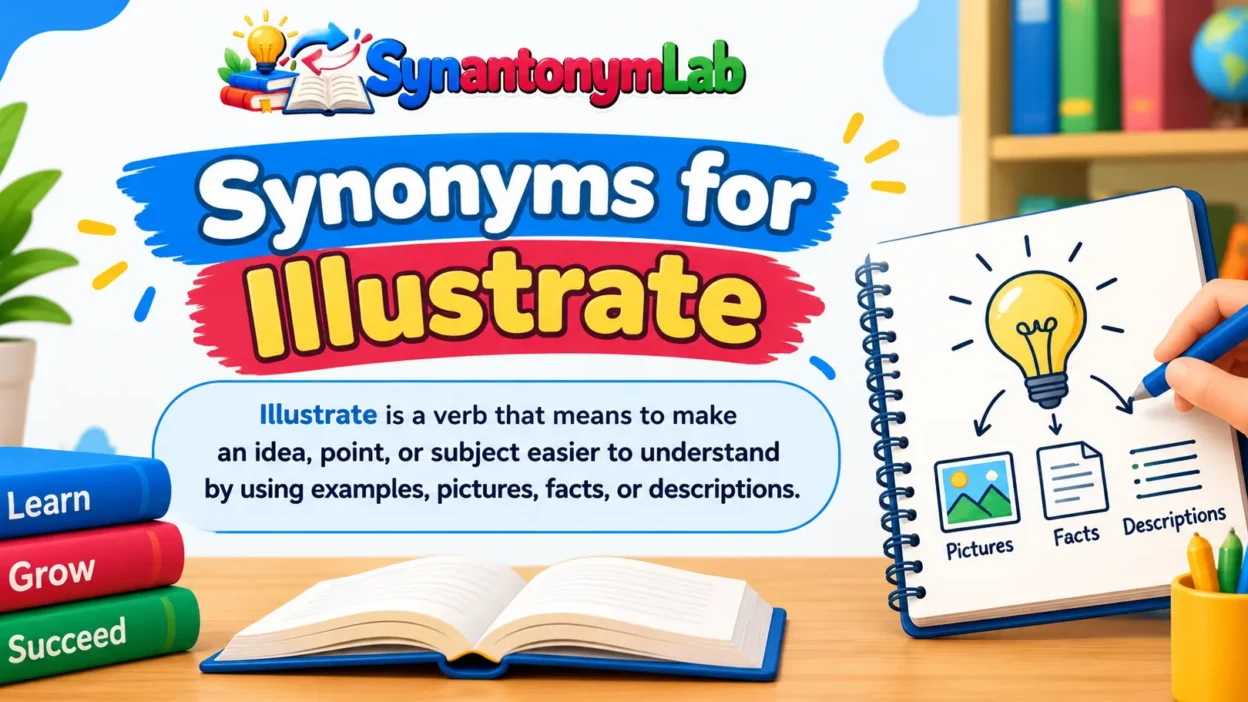
Illustrate is a verb that means to make an idea, point, or subject easier to understand by using examples, pictures, facts, or descriptions.
It can be used in several ways:
- Using examples: A teacher illustrates a grammar rule with sample sentences.
- Using pictures: An artist illustrates a children’s book.
- Using facts: A report illustrates how spending has changed over time.
- Using descriptions: A writer illustrates what life was like in a small village.
The word is common in academic, professional, creative, and everyday writing. It sounds neutral to formal, making it useful in essays, presentations, research papers, business reports, and conversations.
Grammatically, illustrate is a verb. Its common forms are illustrates, illustrated, and illustrating. It often takes a direct object, such as illustrate a point, illustrate a concept, or illustrate a difference.
A key point is that illustrating something does not always mean proving it. An example may help readers understand an idea without proving that the idea is true in every case. Likewise, describing something is not always the same as illustrating it.
The best alternative depends on what you want to do: explain an idea, provide evidence, show a difference, describe a scene, or add a visual element.
21 Best Synonyms for “Illustrate”
These 21 alternatives cover the main uses of illustrate. Some are close synonyms, while others work best in specific contexts.
1. Explain
Meaning: To make an idea, process, or situation easier to understand by giving information.
Tone: Neutral / Academic
Example: The teacher explained the rule with two simple examples.
When to use it: Choose explain when your main goal is to help someone understand something. Unlike illustrate, it does not require an example or picture.
2. Demonstrate
Meaning: To show how something works or provide evidence that supports a point.
Tone: Formal / Academic
Example: The experiment demonstrates how heat affects water.
When to use it: This word is useful in scientific writing, presentations, and arguments. It can suggest stronger evidence than illustrate, although the strength of the evidence still depends on the facts.
3. Show
Meaning: To make something clear, visible, or noticeable.
Tone: Neutral / Casual
Example: The chart shows a rise in monthly sales.
When to use it: Show is one of the simplest alternatives. It works in everyday speech and formal writing, but it may sound less precise when you need to describe how evidence supports a conclusion.
4. Depict
Meaning: To represent a person, place, event, or idea through words, images, or art.
Tone: Formal / Literary
Example: The painting depicts life in a fishing village.
When to use it: Use depict when describing visual art, photographs, films, or detailed written scenes. It focuses on representation rather than explaining a concept.
5. Portray
Meaning: To present someone or something in a particular way, often through art or writing.
Tone: Literary / Formal
Example: The novel portrays the struggles of a young student.
When to use it: Portray is especially useful when discussing characters, people, emotions, or social issues. It may suggest a particular viewpoint or impression.
6. Clarify
Meaning: To make something less confusing or more understandable.
Tone: Neutral / Professional
Example: The diagram clarifies the steps in the process.
When to use it: Choose clarify when information is unclear and you want to remove confusion. It emphasizes improved understanding rather than the use of examples or pictures.
7. Exemplify
Meaning: To serve as an example of a quality, idea, or principle.
Tone: Academic / Formal
Example: Her actions exemplify the value of teamwork.
When to use it: This word works well in essays and formal discussions. Unlike illustrate, it often describes something that represents a broader quality or idea.
8. Represent
Meaning: To stand for, express, or provide a picture of something.
Tone: Neutral / Formal
Example: The blue line represents the average temperature.
When to use it: Use represent for symbols, charts, models, and ideas. It does not necessarily mean that the information explains or proves anything.
9. Describe
Meaning: To give details about what someone or something is like.
Tone: Neutral / Academic
Example: The report describes the effects of air pollution.
When to use it: Describe is useful when you want to provide details about a person, event, process, or situation. It may lack the explanatory purpose that illustrate sometimes carries.
10. Present
Meaning: To put information, an idea, or evidence before an audience.
Tone: Professional / Formal
Example: The researcher presented the findings with a clear chart.
When to use it: Choose present for reports, speeches, meetings, and academic work. It focuses on delivering information rather than necessarily making it easier to understand.
11. Outline
Meaning: To give the main points of a subject without explaining every detail.
Tone: Academic / Professional
Example: The introduction outlines the main goals of the study.
When to use it: Outline is a good choice when you want to summarize a plan, argument, or process. It is less suitable when you need to provide a detailed example.
12. Reveal
Meaning: To make something previously unknown or hidden known.
Tone: Neutral / Formal
Example: The survey reveals a change in customer preferences.
When to use it: Use reveal when information brings something new to light. It suggests discovery, so it may be too strong if the information simply explains something already known.
13. Indicate
Meaning: To point toward a fact, condition, or possible conclusion.
Tone: Academic / Professional
Example: The results indicate a possible link between sleep and memory.
When to use it: This is a useful choice for reports and research. It often expresses a suggestion or sign rather than definite proof.
14. Display
Meaning: To show information, an object, or a result so that people can see it.
Tone: Neutral / Professional
Example: The dashboard displays the latest sales figures.
When to use it: Display is especially suitable for screens, tables, charts, and physical objects. It focuses on making something visible.
15. Express
Meaning: To communicate a thought, feeling, or idea.
Tone: Neutral / Literary
Example: The poem expresses the speaker’s sadness through images of rain.
When to use it: Choose express when the focus is on communicating a feeling or idea. It does not always mean that the idea is explained clearly.
16. Picture
Meaning: To create a mental image of something or present it in a way that helps people imagine it.
Tone: Casual / Literary
Example: The writer pictures a quiet town beside a wide river.
When to use it: This alternative can work in creative writing and informal descriptions. In formal writing, depict or portray may be more precise.
17. Sketch
Meaning: To give a brief outline of an idea, scene, or situation.
Tone: Neutral / Literary**Example: The author sketches the history of the town in the opening chapter.When to use it: Sketch suggests a quick or incomplete presentation. It can also refer to making a rough drawing, so the surrounding words determine its meaning.
18. Illuminate
Meaning: To help people understand an idea by revealing an important aspect of it.Tone: Formal / LiteraryExample: The case study illuminates the challenges faced by small businesses.When to use it: This word adds emphasis and can sound more expressive than explain. It is useful when an example or discovery brings fresh insight.
19. Highlight
Meaning: To draw attention to an important point, feature, or difference.Tone: Professional / AcademicExample: The report highlights the need for better public transport.When to use it: Choose highlight when you want readers to notice something important. It emphasizes selected details rather than explaining every part of a subject.
20. Characterize
Meaning: To describe the main qualities or features of a person, place, period, or situation.Tone: Academic / LiteraryExample: The author characterizes the city as busy but welcoming.When to use it: This word is useful for literary analysis, essays, and detailed descriptions. It focuses on defining features, not on providing proof or visual examples.
21. Graph
Meaning: To represent information or changes using a graph.Tone: Technical / AcademicExample: The students graphed the results to compare their measurements.When to use it: Graph is a specialized alternative when data is plotted visually. It is not a general replacement for illustrate, but it fits sentences about numerical information.
Stronger Alternatives
Sometimes, illustrate feels too general. A stronger word can show that you are providing convincing evidence, drawing attention to an important point, or giving readers a deeper understanding.The following alternatives are useful when their specific meanings match your sentence.
- Substantiate — To support a claim with evidence. Use it when you need to show that facts or records back up an argument.
Example: The documents substantiate the company’s claim. - Corroborate — To provide additional evidence that supports an existing account or finding.
Example: The second witness corroborated her account of the event. - Validate — To confirm that something is sound, acceptable, or supported by suitable evidence.
Example: Further testing helped validate the results. - Emphasize — To give special importance to a point.
Example: The final paragraph emphasizes the need for clean water. - Expose — To bring a hidden problem or fact to light.
Example: The investigation exposed serious flaws in the system. - Uncover — To discover information that was previously unknown or concealed.
Example: The study uncovered a gap in the available data. - Elucidate — To make a difficult subject clearer through careful explanation.
Example: The professor elucidated the theory with a practical example.
Important distinction: These words are not interchangeable. Substantiate and corroborate focus on evidence, while emphasize focuses on importance. Expose and uncover suggest discovery, and elucidate focuses on clarity. Use them only when that stronger meaning is intended.
Softer or Polite Alternatives
A softer alternative can make a statement sound less forceful, especially when you are discussing an uncertain result, offering feedback, or introducing a point in a professional setting.
- Suggest — To present a possible idea or conclusion without stating it as certain.
Example: The early results suggest a link between exercise and better sleep. - Indicate — To point toward a possibility or finding.
Example: The figures indicate that demand may be increasing. - Mention — To refer to something briefly.
Example: The speaker mentioned one example during the discussion. - Note — To draw attention to a fact in a calm, measured way.
Example: The report notes a small change in spending. - Describe — To explain what something is like without necessarily making a strong claim.
Example: The researcher described the changes observed during the trial. - Outline — To introduce the main points without going into every detail.
Example: The manager outlined the proposed changes at the meeting. - Point out — To direct someone’s attention to a particular fact or detail.
Example: She pointed out a possible error in the report.
These alternatives can sound less forceful than demonstrate or prove, but their meanings differ. For example, mention is much less detailed than illustrate, while suggest signals uncertainty. Choose a softer word when it reflects your evidence and intention, not simply to make every sentence sound polite.
Academic & IELTS-Friendly Alternatives
In academic writing and IELTS essays, a good vocabulary choice improves clarity and precision. However, a more advanced word is not automatically better. The best choice is one that accurately describes the evidence, relationship, or idea in your sentence.Here are ten useful options.
| Word | Best use | Example |
|---|---|---|
| Demonstrate | Showing a result or supporting a point | The findings demonstrate the value of early education. |
| Exemplify | Giving a clear example of a quality | This case exemplifies effective teamwork. |
| Indicate | Reporting a sign or possible conclusion | The figures indicate a gradual increase in demand. |
| Depict | Describing a visual representation | The diagram depicts the water cycle. |
| Illustrate | Making an idea clearer through examples or visuals | The example illustrates the main argument. |
| Highlight | Drawing attention to an important issue | The results highlight a need for further research. |
| Clarify | Removing confusion | The revised model clarifies the relationship between the variables. |
| Elucidate | Explaining a complex subject clearly | The paper elucidates the causes of the observed change. |
| Substantiate | Supporting a claim with evidence | The data substantiate the proposed explanation. |
| Portray | Presenting a person, event, or situation in a particular way | The novel portrays the effects of social inequality. |
How to use these words in academic writing
- Use demonstrate when the evidence shows how something works or supports a conclusion.
- Use indicate when results point toward a finding but do not establish it with certainty.
- Use exemplify when one case represents a broader idea or quality.
- Use highlight when drawing attention to an important issue.
- Use substantiate when evidence supports a claim that needs backing.
- Use depict for diagrams, images, and visual representations.
- Use clarify when your goal is to remove confusion.
- Use elucidate when careful explanation makes a complex idea easier to understand.
- Use portray when analyzing the way a writer presents a person or situation.
- Use illustrate when an example, figure, or description makes your point easier to grasp.
For IELTS Writing Task 1, show, indicate, display, and depict can work well when describing charts, diagrams, and trends. For Task 2, demonstrate, highlight, and exemplify may be suitable for arguments and examples. Always check that the sentence matches the word’s meaning.For example:
- Less precise: The chart illustrates that sales went up.
- More direct: The chart shows that sales increased.
- More cautious: The figures indicate that sales may increase.
Each sentence serves a slightly different purpose. Choose based on what the information actually supports.
Synonyms You Should Avoid
Some words seem similar to illustrate but can change the meaning of your sentence. They are not always wrong; they simply need the right context.
1. Prove
Prove makes a stronger claim than illustrate. An example may help explain a point without establishing that it is true.
- Awkward: This example proves that all students learn in the same way.
- Better: This example illustrates one way students may learn.
Use prove only when the evidence genuinely establishes the claim.
2. Imply
Imply usually means to communicate or suggest something indirectly. It does not simply mean to explain or show.
- Awkward: The diagram implies how the machine works.
- Better: The diagram illustrates how the machine works.
Use imply when a message is suggested rather than stated directly.
3. Argue
Argue means to present reasons for a position or to disagree with someone. It is not a general replacement for illustrate.
- Awkward: The picture argues the history of the town.
- Better: The picture depicts the town’s history.
Use argue when discussing claims, reasoning, or opposing views.
4. Mention
Mention usually refers to bringing something up briefly. It may be too weak when an example provides a detailed explanation.
- Weak: The report mentions how the process works.
- Better: The report explains how the process works.
Use mention when the information receives little attention or detail.
5. Decorate
Decorate means to add features that make something more attractive. It does not mean to explain an idea.
- Incorrect for the intended meaning: The chart decorates the results of the study.
- Better: The chart displays the results of the study.
Use decorate when you mean adding visual or artistic details, not presenting information for understanding.
How to Choose the Right Synonym in Writing
Choosing a synonym is not just about finding another word with a similar meaning. You need to consider what the sentence is trying to communicate and how readers will understand it.
1. Consider the context
Think about what you are illustrating.
- An idea: explain or clarify
- A claim supported by evidence: demonstrate or substantiate
- A scene or character: depict or portray
- An important issue: highlight
- A trend in a chart: show or indicate
For example, a diagram can depict a process, while a teacher can explain it. Both sentences may discuss the same process, but the verbs describe different actions.
2. Match the tone to your audience
For everyday conversation, simple words like show and explain are often the clearest choices. In a business report, indicate, highlight, or demonstrate may be more suitable.In creative writing, portray, depict, and picture can help readers imagine a scene or character.Avoid using a formal word just to sound intelligent. If a simpler word communicates your point more clearly, use it.
3. Check the strength of the claim
Some alternatives suggest more certainty than others.Compare these examples:
- The results suggest a possible link.
- The results indicate a link.
- The results demonstrate a link.
These statements express different levels of confidence. Your choice should reflect the strength and limits of the evidence, not the impression you want to create.
4. Think about the level of detail
Outline introduces the main points. Describe provides details about a subject. Clarify removes confusion, while elucidate offers a careful explanation of something complex.Choose the word that matches the amount and type of information you provide.
5. Check grammar and sentence structure
Not every synonym fits the same grammatical pattern.
- The diagram illustrates the process.
- The findings demonstrate a pattern.
- The results provide an example of the problem.
- The report draws attention to the issue.
Notice that provide an example of and draw attention to are phrases, not single-word synonyms. They can still be useful alternatives when rewriting a sentence.
6. Read the sentence aloud
A sentence may be grammatically correct but sound unnatural. Read it aloud and ask whether the chosen verb expresses your intended meaning.For example, The chart elucidates the sales figures may sound unnecessarily formal. The chart shows the sales figures is simpler and more natural.A useful rule: Choose the most precise word, not the most complicated one.
Example Paragraph Rewritten Using Synonyms
Consider this original paragraph about education.Original paragraphThe teacher uses pictures and examples to illustrate difficult science topics. These methods illustrate how natural processes work and help students understand new ideas. The lesson also illustrates the importance of asking questions.
Version 1: Using simple alternatives
The teacher uses pictures and examples to explain difficult science topics. These methods show how natural processes work and help students understand new ideas. The lesson also highlights the importance of asking questions.This version is direct and easy to read. Explain focuses on understanding, show presents how something works, and highlight draws attention to an important lesson.
Version 2: Using more formal alternatives
The teacher uses diagrams and examples to clarify difficult science topics. These materials demonstrate how natural processes work and help students understand new ideas. The lesson also emphasizes the importance of asking questions.This version suits a formal report about teaching methods. Clarify focuses on removing confusion, demonstrate suggests showing how a process works, and emphasize gives special importance to the final point.
Version 3: Using alternatives for visual description
The teacher uses pictures to depict natural processes and examples to explain difficult science topics. Together, these methods illustrate new ideas and highlight the value of asking questions.This version distinguishes between visual representation and explanation instead of replacing every use of illustrate with the same word.The main lesson is simple: use different verbs when they express different actions. Good vocabulary makes writing more accurate, not merely more varied.
FAQs
1. What are the best synonyms for illustrate?
Some of the most useful alternatives are show, explain, demonstrate, depict, clarify, describe, highlight, and exemplify. The best choice depends on whether you are explaining an idea, presenting evidence, or describing something visually.
2. What is a simple word for illustrate?
Show is often the simplest alternative. You can also use explain when your purpose is to make an idea easier to understand.For example: This example shows how the rule works.
3. What is a formal synonym for illustrate?
Demonstrate, indicate, exemplify, and elucidate can work in formal writing. However, each has a different meaning. Use demonstrate for showing how something works or supporting a point, and elucidate for explaining a complex idea clearly.
4. What is the difference between illustrate and demonstrate?
Illustrate often makes an idea clearer through an example, picture, or description. Demonstrate often shows how something works or provides evidence for a claim.For example, a diagram may illustrate a process, while an experiment may demonstrate how that process works.
5. Can I use show instead of illustrate in an essay?
Yes. Show is clear, natural, and suitable for many academic sentences. However, illustrate may be more precise when you are discussing an example that explains a broader point.Use the word that best describes the role of the evidence or example.
6. What is the best synonym for illustrate in IELTS writing?
There is no single best choice. Show, indicate, demonstrate, depict, and highlight can all work in suitable contexts. For chart descriptions, show and indicate are often useful. For argumentative essays, demonstrate and highlight may be more appropriate.Accuracy and natural grammar matter more than choosing an advanced word.
7. Is exemplify the same as illustrate?
They are similar, but not identical. Exemplify means to serve as an example of a quality, idea, or principle. Illustrate can also mean to explain an idea through an example, picture, or description.For example, a student’s actions may exemplify honesty, while a story about that student may illustrate why honesty matters.
Conclusion
The best synonym for illustrate depends on what you want readers to understand.
Use show for simple statements, explain for clearer understanding, demonstrate for showing how something works or supporting a point, and depict for visual or written representations.
When you need to draw attention to an important idea, highlight may be the better choice.
For academic writing, choose words such as indicate, exemplify, and substantiate only when their meanings fit the evidence and sentence.
For everyday communication, simple alternatives are often more effective than formal ones.Instead of replacing illustrate every time it appears, focus on the action your sentence describes.
The right word will make your writing clearer, more natural, and more precise.

Milo Carter is a passionate writer who loves exploring words, synonyms, and antonyms. Through SynantonymLab, he helps readers improve their English vocabulary and language skills.