
The word travel is used in many types of writing, from school essays and travel blogs to business reports and everyday conversations. It describes moving from one place to another, often for fun, work, education, or personal reasons.
However, using the same word repeatedly can make your writing feel plain. Finding the right alternatives can help you express your ideas more clearly and make your sentences more interesting.
There are many ways to describe travel, but not every alternative has exactly the same meaning. Some words focus on the journey itself, while others describe a long trip, a short visit, or an exciting adventure.
Choosing the right word depends on your purpose and the situation.
Whether you are a student, teacher, professional writer, blogger, or English learner, learning synonyms for travel can improve your vocabulary. This guide explores 26 useful alternatives, explains their differences, and provides natural examples. You will also discover stronger expressions, polite alternatives, academic vocabulary, and common word choices that should be used carefully.
What Does “Travel” Mean?
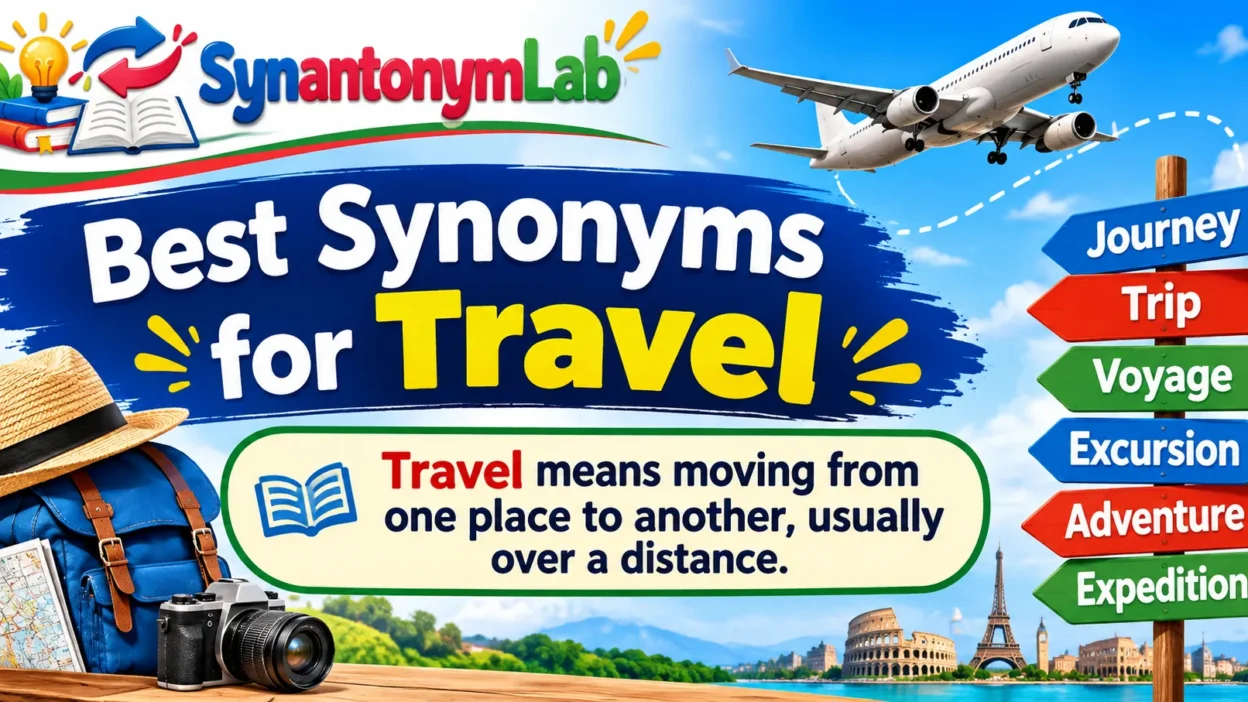
Travel means moving from one place to another, usually over a distance. It can involve going to another town, visiting a different country, or moving between locations for personal or professional reasons.
Travel is most commonly used as a verb, but it can also function as a noun.
As a verb:
- We travel to different cities during the summer.
- She travels abroad for business meetings.
As a noun:
- Air travel is popular for long-distance journeys.
- Their travel lasted several weeks.
The word has a neutral and flexible tone. It works in casual conversations, academic writing, business communication, and professional content.
Travel can describe different types of movement, including:
- Leisure travel: Going somewhere for enjoyment or relaxation.
- Business travel: Visiting another place for work.
- International travel: Moving between different countries.
- Domestic travel: Visiting places within your own country.
- Educational travel: Visiting places to learn or gain experience.
One important point is that travel does not always mean taking a holiday. Someone may travel to attend a meeting, visit family, study, or complete a professional task.
It is also important to understand that some alternatives describe a particular kind of travel rather than the entire meaning. For example, journey focuses on the movement from one place to another, while tour usually involves visiting several places.
26 Best Synonyms for “Travel”
Here are 26 useful alternatives to travel. Each word has its own meaning, tone, and appropriate context.
1. Journey
A journey is the act of moving from one place to another, especially over a distance.
Tone: Neutral
Example: Our journey across the country took three days.
Journey is one of the closest alternatives to travel when describing a particular trip. It can also describe personal growth or progress, depending on the context.
2. Trip
A trip is a visit or journey to a place, usually for a specific purpose and period.
Tone: Casual
Example: We planned a short trip to the mountains.
Trip is especially common in everyday English. It often refers to a particular visit rather than travel as a general activity.
3. Voyage
A voyage is a long journey, especially one made by sea or through space.
Tone: Formal / Literary
Example: The explorers began their voyage across the ocean.
Voyage is more specific and often sounds more adventurous or historical than travel.
4. Tour
A tour involves visiting different places, often following a planned route.
Tone: Neutral / Formal
Example: They took a guided tour of several European cities.
Use tour when the activity includes visiting multiple locations or exploring a destination with a planned schedule.
5. Excursion
An excursion is a short journey made for pleasure, education, or exploration.
Tone: Formal
Example: The students went on an excursion to the science museum.
Excursion usually describes a short organized outing rather than long-distance travel.
6. Expedition
An expedition is an organized journey made for exploration, research, or a challenging purpose.
Tone: Formal / Academic
Example: The researchers organized an expedition to study the rainforest.
Expedition suggests planning, preparation, and a specific goal.
7. Trek
A trek is a long or difficult journey, often on foot through natural areas.
Tone: Neutral / Informal
Example: We completed a challenging trek through the mountains.
Trek is especially suitable when describing physically demanding outdoor travel.
8. Voyage of Discovery
A voyage of discovery describes a journey undertaken to explore unfamiliar places or learn something new.
Tone: Literary
Example: Their voyage of discovery introduced them to new cultures.
This expression is more descriptive than travel and is useful for creative writing.
9. Roam
To roam means to move around without following a fixed route or destination.
Tone: Casual / Literary
Example: We spent the afternoon roaming around the old town.
Roam focuses on freedom and exploration rather than a planned journey.
10. Wander
To wander means to move around slowly or without a particular destination.
Tone: Casual / Literary
Example: Tourists wandered through the narrow streets.
Wander often suggests relaxed movement and spontaneous exploration.
11. Explore
To explore means to visit or examine unfamiliar places to discover something.
Tone: Neutral / Academic
Example: We explored the historic areas of the city.
Explore focuses more on discovering a place than simply moving between locations.
12. Commute
To commute means to travel regularly between home and work or another usual destination.
Tone: Neutral / Professional
Example: She commutes to the office by train every morning.
Commute is appropriate for routine travel, not usually for holidays or occasional adventures.
13. Navigate
To navigate means to find or follow a route through an area.
Tone: Formal / Technical
Example: The hikers navigated the mountain trails using a map.
Navigate emphasizes finding the correct direction rather than the general act of travel.
14. Tour Around
To tour around means to visit and look around different places in an area.
Tone: Casual
Example: We toured around the city during our weekend break.
This expression is useful in everyday conversations about sightseeing.
15. Venture
To venture means to go somewhere unfamiliar, sometimes involving uncertainty or risk.
Tone: Literary / Formal
Example: They ventured into the remote countryside.
Venture adds a sense of courage, curiosity, or uncertainty to a journey.
16. Roam Around
To roam around means to move freely through different places without a strict plan.
Tone: Casual
Example: We roamed around the shopping district all afternoon.
This phrase works well when describing relaxed movement and informal exploration.
17. Hike
To hike means to take a long walk, usually in the countryside, hills, or mountains.
Tone: Neutral / Casual
Example: They hiked through the forest during their vacation.
Hike is suitable for outdoor walking trips, but it should not replace travel in every context.
18. Backpack
To backpack means to travel while carrying personal belongings in a backpack, often using a flexible or budget-friendly travel style.
Tone: Casual
Example: She plans to backpack across Southeast Asia next year.
Backpack describes a particular style of travel rather than travel in general.
19. Sightsee
To sightsee means to visit interesting places, landmarks, and attractions.
Tone: Neutral
Example: We spent the morning sightseeing in Rome.
Sightsee is especially useful when the main purpose of a visit is to see popular attractions.
20. Cruise
To cruise means to travel by ship, often for pleasure, or to move smoothly at a steady speed.
Tone: Neutral / Casual
Example: They cruised around the Mediterranean for two weeks.
When used for holidays, cruise generally refers to leisure travel by ship.
21. Roam Freely
To roam freely means to move from place to place without strict restrictions or a fixed schedule.
Tone: Literary / Casual
Example: Visitors can roam freely around the beautiful gardens.
This expression highlights freedom and flexibility.
22. Trekking
Trekking refers to taking a long, often challenging walk through natural or remote areas.
Tone: Neutral / Outdoor
Example: Trekking in the northern mountains requires proper preparation.
Trekking is the activity form of trek and is commonly used when discussing outdoor adventures.
23. Fly
To fly means to travel through the air, usually by airplane.
Tone: Neutral
Example: We will fly to London next Friday.
Fly is a useful alternative when the method of transportation is important.
24. Sail
To sail means to travel on water using a boat or ship.
Tone: Neutral
Example: They sailed along the coast during their holiday.
Sail is suitable for water-based journeys, not general land or air travel.
25. Proceed
To proceed means to continue or move forward toward a destination or the next stage of an activity.
Tone: Formal
Example: The visitors proceeded to the next location on their tour.
Proceed is a formal alternative for describing movement in specific situations. It does not always mean travel.
26. Make a Trip
To make a trip means to travel somewhere for a particular reason.
Tone: Casual / Neutral
Example: We made a trip to the countryside last weekend.
This phrase is natural in everyday English and works well when discussing a specific visit.
Stronger Alternatives
Sometimes, the word travel does not fully express the excitement, challenge, or purpose of a journey. The following alternatives add more detail and emotional strength.
- Embark: To begin an important or exciting journey.
Example: They embarked on a journey across Africa.
Use it when describing the beginning of a significant adventure. - Explore: To visit unfamiliar places and discover new things.
Example: The team explored the remote island.
It adds curiosity and discovery to the sentence. - Venture: To go somewhere unfamiliar or potentially challenging.
Example: The climbers ventured into the wilderness.
It suggests courage or uncertainty. - Expedition: An organized journey with a challenging or specific goal.
Example: The scientists joined an expedition to Antarctica.
It is stronger and more purposeful than ordinary travel. - Trek: To make a difficult or lengthy journey, usually on foot.
Example: They trekked through the rocky mountains.
It emphasizes physical effort. - Conquer: To overcome a difficult route or challenge.
Example: The hikers conquered the difficult mountain trail.
This is more dramatic than travel and focuses on achievement. - Traverse: To travel across or through an area.
Example: The explorers traversed the vast desert.
It is a more formal and descriptive alternative.
Softer or Polite Alternatives
Gentler alternatives can make travel-related sentences sound more relaxed, friendly, or suitable for professional communication.
- Visit: To go somewhere for a short time.
Example: We plan to visit our relatives next month.
It is simple and friendly. - Stop by: To make a short, informal visit.
Example: I will stop by the nearby town this afternoon.
It works best for brief visits. - Head to: To go toward a particular place.
Example: We are heading to the airport now.
It sounds natural in casual conversation. - Go to: A simple way to describe movement toward a destination.
Example: They will go to the beach tomorrow.
It is one of the easiest expressions for everyday English. - Make a visit: To go somewhere for a particular reason.
Example: We would like to make a visit to the local museum.
It can sound slightly more formal than simply saying visit. - Take a short trip: To travel somewhere for a brief period.
Example: She wants to take a short trip during the holidays.
It emphasizes a relaxed, limited journey. - Drop in: To visit someone or somewhere briefly, often without a formal arrangement.
Example: We may drop in on our friends this evening.
This is informal and is mainly used for social visits.
Academic & IELTS-Friendly Alternatives
In academic essays, formal reports, and IELTS writing, choosing precise vocabulary is more important than using complicated words. These alternatives can help describe different forms and purposes of movement.
- Migration: The movement of people from one place or country to another, often to live there.
Example: Economic conditions can influence migration patterns. - Mobility: The ability or process of moving between places.
Example: Improved public transport increases urban mobility. - Transportation: The movement of people or goods from one location to another, or the systems used for it.
Example: Modern transportation has changed international connections. - Transit: The process of passing through or being transported from one location to another.
Example: Passengers spent several hours in transit. - Passage: Movement or a journey from one place to another.
Example: The passage across the sea was difficult. - Itinerary: A planned schedule or route for a journey.
Example: The researchers prepared a detailed itinerary before departure. - Pilgrimage: A journey to a place that has religious or spiritual importance.
Example: Thousands of people undertake a pilgrimage each year. - Cross-border movement: The movement of people between different countries.
Example: Cross-border movement supports international trade and cultural exchange. - Long-distance journey: Travel over a considerable distance.
Example: Long-distance journeys often require careful planning. - International mobility: The ability or process of moving between countries for work, study, or other purposes.
Example: International mobility gives students opportunities to study abroad.
Remember that these words are not interchangeable in every sentence. Migration usually involves relocation, while mobility describes the broader ability or process of movement. Itinerary refers to a plan, not the act of traveling itself.
Synonyms You Should Avoid
Some words may appear similar to travel but can change the meaning of your sentence. Understanding these differences helps prevent awkward or incorrect writing.
- Escape: Escape means getting away from a place, situation, or danger.
Incorrect context: We escaped to Paris for our school trip.
Better: We traveled to Paris for our school trip.
Escape is suitable when someone is trying to get away from something unpleasant or dangerous. - Relocate: Relocate means moving to a different place to live or work.
Incorrect context: We relocated to the beach for a two-day holiday.
Better: We traveled to the beach for a two-day holiday.
Relocate suggests a change of residence or workplace. - Transport: Transport generally means carrying people or goods from one location to another.
Incorrect context: I want to transport around Europe next summer.
Better: I want to travel around Europe next summer.
Transport is usually a verb describing the movement of people or things, or a noun referring to transportation systems. - Move: Move is a broad word that can describe changing position, location, or residence.
Incorrect context: We moved through three countries on our vacation.
Better: We traveled through three countries on our vacation.
Move can work in some contexts, but travel is more specific for journeys. - Shift: Shift means to change position, direction, or focus.
Incorrect context: They shifted to another country for sightseeing.
Better: They traveled to another country for sightseeing.
Shift is generally not a natural replacement for travel when describing a holiday or journey.
How to Choose the Right Synonym in Writing
Choosing the right alternative depends on what you want to communicate. A word may be grammatically correct but still fail to express your intended meaning.
Here are some useful points to consider.
1. Understand the context
Think about the type of movement you are describing.
- Use trip for a particular visit.
- Use journey for movement over a distance.
- Use expedition for an organized exploration.
- Use commute for regular travel between home and work.
- Use excursion for a short organized outing.
2. Consider your tone
Different words create different feelings.
For casual writing, words such as go, visit, wander, and trip sound natural. For formal writing, terms such as expedition, migration, mobility, and passage may be more suitable.
3. Think about your audience
A school assignment may need simple and clear vocabulary. A professional report may require more precise terms. A travel blog can use descriptive words such as explore, wander, and venture to make the content engaging.
4. Check the level of formality
Avoid using overly formal expressions in friendly conversations. Similarly, avoid slang when writing academic essays or professional documents.
For example:
- Casual: We went to the mountains.
- Neutral: We traveled to the mountains.
- Descriptive: We explored the mountain region.
Each sentence is correct, but the wording changes the focus.
5. Pay attention to grammar
Not every alternative works in the same grammatical structure.
For example:
- We travel every summer.
- We are exploring the city.
- We went on an excursion.
- She commutes by bus.
Notice that some alternatives need different sentence patterns. Always check whether the word is being used as a noun, verb, or phrase.
6. Choose clarity over complexity
A simple word is often better than a complicated one. Do not use expedition when you simply mean a family holiday. Likewise, do not use pilgrimage unless the journey has a religious or spiritual purpose.
The best synonym is the one that communicates your meaning accurately.
Example Paragraph Rewritten Using Synonyms
Consider this original paragraph:
Original paragraph:
Last summer, we traveled to a beautiful coastal town. We spent five days exploring the area, visiting local attractions, and enjoying the beaches. Our trip was relaxing, and we hope to travel there again next year.
Now, look at how different alternatives can improve the paragraph.
Rewritten paragraph:
Last summer, we journeyed to a beautiful coastal town. We spent five days exploring the area, sightseeing at local attractions, and wandering along the beaches. Our visit was relaxing, and we hope to return there next year.
Why these alternatives work:
- Journeyed: Gives the first sentence a more descriptive feel.
- Sightseeing: Clearly describes visiting interesting attractions.
- Wandering: Suggests relaxed movement along the beaches.
- Visit: Provides a natural alternative to trip in the final part.
- Return: Avoids repeating travel while clearly expressing the idea of going back.
The rewritten paragraph sounds more varied without changing its main meaning. This is the purpose of using synonyms: to make writing clearer and more natural, not simply to replace every repeated word.
FAQs
1. What is the closest synonym for travel?
Journey is one of the closest alternatives when describing movement from one place to another. Trip is another common choice when referring to a specific visit.
2. What are five common synonyms for travel?
Five common alternatives are journey, trip, tour, voyage, and excursion. Their meanings differ slightly, so choose the one that best fits the situation.
3. What is a formal word for travel?
Voyage, expedition, passage, and mobility can work in formal writing. However, the best option depends on the type of movement being described.
4. What is another word for traveling?
Journeying, exploring, touring, trekking, and wandering can replace traveling in suitable contexts. For example, exploring works well when someone is discovering unfamiliar places.
5. What is a stronger word for travel?
Expedition, trek, and venture can sound stronger because they suggest exploration, difficulty, or uncertainty. These words are not suitable for every ordinary journey.
6. What is the difference between travel, trip, and journey?
Travel generally describes the activity of moving between places. A trip usually refers to a specific visit, while a journey focuses on the movement from one place to another.
7. How can I avoid repeating the word travel in an essay?
Use alternatives such as journey, visit, exploration, mobility, or trip when their meanings fit. You can also rewrite sentences to remove unnecessary repetition rather than replacing every occurrence with another word.
Conclusion
Learning different ways to express travel can make your writing more natural, clear, and engaging. Words such as journey, trip, voyage, excursion, and expedition describe different types of movement, while alternatives such as explore, wander, and trek add more detail to your sentences.
The most important thing is to understand the meaning behind each word before using it. A short family visit, a difficult mountain trek, and an international business journey are different experiences and deserve different descriptions.
Whether you are writing an essay, creating a travel blog, preparing a report, or improving your everyday English, choose vocabulary that matches your message.
The right word will always make your writing more effective than a complicated word used in the wrong context.

Milo Carter is a passionate writer who loves exploring words, synonyms, and antonyms. Through SynantonymLab, he helps readers improve their English vocabulary and language skills.