Finding the right way to say thank you can make a message feel warmer, more personal, and more meaningful. Although “thank you” is one of the most common expressions in English, using the same words in every conversation can make your writing sound repetitive. That is why many people look for different ways to express gratitude.
Whether you are writing an email, preparing an academic assignment, speaking with a colleague, or sending a message to a friend, choosing the right expression matters. Some alternatives sound formal and professional, while others feel friendly, emotional, or casual.
Learning different ways to express thanks can help you communicate more clearly and confidently. It also allows you to match your words to the person, situation, and level of appreciation you want to show.
In this guide, you will discover 24 useful alternatives to “thank you,” along with their meanings, tones, and example sentences. You will also learn which expressions work best in professional emails, everyday conversations, academic writing, and personal messages.
What Does “Thank You” Mean?
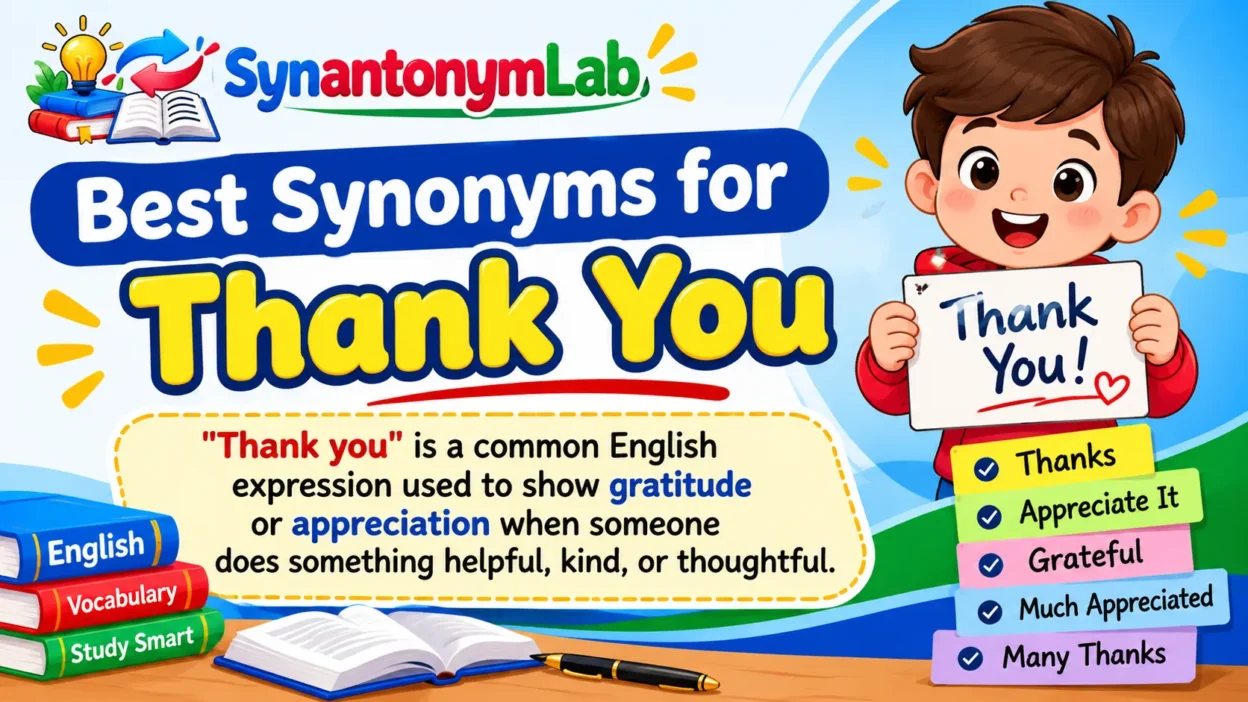
“Thank you” is a common English expression used to show gratitude or appreciation when someone does something helpful, kind, or thoughtful.
People use it when receiving a gift, getting assistance, accepting an invitation, or benefiting from someone’s time and effort. It is one of the simplest ways to recognize another person’s kindness.
The expression consists of two words:
- Thank: A verb that expresses gratitude or appreciation.
- You: A pronoun referring to the person receiving the expression of gratitude.
Together, these words create a polite expression that works in many situations.
“Thank you” is suitable for both formal and informal communication. However, its tone can change depending on the words around it. For example, “Thank you for your assistance” sounds professional, while “Thank you so much!” feels warmer and more personal.
It is also important to understand that not every alternative has exactly the same meaning. Some expressions communicate gratitude, while others recognize someone’s effort, kindness, support, or generosity.
Choosing the right expression helps you show appreciation without sounding unnatural or overly formal.
24 Best Synonyms for “Thank You”
Here are 24 useful expressions you can use instead of repeating “thank you.” Each option has a slightly different tone and works best in particular situations.
1. Thanks
A short and common way to express gratitude for someone’s help, kindness, or effort.
Tone: Casual / Informal
Example: Thanks for helping me complete the project.
Difference: “Thanks” is shorter and more relaxed than “thank you.” It works well in everyday conversations and friendly messages.
2. Many Thanks
A polite expression used to show appreciation for someone’s help or contribution.
Tone: Formal / Professional
Example: Many thanks for sending the documents before the deadline.
Difference: This expression sounds slightly more polished than a simple “thanks.” It is useful in emails and professional messages.
3. Thanks a Lot
A friendly way to show that you appreciate someone’s action or support.
Tone: Casual / Informal
Example: Thanks a lot for giving me a ride home.
Difference: It often communicates stronger appreciation than “thanks.” However, depending on the speaker’s tone, it can sometimes sound sarcastic.
4. Thank You So Much
A warm expression that communicates strong appreciation.
Tone: Informal / Warm
Example: Thank you so much for remembering my birthday.
Difference: Adding “so much” makes the expression more personal and emotional. It is suitable for friends, family, and helpful colleagues.
5. I Appreciate It
A natural way to recognize someone’s help, time, or effort.
Tone: Professional / Casual
Example: I appreciate it when you take the time to explain difficult topics.
Difference: This expression sounds sincere and direct. It is especially useful when you want to recognize a specific action.
6. Much Appreciated
A concise expression that shows gratitude for someone’s contribution.
Tone: Professional / Formal
Example: Your quick response is much appreciated.
Difference: It is common in workplace communication. It sounds more businesslike than “thanks a lot.”
7. I Am Grateful
A sincere expression used to communicate personal appreciation.
Tone: Formal / Warm
Example: I am grateful for your continued support during this difficult time.
Difference: This expression often communicates deeper or more lasting appreciation than an ordinary thank-you.
8. I Am Thankful
A simple way to express appreciation for someone’s actions or something positive in your life.
Tone: Warm / Personal
Example: I am thankful for everything you have done for my family.
Difference: “Thankful” can express gratitude toward a person, an experience, or a situation. It is often more reflective than “thanks.”
9. Much Obliged
A polite expression used to acknowledge someone’s assistance or kindness.
Tone: Formal / Traditional
Example: I am much obliged for your assistance with the application.
Difference: This phrase sounds old-fashioned or traditional in many modern settings. Use it when that tone feels appropriate.
10. I Can’t Thank You Enough
A heartfelt expression used when someone has done something especially meaningful.
Tone: Emotional / Warm
Example: I can’t thank you enough for standing by me during this challenging time.
Difference: It communicates deep appreciation and is stronger than a simple “thank you.”
11. You’re a Lifesaver
A friendly expression used when someone’s help solves an urgent or difficult problem.
Tone: Casual / Friendly
Example: You’re a lifesaver for sharing your notes before the exam.
Difference: This is not a direct synonym in every situation. It specifically praises someone whose help was extremely useful.
12. I Owe You One
An informal way to show appreciation while suggesting that you would like to return the favor.
Tone: Casual / Friendly
Example: Thanks for fixing my laptop. I owe you one!
Difference: It adds the idea of returning someone’s kindness. It is best for friends and familiar colleagues.
13. I Appreciate Your Help
A clear expression that recognizes someone’s effort or assistance.
Tone: Professional / Polite
Example: I appreciate your help in preparing the final presentation.
Difference: This phrase is more specific than “thank you” because it directly identifies the person’s helpful action.
14. I Appreciate Your Time
A polite way to recognize someone for giving you their attention or time.
Tone: Formal / Professional
Example: I appreciate your time and consideration during the interview.
Difference: This is especially useful in business emails, meetings, interviews, and professional requests.
15. I Am Indebted to You
A strong expression of gratitude that suggests someone’s help was extremely valuable.
Tone: Formal / Serious
Example: I am indebted to you for your guidance throughout this project.
Difference: It communicates a deep sense of obligation or appreciation. It can sound too serious for ordinary favors.
16. Please Accept My Thanks
A courteous way to express appreciation, especially in formal communication.
Tone: Formal / Respectful
Example: Please accept my thanks for your generous contribution to the event.
Difference: It sounds more formal than everyday expressions and works well in official messages or written acknowledgments.
17. I Truly Appreciate It
A sincere expression that adds emphasis to your gratitude.
Tone: Warm / Professional
Example: I truly appreciate it when you share helpful feedback on my work.
Difference: The word “truly” makes the message sound more personal and genuine.
18. I Am So Grateful
A warm and emotional expression used to show strong appreciation.
Tone: Emotional / Personal
Example: I am so grateful for your kindness and encouragement.
Difference: It is useful when someone’s support has made a meaningful difference in your life.
19. Cheers
An informal expression used to thank someone, especially in British and some other varieties of English.
Tone: Casual / Friendly
Example: Cheers for sending me the meeting notes.
Difference: It is common in relaxed conversations and informal messages. It may sound too casual in formal business correspondence.
20. Kudos
An expression of praise or recognition for someone’s achievement or good work.
Tone: Casual / Professional
Example: Kudos to the design team for completing the project successfully.
Difference: “Kudos” is not a direct replacement for “thank you.” It praises someone’s achievement rather than simply expressing gratitude.
21. I Value Your Support
A respectful expression that recognizes the importance of someone’s continued help.
Tone: Formal / Professional
Example: I value your support as we work toward completing this project.
Difference: It focuses on the importance of someone’s support rather than only acknowledging a single favor.
22. I Appreciate Your Kindness
A warm expression used to recognize someone’s thoughtful or caring behavior.
Tone: Warm / Polite
Example: I appreciate your kindness in helping my family during this difficult period.
Difference: This phrase is particularly suitable when someone’s action shows care, generosity, or compassion.
23. You Have My Gratitude
A formal expression used to communicate sincere appreciation.
Tone: Formal / Respectful
Example: You have my gratitude for your generous contribution to our community.
Difference: It sounds more formal and serious than ordinary expressions of thanks. It is suitable for speeches, formal notes, and acknowledgments.
24. I Sincerely Thank You
A respectful expression that emphasizes genuine appreciation.
Tone: Formal / Professional
Example: I sincerely thank you for your patience and cooperation throughout the process.
Difference: It works well in professional letters, formal statements, and situations where you want your gratitude to sound thoughtful and respectful.
Stronger Alternatives
Sometimes, a simple thank-you does not fully communicate how much someone’s actions mean to you. In these situations, stronger expressions can make your appreciation clearer.
Here are some powerful alternatives:
- I Can’t Thank You Enough: Use this when someone’s help has made a major difference. It communicates deep appreciation.
- I Am Deeply Grateful: This expression is suitable for meaningful personal or professional support.
- I Am Truly Indebted to You: Use it when someone’s assistance was especially valuable and you feel a strong sense of gratitude.
- I Will Always Be Grateful: This works when someone’s kindness has had a lasting impact on your life.
- You Have My Heartfelt Thanks: A warm and sincere expression suitable for personal messages and formal acknowledgments.
- I Am Eternally Grateful: This communicates very strong, lasting appreciation. It may sound too dramatic for small favors.
- Words Cannot Express My Gratitude: Use this when you feel that ordinary words are not enough to communicate your appreciation.
These expressions are best reserved for situations that genuinely deserve strong appreciation. Using them for small everyday favors can make your message sound exaggerated.
Softer or Polite Alternatives
Not every situation requires an emotional or powerful expression. Sometimes, a gentle and polite phrase is more appropriate.
Here are seven softer alternatives:
- I Appreciate Your Time: A respectful way to acknowledge someone who has listened to you or attended a meeting.
- That’s Very Kind of You: A friendly response when someone offers help or does something thoughtful.
- I Appreciate Your Consideration: Useful when someone has reviewed your request or taken your situation into account.
- That Means a Lot to Me: A warm way to show that someone’s action has personal value.
- I Am Grateful for Your Understanding: Suitable when someone has been patient or considerate.
- I Appreciate Your Thoughtfulness: A gentle expression for recognizing a kind or caring action.
- I Value Your Help: A simple and respectful way to acknowledge someone’s assistance.
These alternatives are especially useful in professional emails, conversations with unfamiliar people, and situations where you want to sound polite without being overly emotional.
Academic & IELTS-Friendly Alternatives
In academic writing and IELTS tasks, it is important to choose expressions that fit the purpose and style of the sentence.
However, not every alternative to “thank you” belongs in an academic essay. Expressions of gratitude are most natural in acknowledgments, formal letters, presentations, and spoken communication.
Here are ten useful options:
1. Express Gratitude
A formal way to communicate appreciation.
Example: I would like to express my gratitude to everyone who contributed to this research.
2. Convey Appreciation
A professional expression used to communicate recognition and thanks.
Example: The organization wishes to convey its appreciation to the volunteers.
3. Acknowledge Support
A suitable phrase for recognizing someone’s assistance.
Example: I would like to acknowledge the support provided by my research supervisor.
4. Extend My Thanks
A formal phrase used when addressing a person or group.
Example: I would like to extend my thanks to all participants in this study.
5. Show Appreciation
A clear expression for recognizing helpful actions.
Example: The university organized an event to show appreciation for its teaching staff.
6. Offer My Sincere Thanks
A respectful phrase suitable for formal writing and speeches.
Example: I wish to offer my sincere thanks to the research team.
7. Recognize Your Contribution
A professional way to acknowledge someone’s work or involvement.
Example: We would like to recognize your contribution to the successful completion of this project.
8. Acknowledge Your Assistance
A formal phrase used to recognize practical help.
Example: I would like to acknowledge your assistance in collecting the research data.
9. Extend My Appreciation
A polished expression used in formal communication.
Example: The department would like to extend its appreciation to the guest speakers.
10. Express My Sincere Appreciation
A formal and respectful way to communicate genuine gratitude.
Example: I would like to express my sincere appreciation for your valuable guidance.
IELTS tip: Do not replace “thank you” with advanced expressions simply to make your English sound more sophisticated. Use natural language that matches the task. In an IELTS essay, gratitude phrases are usually unnecessary unless the question specifically calls for a letter or another appropriate format.
Synonyms You Should Avoid
Some words and expressions seem similar to “thank you,” but they do not communicate exactly the same message. Using them in the wrong situation can make your writing confusing or unnatural.
Here are five examples to understand.
1. Congratulations
“Congratulations” recognizes someone’s success or achievement.
Awkward: Congratulations for helping me with my homework.
Better: Thank you for helping me with my homework.
Use congratulations when someone achieves something, not simply when they help you.
2. Sorry
“Sorry” expresses regret or an apology rather than gratitude.
Awkward: Sorry for giving me such a thoughtful gift.
Better: Thank you for giving me such a thoughtful gift.
Use “sorry” when you want to apologize or express regret.
3. Welcome
“Welcome” can be part of the response “You’re welcome,” which is commonly used after someone expresses thanks. However, it is not usually a replacement for “thank you.”
Awkward: Welcome for helping me.
Better: Thank you for helping me.
Remember that “You’re welcome” is a response to gratitude, not an expression of gratitude itself.
4. Respect
“Respect” communicates admiration or regard for someone. It does not automatically express thanks.
Awkward: Respect for sending me the report.
Better: Thank you for sending me the report.
You can use “I respect your effort” when you want to recognize someone’s dedication, but it does not mean exactly the same thing as thanking them.
5. Praise
“Praise” means expressing approval or admiration for someone’s actions or qualities.
Awkward: Praise for bringing me a glass of water.
Better: Thank you for bringing me a glass of water.
Use praise when recognizing good performance or behavior, rather than simply expressing gratitude for a favor.
How to Choose the Right Synonym in Writing
Choosing the right alternative depends on your relationship with the other person, the situation, and the message you want to communicate.
Here are seven simple ways to make the right choice.
1. Consider the Context
Think about why you are expressing gratitude.
If someone helps you with a small task, “Thanks” may be enough. If someone provides important support, “I am deeply grateful” may communicate your feelings better.
Always match the expression to the action.
2. Match Your Tone
Your words should sound natural for the situation.
- Friendly: Thanks a lot!
- Warm: That means a lot to me.
- Professional: I appreciate your assistance.
- Formal: Please accept my sincere thanks.
A suitable tone makes your message feel more genuine.
3. Think About Your Audience
Consider who will receive your message.
A friend may appreciate a relaxed expression such as “You’re a lifesaver.” A manager or client may prefer “I appreciate your support.”
Using language that suits your audience helps avoid awkward communication.
4. Choose the Right Level of Formality
Formal communication often requires complete, respectful expressions.
For example:
- Casual: Cheers for your help.
- Neutral: Thanks for your help.
- Professional: I appreciate your assistance.
- Very formal: Please accept my sincere appreciation.
Avoid using slang in official emails, business letters, or academic acknowledgments unless the situation allows it.
5. Consider Emotional Strength
Some expressions show more gratitude than others.
“Thanks” is simple and direct, while “I can’t thank you enough” communicates stronger feelings.
Do not use highly emotional phrases for ordinary situations. A natural expression often sounds more sincere than an exaggerated one.
6. Be Specific
A specific thank-you can feel more meaningful than a general one.
Instead of writing:
“Thank you for everything.”
You could write:
“I appreciate the time you spent reviewing my presentation.”
The second sentence tells the reader exactly what you value.
7. Check Grammar and Sentence Structure
Not every expression works in the same grammatical pattern.
For example:
- “I appreciate your help.”
- “I am grateful for your help.”
- “Thanks for your help.”
- “I would like to thank you for your help.”
Notice how each expression uses different sentence structures. Make sure the words following your chosen phrase fit its grammar.
Example Paragraph Rewritten Using Synonyms
The following example shows how you can use different expressions of gratitude without making a paragraph sound repetitive.
Original Paragraph:
Thank you for helping me with my school project. Thank you for giving me useful advice. Thank you for spending your time reviewing my work. I really want to thank you for your support.
Rewritten Paragraph:
I truly appreciate your help with my school project. I am grateful for the useful advice you shared with me. Your time and effort in reviewing my work are much appreciated. I can’t thank you enough for your continued support.
Why These Changes Work:
- “I truly appreciate” makes the opening sound more personal.
- “I am grateful” communicates sincere appreciation for useful advice.
- “Much appreciated” gives the third sentence a professional tone.
- “I can’t thank you enough” adds emotional strength to the final sentence.
The rewritten paragraph sounds more natural because it uses different expressions while keeping the original meaning.
FAQs
1. What Are the Best Synonyms for Thank You?
Some useful alternatives include “thanks,” “many thanks,” “I appreciate it,” “I am grateful,” “much appreciated,” and “I can’t thank you enough.” The best choice depends on your situation and tone.
2. How Can I Say Thank You Professionally?
You can write “I appreciate your assistance,” “Many thanks for your support,” or “I sincerely appreciate your time and consideration.” These expressions work well in professional emails and workplace communication.
3. What Is a More Polite Way to Say Thank You?
“I appreciate your kindness,” “Please accept my thanks,” and “I am grateful for your understanding” are polite alternatives. They are suitable for respectful conversations and formal messages.
4. How Can I Say Thank You in a Heartfelt Way?
You can say “I can’t thank you enough,” “I am deeply grateful,” or “Words cannot express my gratitude.” These expressions communicate strong and sincere appreciation.
5. What Is a Short Way to Say Thank You?
“Thanks,” “Cheers,” and “Much appreciated” are short alternatives. “Cheers” is more common in casual communication, while “much appreciated” can also work in professional messages.
6. How Do I Say Thank You in a Formal Email?
You can write, “I would like to express my sincere appreciation for your assistance.” Another natural option is, “Many thanks for your time and consideration.” Both expressions are respectful and professional.
7. Is I Appreciate It the Same as Thank You?
Both expressions communicate gratitude, but they have slightly different tones. “Thank you” is a general expression of gratitude, while “I appreciate it” often sounds more personal and directly recognizes someone’s effort or help.
Conclusion
Learning different ways to say thank you helps you communicate gratitude with greater clarity and warmth.
Expressions such as “thanks,” “I appreciate it,” “many thanks,” and “I am deeply grateful” can make your conversations and writing more natural.
The most important thing is to choose an expression that matches the situation. Use casual phrases with friends, polite alternatives in everyday communication, and professional expressions in workplace emails.
When someone’s help has made a meaningful difference, a heartfelt phrase can communicate your appreciation more effectively.
Remember, the best alternative is not always the longest or most advanced expression. It is the one that honestly reflects what you feel and makes the other person understand how much you value their kindness.

Milo Carter is a passionate writer who loves exploring words, synonyms, and antonyms. Through SynantonymLab, he helps readers improve their English vocabulary and language skills.