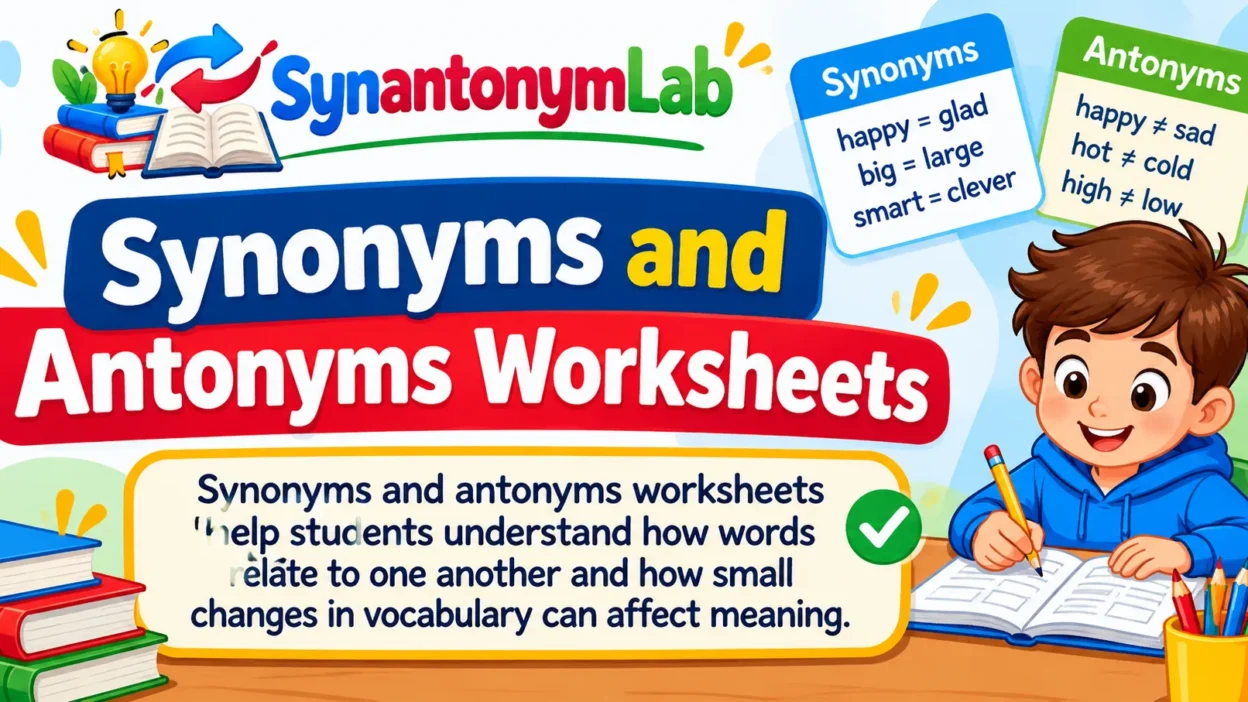
Synonyms and antonyms worksheets help students understand how words relate to one another and how small changes in vocabulary can affect meaning.
These worksheets are useful for children, English learners, teachers, and anyone who wants to improve reading, writing, and vocabulary skills. They provide simple exercises that help learners recognize words with similar meanings and words with opposite meanings.
Learning synonyms helps students avoid repeating the same words in sentences. Antonyms, on the other hand, help them understand differences between ideas, feelings, actions, and descriptions. Both skills are important in academic writing, classroom activities, professional communication, and everyday conversations.
Whether students are matching words, completing sentences, choosing the correct opposite, or creating their own examples, regular practice can make vocabulary learning easier and more enjoyable.
In this guide, you will learn 27 useful synonym and antonym pairs, understand how to use them correctly, explore stronger and softer alternatives, and discover practical ways to choose the right words. You will also find helpful examples and worksheet ideas for different learning levels.
What Does “Synonyms and Antonyms” Mean?
Synonyms and antonyms are two important types of vocabulary relationships.
Synonyms are words that have the same or nearly the same meaning. They allow writers and speakers to express an idea in different ways.
For example:
- Happy – Glad
- Big – Large
- Begin – Start
- Quick – Fast
These words have similar meanings, but they do not always work in every sentence. The correct choice depends on context and grammar.
Antonyms are words that express opposite or contrasting meanings. They help readers understand differences between words and ideas.
For example:
- Happy – Sad
- Hot – Cold
- Early – Late
- Strong – Weak
Synonyms and antonyms can be nouns, verbs, adjectives, or adverbs. Their grammatical roles matter when using them in sentences.
For example, beautiful and pretty are adjectives, while beauty is a noun. Although these words are related, they cannot always replace one another.
Why Are Synonyms and Antonyms Worksheets Important?
These worksheets provide structured ways to practice vocabulary. They help learners:
- Recognize words with similar meanings.
- Identify opposite words.
- Improve spelling and reading comprehension.
- Build confidence when writing sentences.
- Understand how words work in different situations.
- Develop a stronger everyday vocabulary.
- Reduce unnecessary repetition in writing.
Teachers can also use these activities to check students’ understanding and identify words that need more practice.
27 Best Synonyms and Antonyms Word Pairs
The following 27 pairs are useful for vocabulary lessons, classroom exercises, spelling activities, and English language practice. Each pair includes a simple meaning and an example sentence.
1. Happy – Sad
Synonyms: Glad, joyful, cheerful.
Antonym: Sad.
Happy describes a person who feels pleasure or satisfaction. Sad describes someone experiencing unhappiness.
Example: Sara felt happy when her friends visited her.
Opposite example: Ali felt sad when his team lost the game.
2. Big – Small
Synonyms: Large, huge, enormous.
Antonym: Small.
Big describes something of considerable size. Small refers to something with limited size.
Example: We live in a big house near the park.
Opposite example: My brother has a small bicycle.
3. Fast – Slow
Synonyms: Quick, speedy, rapid.
Antonym: Slow.
Fast describes something that moves or happens at a high speed. Slow refers to movement or action at a low speed.
Example: The fast train reached the station early.
Opposite example: The old bus moved very slowly.
4. Hot – Cold
Synonyms: Warm, heated, scorching.
Antonym: Cold.
Hot describes something with a high temperature. Cold describes something with a low temperature.
Example: The soup is too hot to eat.
Opposite example: The water in the refrigerator is cold.
5. Easy – Difficult
Synonyms: Simple, effortless, straightforward.
Antonym: Difficult.
Easy describes something that requires little effort. Difficult describes something that needs more effort or skill.
Example: This English exercise is easy for me.
Opposite example: The final mathematics question was difficult.
6. Good – Bad
Synonyms: Excellent, pleasant, positive.
Antonym: Bad.
Good describes something positive or suitable. Bad describes something unpleasant, harmful, or unsuitable.
Example: She received good marks in English.
Opposite example: The weather was bad yesterday.
7. Strong – Weak
Synonyms: Powerful, sturdy, robust.
Antonym: Weak.
Strong describes something with great physical or mental power. Weak describes something lacking strength.
Example: The strong player lifted the heavy box.
Opposite example: The weak branch broke during the storm.
8. Beautiful – Ugly
Synonyms: Pretty, attractive, lovely.
Antonym: Ugly.
Beautiful describes something that looks pleasing. Ugly describes something that looks unpleasant.
Example: The garden looks beautiful in spring.
Opposite example: The damaged wall looked ugly.
9. Clean – Dirty
Synonyms: Spotless, tidy, neat.
Antonym: Dirty.
Clean describes something free from dirt. Dirty describes something covered with dust, stains, or other unwanted material.
Example: Please keep your classroom clean.
Opposite example: His shoes became dirty after playing outside.
10. Rich – Poor
Synonyms: Wealthy, prosperous, affluent.
Antonym: Poor.
Rich describes someone who has plenty of money or valuable resources. Poor describes someone who has little money or limited resources.
Example: The wealthy family donated books to the school.
Opposite example: The organization supports poor families.
11. Brave – Cowardly
Synonyms: Courageous, fearless, bold.
Antonym: Cowardly.
Brave describes someone who faces danger or difficulty with courage. Cowardly describes behavior that shows an unwillingness to face danger because of fear.
Example: The brave firefighter rescued the child.
Opposite example: His cowardly behavior disappointed his friends.
12. Early – Late
Synonyms: Ahead of time, beforehand, premature.
Antonym: Late.
Early describes something happening before the expected time. Late describes something happening after the expected time.
Example: We arrived early for the meeting.
Opposite example: The student arrived late for class.
13. Young – Old
Synonyms: Youthful, junior, youthful-looking.
Antonym: Old.
Young describes someone or something at an early stage of life or development. Old describes someone or something that has existed for a long time.
Example: The young boy enjoys reading stories.
Opposite example: The old man walks in the park every morning.
14. Loud – Quiet
Synonyms: Noisy, booming, deafening.
Antonym: Quiet.
Loud describes a sound with high volume. Quiet describes a situation with little or no noise.
Example: The loud music disturbed the neighbors.
Opposite example: The library is usually quiet.
15. Kind – Cruel
Synonyms: Caring, thoughtful, compassionate.
Antonym: Cruel.
Kind describes someone who treats others with care and respect. Cruel describes someone who causes pain or suffering without concern.
Example: The kind teacher helped the new student.
Opposite example: The cruel man treated the animals badly.
16. Light – Heavy
Synonyms: Lightweight, weightless, easy to carry.
Antonym: Heavy.
Light describes something that weighs very little. Heavy describes something with considerable weight.
Example: This bag is light enough to carry.
Opposite example: The heavy suitcase was difficult to lift.
17. Open – Closed
Synonyms: Unlocked, accessible, uncovered.
Antonym: Closed.
Open describes something that is not shut. Closed describes something that is shut or not accessible.
Example: Please leave the window open.
Opposite example: The shop is closed on Sunday.
18. Begin – End
Synonyms: Start, commence, initiate.
Antonym: End.
Begin means to start an activity or process. End means to finish it.
Example: We will begin the lesson at nine.
Opposite example: The lesson will end at ten.
19. Love – Hate
Synonyms: Adore, cherish, care for.
Antonym: Hate.
Love expresses strong affection or care. Hate expresses intense dislike or hostility.
Example: Children love playing with their friends.
Opposite example: He hates waiting in long lines.
20. Full – Empty
Synonyms: Filled, packed, complete.
Antonym: Empty.
Full describes something containing as much as it can hold or having a substantial amount inside. Empty describes something containing nothing or very little.
Example: The water bottle is full.
Opposite example: The glass is empty.
21. Wet – Dry
Synonyms: Damp, moist, soaked.
Antonym: Dry.
Wet describes something covered with or containing water. Dry describes something without moisture.
Example: My clothes are wet after the rain.
Opposite example: The towel is dry now.
22. Safe – Dangerous
Synonyms: Secure, protected, harmless.
Antonym: Dangerous.
Safe describes something that does not create serious risk. Dangerous describes something that may cause harm.
Example: This playground is safe for children.
Opposite example: Driving too fast can be dangerous.
23. Sweet – Sour
Synonyms: Sugary, sugary-tasting, honeyed.
Antonym: Sour.
Sweet describes a sugary taste. Sour describes a sharp or acidic taste.
Example: The mango tastes sweet.
Opposite example: The lemon tastes sour.
24. Friend – Enemy
Synonyms: Companion, ally, supporter.
Antonym: Enemy.
A friend is someone who cares about or supports another person. An enemy is someone who opposes or wishes harm to another.
Example: My best friend always supports me.
Opposite example: The two groups treated each other as enemies.
25. Victory – Defeat
Synonyms: Triumph, success, win.
Antonym: Defeat.
Victory means winning a contest or overcoming an opponent. Defeat means losing a contest or being overcome.
Example: The team celebrated its victory.
Opposite example: The players learned from their defeat.
26. Increase – Decrease
Synonyms: Grow, expand, rise.
Antonym: Decrease.
Increase means to become greater in number, size, or amount. Decrease means to become smaller or lower.
Example: The school plans to increase its library books.
Opposite example: We need to decrease the amount of waste.
27. Accept – Reject
Synonyms: Approve, receive, agree to.
Antonym: Reject.
Accept means to agree to receive or take something. Reject means to refuse or decline something.
Example: She decided to accept the job offer.
Opposite example: He chose to reject the invitation.
Stronger Alternatives
Some synonyms express a stronger meaning than ordinary vocabulary words. They are useful when a basic word does not fully describe an action, feeling, or situation.
Here are seven examples:
| Basic word | Stronger alternative | Meaning |
|---|---|---|
| Happy | Ecstatic | Extremely happy |
| Angry | Furious | Extremely angry |
| Big | Enormous | Very large |
| Fast | Rapid | Moving or happening quickly |
| Tired | Exhausted | Extremely tired |
| Scared | Terrified | Extremely frightened |
| Bad | Awful | Very unpleasant or poor |
Example sentences:
- She was ecstatic after winning the competition.
- The customer became furious about the mistake.
- An enormous tree stood beside the house.
- The exhausted runner needed a rest.
- The frightened child became terrified during the storm.
These alternatives add intensity to sentences. However, they should match the situation. For example, furious is much stronger than annoyed, so it may not be suitable for a minor disagreement.
Softer or Polite Alternatives
Gentler words can make communication sound more respectful and friendly. They are especially helpful in professional emails, classroom discussions, and everyday conversations.
| Direct word | Softer alternative | Usage |
|---|---|---|
| Wrong | Incorrect | Polite correction |
| Angry | Upset | Less intense emotion |
| Cheap | Affordable | Positive description of price |
| Lazy | Unmotivated | Less judgmental description |
| Old | Possible | Respectful description of a person |
| Bad | Unsatisfactory | Professional feedback |
| Refuse | Decline | Polite rejection |
Examples:
- Your answer is incorrect. (Instead of saying it is wrong.)
- She seemed upset about the result.
- This is an affordable laptop.
- He declined the invitation politely.
- The service was unsatisfactory.
A softer alternative does not always have exactly the same meaning as the original word. Choose one that communicates your message honestly without sounding unnecessarily harsh.
Academic & IELTS-Friendly Alternatives
Students preparing for academic writing, school examinations, and IELTS can benefit from learning more precise vocabulary.
The following alternatives are useful in formal writing when their meanings fit the sentence.
| Basic word | Academic alternative | Example |
|---|---|---|
| Show | Demonstrate | The results demonstrate a clear pattern. |
| Help | Assist | Teachers assist students with difficult tasks. |
| Get | Obtain | Researchers obtain information through surveys. |
| Use | Utilize | Students utilize online learning resources. |
| Important | Significant | Education plays a significant role in society. |
| Improve | Enhance | Reading can enhance vocabulary skills. |
| Start | Initiate | The organization will initiate a new program. |
| End | Conclude | The report will conclude with recommendations. |
| Explain | Clarify | The teacher will clarify the instructions. |
| Change | Modify | Students may modify their writing after feedback. |
| Need | Require | This task requires careful attention. |
These words can make academic writing more precise, but complicated vocabulary is not automatically better. For IELTS and other examinations, clear meaning, correct grammar, and natural word choice matter more than using difficult words.
Synonyms You Should Avoid
Some words look similar in meaning but cannot replace one another in every situation. Understanding these differences helps prevent mistakes.
Here are five common examples:
1. Skinny Instead of Thin
Skinny can suggest that someone is too thin. Thin is more neutral.
- Natural: The paper is very thin.
- Less suitable: The paper is very skinny.
Use skinny mainly for people or objects when that specific meaning fits.
2. Cheap Instead of Affordable
Cheap can suggest poor quality, while affordable focuses on a reasonable price.
- Natural: This phone is affordable.
- Different meaning: This phone is cheap.
Choose affordable when you want to describe a price positively.
3. Furious Instead of Angry
Furious describes extreme anger. It is too strong for minor irritation.
- Natural: She was angry about the delay.
- Stronger meaning: She was furious about the serious mistake.
Use the stronger word only when the situation supports it.
4. Huge Instead of Big
Huge suggests a very large size. It may exaggerate something that is only slightly larger than usual.
- Natural: I bought a big notebook.
- More intense: They built a huge shopping center.
Choose big for general situations and huge for greater size.
5. Fearless Instead of Brave
Fearless suggests having no fear, while brave means facing difficulty or danger despite fear.
- Natural: The brave firefighter entered the burning building.
- Different meaning: The fearless character never showed fear.
These words are related, but they do not express exactly the same idea.
How to Choose the Right Synonym in Writing
Choosing a synonym is not simply about finding another word with a similar meaning. You must also consider how it fits your sentence.
Here are seven practical tips.
1. Understand the Context
Think about what you want to communicate.
For example:
- The room is big.
- The room is enormous.
Both sentences describe size, but enormous suggests a much greater size.
Choose a word that accurately describes the situation.
2. Consider Your Audience
Different readers may need different vocabulary.
For young students, simple words such as happy, sad, and big are easy to understand. Academic readers may benefit from more precise choices such as satisfied, unhappy, and substantial when appropriate.
3. Match the Tone
Your vocabulary should match the feeling of your message.
For example:
- Casual: I’m glad you came.
- Formal: I am pleased you attended.
Both express a positive feeling, but the second sounds more formal.
4. Check the Level of Formality
Some words are suitable for casual conversations but may sound awkward in professional writing.
For example, kids is common in everyday speech, while children is often more suitable for formal writing.
Always consider where your sentence will appear.
5. Check the Strength of the Word
Words with similar meanings can express different levels of intensity.
For example:
- Annoyed
- Angry
- Furious
These words describe increasing levels of anger. Using the wrong one can make your sentence sound exaggerated or unclear.
6. Keep Grammar Correct
A synonym must fit the grammatical structure of your sentence.
For example:
- Correct: She is a beautiful singer.
- Incorrect: She is a beauty singer.
Beautiful is an adjective, while beauty is a noun. Similar meanings do not make different parts of speech interchangeable.
7. Read the Sentence Again
After replacing a word, read the complete sentence.
Ask yourself:
- Does the sentence still make sense?
- Is the meaning accurate?
- Does the word sound natural?
- Is the grammar correct?
- Does it match the intended tone?
This simple habit can help improve vocabulary and writing skills.
Example Paragraph Rewritten Using Synonyms
One effective way to understand synonyms is to see how they work in a complete paragraph.
Original paragraph:
The happy children entered the big classroom. Their teacher gave them an easy activity and helped them complete their work. Everyone was excited because the lesson was interesting.
Rewritten paragraph:
The cheerful children entered the large classroom. Their teacher gave them a simple activity and assisted them with their work. Everyone was delighted because the lesson was engaging.
Words changed:
| Original word | Replacement |
|---|---|
| Happy | Cheerful |
| Big | Large |
| Easy | Simple |
| Helped | Assisted |
| Excited | Delighted |
| Interesting | Engaging |
The rewritten paragraph uses different vocabulary while keeping the original message. The replacements also fit the grammar and meaning of each sentence.
Antonym practice:
You can also change the meaning by replacing selected words with their opposites.
For example:
- Happy → Sad
- Big → Small
- Easy → Difficult
- Excited → Bored
This activity helps students understand how changing one word can change the meaning of an entire sentence.
FAQs
1. What Are Synonyms and Antonyms Worksheets?
These are educational activities that help students learn words with similar and opposite meanings. They often include matching exercises, fill-in-the-blanks, multiple-choice questions, and sentence-writing tasks.
2. What Is the Difference Between Synonyms and Antonyms?
Synonyms have the same or similar meanings, while antonyms express opposite meanings.
For example, happy and glad are synonyms, whereas happy and sad are antonyms.
3. How Do Synonyms and Antonyms Worksheets Help Students?
They help students build vocabulary, improve reading comprehension, understand word relationships, and write clearer sentences. They also encourage learners to think about the meanings of words.
4. At What Age Can Children Start Learning Synonyms and Antonyms?
Children can begin learning simple word relationships during their early school years. Activities should match their reading ability and vocabulary level.
Young learners can start with familiar pairs such as hot and cold, big and small, and happy and sad.
5. What Are Some Easy Examples of Synonyms and Antonyms?
Here are five simple examples:
| Word | Synonym | Antonym |
|---|---|---|
| Happy | Glad | Sad |
| Big | Large | Small |
| Fast | Quick | Slow |
| Hot | Warm | Cold |
| Easy | Simple | Difficult |
6. How Can Teachers Make Vocabulary Worksheets More Interesting?
Teachers can use word-matching games, picture activities, group competitions, sentence completion, and vocabulary challenges. Allowing students to create their own examples can also make learning more active.
7. How Can I Practice Synonyms and Antonyms at Home?
Choose five common words each day. Find one synonym and one antonym for each word where possible. Then write short sentences using the new vocabulary.
For example:
- Word: Strong
- Synonym: Powerful
- Antonym: Weak
- Sentence: The strong boy carried the heavy bag.
Regular practice can help make new vocabulary easier to remember and use.
Conclusion
Synonyms and antonyms are essential parts of vocabulary learning. They help students understand word meanings, recognize differences, and express their thoughts more clearly.
Practicing with matching activities, sentence exercises, and word-pair lists can make learning easier for children and English learners.
The 27 word pairs in this guide provide a useful starting point for classroom lessons, homework, and independent study.
Remember that similar words do not always have identical meanings, so it is important to consider context, grammar, and tone before choosing a replacement.
With regular practice, students can build a stronger vocabulary and become more confident readers, writers, and speakers.

Milo Carter is a passionate writer who loves exploring words, synonyms, and antonyms. Through SynantonymLab, he helps readers improve their English vocabulary and language skills.